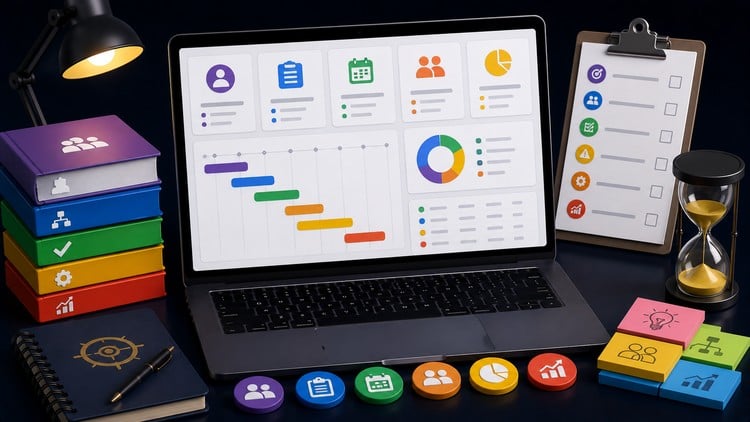
Ace your PMI exams with 200 practice scenarios on Earned Value, Critical Path, Risk Management, and Hybrid projects.
What You Will Learn:
- Master quantitative Earned Value Management (EVM) to accurately calculate Cost Variance (CV) and Schedule Variance (SV) for large budgets.
- Formulate and optimize project schedules using the Critical Path Method (CPM), calculating float and applying resource leveling/smoothing.
- Establish robust Integrated Change Control, managing scope baselines and navigating the Change Control Board (CCB) to prevent scope creep.
- Apply formal Risk Management strategies, distinguishing between Qualitative and Quantitative Risk Analysis within complex enterprise scenarios.
The No-Nonsense Reality Check: Why This Exam Prep Hits Different
Let’s be real for a second. If you’ve spent more than five minutes in the tech or construction world, you know that certification prep is often a soul-crushing exercise in memorizing dry acronyms that you’ll forget the moment you walk out of the testing center. I’ve sat through my fair share of “death by PowerPoint” sessions, but the PMP & CAPM Certification Mastery: Practice Exams course actually manages to bridge the gap between theoretical fluff and the high-pressure environment of the actual PMI exams.
What I appreciated most isn’t just the sheer volume of questions, but the “flavor” of the scenarios. Most cheap mock exams give you one-sentence questions that are way too easy. This course, however, simulates the actual mental fatigue of a four-hour PMP marathon. It forces you to look at a project crisis from multiple angles—budgetary, temporal, and human. It’s less about “what is the definition of a risk” and more about “your lead developer just quit, the budget is blown by 15%, and the stakeholder is screaming—what do you do first?” That kind of pressure is exactly what you need to build job-ready skills that actually translate to real-world projects once you’ve got those letters after your name.
Prerequisites: What You Need in the Tank
You don’t need to be a seasoned Project Management Professional to start, but don’t walk in totally cold. To get the most out of these practice exams, you should have a baseline understanding of the PMBOK Guide (both 6th and 7th editions). This is a beginner to advanced resource, but it leans heavily into the “advanced” application of logic. If you don’t know the difference between a Gantt chart and a Stakeholder Register, spend a weekend on the basics first. You’ll also want a functional understanding of basic algebra for the formulas—nothing crazy, but you shouldn’t be afraid of a calculator.
The Arsenal: Skills & Industry-Standard Tools
This isn’t just a list of questions; it’s a sandbox for mastering industry-standard tools. While you aren’t clicking around in MS Project or Jira, the course forces you to think in the logic of those tools. You’ll be sharpening your skills in:
- Quantitative Analysis: Moving beyond “gut feelings” to hard data.
- Resource Optimization: Learning how to balance a team without burning them out (Resource Leveling).
- Agile & Hybrid Methodologies: Navigating the shift from traditional Waterfall to the flexible frameworks used in modern tech stacks.
- Documentation Integrity: Understanding why a Change Request isn’t just red tape—it’s your best friend when preventing scope creep.
Career Benefits & Job Roles: The ROI of the Grind
We talk a lot about career growth, but let’s talk numbers. Adding a PMP or CAPM to your resume is often the literal “unlock” button for six-figure salaries in the tech sector. This course prepares you for roles like Technical Project Manager, Operations Manager, or PMO Lead. Beyond the title, it gives you the confidence to lead large-scale enterprise projects. When you can walk into a boardroom and explain exactly why the Cost Performance Index (CPI) suggests a project is in trouble before the money actually runs out, you become an indispensable asset. It’s about moving from “the person who handles tasks” to “the leader who manages outcomes.”
Pros: Why It’s Worth Your Time
- The “Why” Behind the “What”: The explanations for the answers are top-tier. They don’t just tell you that (C) is right; they explain why (A), (B), and (D) are subtle traps designed to trick you. This is crucial for certification prep.
- Hybrid Focus: A lot of old-school courses ignore Agile. This one weaves Hybrid project scenarios throughout, which is exactly how the modern PMI exams are weighted.
- EVM Deep-Dives: Many people fail because they panic during the math. These exams provide enough hands-on practice with Earned Value calculations that it becomes second nature.
- Scenario Realism: The questions feel like they were written by people who have actually survived a project board meeting from hell. They are messy, complex, and layered.
Cons: The Honest Truth
If I have one gripe, it’s that the course can be incredibly math-heavy in some sections. While the PMP has moved toward more “people” and “process” questions lately, this course still leans hard into the quantitative side of things. If you’re looking for a “soft skills only” vibe, this will feel like a punch in the face. It’s rigorous, and sometimes the difficulty feels slightly higher than the actual exam—though some might argue that’s a pro if you want to be over-prepared.