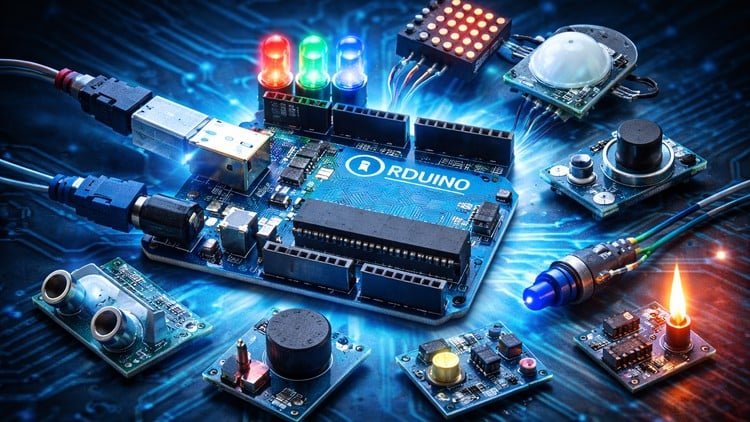
Mastering Arduino UNO: Hands-on Projects with Sensors, Modules, and Real-World Applications
What You Will Learn:
- Introduction to Arduino.
- Using Arduino to interface various sensors/modules.
- Using arduino to run C++ coding which includes loops, GPIO inputs, UART etc.
- Using Arduino UNO’s ADC modules, UART ports and GPIO pins to make various projects.
Learning Tracks: English
Note➛ Make sure your 𝐔𝐝𝐞𝐦𝐲 cart has only this course you're going to enroll it now, Remove all other courses from the 𝐔𝐝𝐞𝐦𝐲 cart before Enrolling!
Add-On Information:
- Course Caption: Mastering Arduino UNO: Hands-on Projects with Sensors, Modules, and Real-World Applications
Course Overview
- Embark on an immersive journey into physical computing with the celebrated Arduino UNO, transforming your ideas into tangible electronic creations. This course emphasizes practical application, guiding you from foundational concepts to building sophisticated interactive projects.
- Delve into the symbiotic relationship between software logic and hardware components, gaining a profound understanding of how code orchestrates physical actions. You’ll move beyond abstract theories to actively construct, experiment, and innovate.
- Participate in a dynamic, project-based curriculum where each exercise progressively builds your skill set. Learn to integrate diverse sensors and actuators, culminating in the ability to design and implement your own custom electronic solutions.
- Discover the versatility of the open-source Arduino ecosystem, empowering you to troubleshoot effectively and leverage a vast global community. This course is your gateway to understanding and creating solutions in areas like IoT, home automation, and basic robotics.
- Develop critical thinking and problem-solving abilities by tackling real-world challenges, from optimizing circuit designs to refining program logic. You’ll learn to prototype efficiently, turning concepts into functional hardware with confidence.
Requirements / Prerequisites
- No prior experience in electronics or programming is required. A keen interest in technology and a willingness to learn are your primary prerequisites.
- Basic computer literacy, including software installation and file management, is expected.
- Access to an Arduino UNO board, a breadboard, jumper wires, and a starter kit of common electronic components (e.g., LEDs, resistors, pushbuttons) is necessary for hands-on activities.
- A personal computer (Windows, macOS, or Linux) with an available USB port and an internet connection for the Arduino IDE and course resources.
Skills Covered / Tools Used
-
Skills Covered:
- Fundamentals of microcontroller programming and effective utilization of Arduino UNO’s digital and analog I/O capabilities.
- Proficiency in serial communication, essential for data exchange and debugging embedded systems.
- Practical circuit prototyping, including component selection, breadboard assembly, and basic electrical considerations for robust designs.
- Systematic debugging of both C++ based Arduino code and hardware connections to identify and resolve operational issues.
- Interfacing and interpreting data from a variety of physical sensors to build responsive, context-aware projects.
- Basic control system design, enabling the automation of physical processes using software logic.
-
Tools Used:
- The Arduino IDE for all coding, compilation, and uploading tasks.
- The Arduino UNO Board as the core development platform.
- Essential electronic components: breadboard, jumper wires, resistors, LEDs, pushbuttons, potentiometers, and various sensors/actuators (e.g., ultrasonic, temperature, servo motors).
- A personal computer (Windows, macOS, or Linux).
- Recommended: A multimeter for circuit verification and diagnostics.
-
Skills Covered:
Benefits / Outcomes
- The ability to conceptualize, design, and build custom electronic gadgets and automated systems independently.
- A strong foundational understanding of embedded systems, positioning you for further exploration in robotics, IoT, and advanced electronics.
- Enhanced problem-solving, logical reasoning, and creative thinking skills through hands-on project execution.
- A practical portfolio of functional Arduino projects, demonstrating tangible skills to prospective employers or for personal innovation.
- Confidence in bridging the gap between software instructions and real-world physical interactions.
PROS
- Highly Practical: Emphasizes hands-on project implementation for deep learning.
- Beginner-Friendly: Accessible entry point for individuals new to electronics and programming.
- Fosters Creativity: Equips you to transform innovative ideas into working prototypes.
- Foundation for Future Tech: Builds essential skills for careers in IoT, automation, and embedded systems.
- Community Support: Benefits from the vast and active global Arduino community.
CONS
- Initial Hardware Investment: Requires purchasing an Arduino board and components for practical engagement.