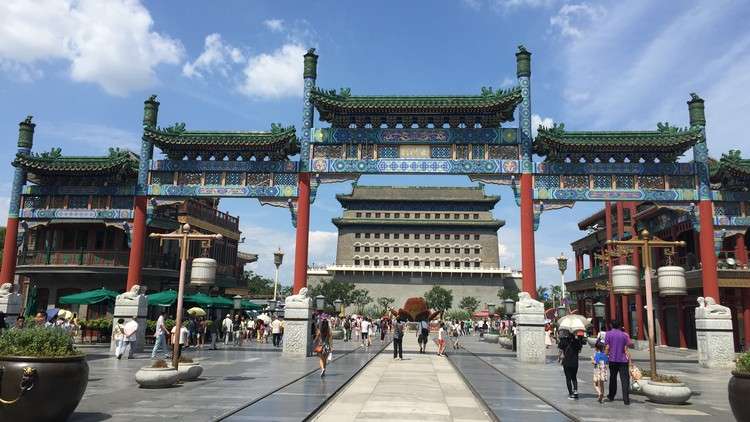
The facade of the city
What you will learn
Know the history of Beijing‘s 9 inner city gates
Recognize recognize the remant of the one and a half city gate
Why take this course?
This is the course which can help you to know the 9 different inner city gates of Beijing,from ancient to modern.
In this course,you can learn the following things:
1. The history and shape of 9 inner city gates of Beijing and how do they like right now.
Note➛ Make sure your 𝐔𝐝𝐞𝐦𝐲 cart has only this course you're going to enroll it now, Remove all other courses from the 𝐔𝐝𝐞𝐦𝐲 cart before Enrolling!
2. The interesting or famous place to visit or recall the history of Beijing around the city gates.
Each part of the lecture will content at least 3 minutes video
English
Add-On Information:
- Course Overview
- Investigate the historical and architectural grandeur of the “Inner Nine Gates” (Neicheng Jiu Men), the monumental thresholds that once governed movement into the heart of Ming and Qing dynasty Beijing.
- Analyze the philosophical underpinnings of the city’s layout, exploring how these gates functioned as the “facade” of the capital to project imperial authority and celestial order.
- Trace the evolution of the fortifications from the medieval Dadu period through the massive Ming reconstructions to their eventual role in the 20th-century transition to a modern metropolis.
- Examine the unique socio-economic identity of each gate, such as the water-bearing role of Dongzhimen or the grim judicial associations of Xuanwumen, known as the “Gate of Death.”
- Study the relationship between the gates and the Central Axis, understanding how these structures facilitated the ritualistic movement of the Emperor between the Forbidden City and the Altar of Heaven.
- Requirements / Prerequisites
- A foundational interest in East Asian history, urban planning, or traditional timber-frame architecture.
- No prior knowledge of Mandarin is required, as all technical terms will be explained through visual aids and phonetic transliterations.
- Access to a digital environment capable of rendering high-resolution historical maps and 3D architectural models.
- Skills Covered / Tools Used
- Historical Cartography: Learn to interpret and overlay 18th-century “Qianlong Maps” with modern satellite imagery to identify the footprints of vanished fortifications.
- Structural Analysis: Gain the ability to identify specific Ming-era defensive features, including the Xieshan roof styles, the embrasures of the watchtowers, and the strategic design of the Wengcheng (barbican).
- Cultural Heritage Assessment: Develop frameworks for evaluating the loss of physical heritage versus the preservation of intangible cultural memory in urban environments.
- Comparative Urbanism: Master the tools needed to compare Beijing’s walled “nested” design with other global fortified cities like Paris or Xi’an.
- Benefits / Outcomes
- Achieve a deep conceptual understanding of the “spiritual geography” of Beijing, allowing you to navigate the modern city with an awareness of its hidden imperial boundaries.
- Acquire specialized knowledge of Chinese gatehouse construction, a niche field that bridges the gap between military engineering and aesthetic artistry.
- Learn to articulate the historical significance of the “Second Ring Road” as the former site of the city walls, transforming your perception of Beijing’s modern infrastructure.
- Develop a nuanced appreciation for the “facade” concept—understanding how a city presents its power through gateways, thresholds, and monumental scale.
- PROS
- Features rare archival photography and cinematic reconstructions that bring long-demolished structures back to life.
- Provides a multi-disciplinary approach combining military history, spiritual symbolism, and architectural design.
- Encourages a unique “detective” style of learning by looking for physical remnants of the gates in the modern urban fabric.
- CONS
- Because most of the inner city gates were dismantled in the mid-20th century, the course relies heavily on visual imagination and historical records rather than on-site physical exploration.
language
Found It Free? Share It Fast!