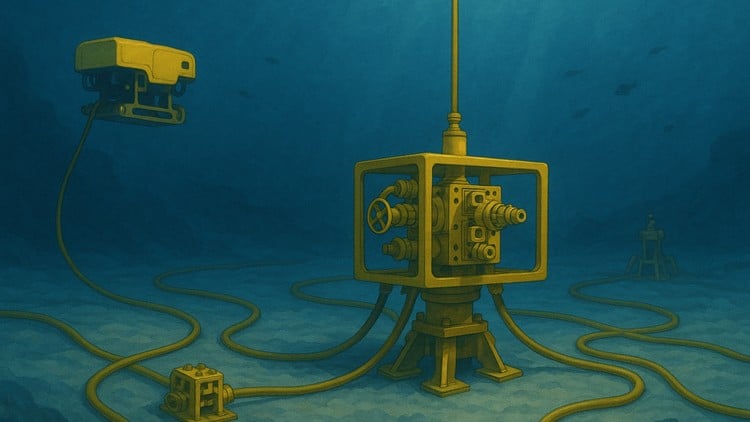
A complete guide to subsea oil and gas production systems — from wellheads and manifolds to umbilicals, pipelines, riser
⏱️ Length: 1.8 total hours
👥 18 students
🔄 November 2025 update
Add-On Information:
Note➛ Make sure your 𝐔𝐝𝐞𝐦𝐲 cart has only this course you're going to enroll it now, Remove all other courses from the 𝐔𝐝𝐞𝐦𝐲 cart before Enrolling!
-
Course Overview
- Explore intricate subsea oil and gas engineering, unlocking deepwater energy from wellheads to surface facilities.
- Guide through the subsea value chain: strategic deployment and operational integration in challenging underwater environments.
- Delve into foundational principles of subsea infrastructure design, installation, and operation, understanding systems rather than just components.
- Demystify core subsea elements: wellheads, advanced manifolds, crucial control mechanisms, and safety interlocks.
- Gain insights into umbilicals, pipelines, and risers – vital lifelines for power, signals, chemicals, and hydrocarbon transport.
- Examine diverse functions, material selections, and installation methodologies for secure transport across ocean depths.
- Explore subsea technology evolution, recognizing innovations enabling operations in deeper, harsher, remote marine conditions.
- Appreciate engineering ingenuity: withstand extreme pressures, low temperatures, corrosive environments for continuous, safe production.
- Understand subsea field lifecycle: development planning, system reliability, intervention, and asset integrity management.
- Learn critical interfaces: subsea elements, floating production units, drilling rigs, and shore-based control for optimal system integration.
- Recognize paramount safety protocols and environmental stewardship; assess how design mitigates risks to marine ecosystems.
- Cover future trends: digitalization, automation, and renewable energy integration for subsea industry sustainability.
-
Requirements / Prerequisites
- No prior oil and gas experience is required, making this an accessible entry point.
- A general interest in engineering, offshore operations, or the energy sector is beneficial.
- Basic analytical thinking and eagerness to learn about complex technical systems are advantageous.
- Access to a stable internet connection and a compatible device for online course delivery is necessary.
-
Skills Covered / Tools Used
- Subsea System Architecture Comprehension: Ability to visualize and understand the layout and interconnection of various subsea components.
- Operational Process Awareness: Grasp high-level operational sequences, challenges, and strategic considerations unique to deepwater production.
- Key Industry Terminology Fluency: Develop a robust vocabulary for discussing complex subsea systems with industry peers.
- Risk Management & Safety Appreciation: Understand fundamental approaches to managing safety, environmental hazards, and compliance in subsea environments.
- No specific software tools are taught or required; focus is on foundational conceptual understanding.
-
Benefits / Outcomes
- Foundational Expertise: Establish a solid understanding of subsea systems, preparing you for advanced studies or entry-level roles.
- Career Gateway: A crucial stepping stone for aspiring professionals in offshore engineering, marine operations, or technical support.
- Enhanced Industry Insight: Develop a holistic perspective on subsea technology’s role in global energy demands and economic implications.
- Informed Technical Participation: Equip yourself to understand technical discussions, evaluate system proposals, and appreciate subsea development complexities.
-
PROS
- Accessibility & Efficiency: Concise 1.8-hour format offers a rapid, comprehensive introduction to subsea systems.
- Foundational Knowledge: Builds a strong base for understanding complex operations and their importance in energy production.
- Career Insight: Excellent for professionals pivoting or students exploring specialized offshore engineering fields.
- Up-to-Date Content: November 2025 update ensures material reflects current industry practices.
CONS
- Limited In-Depth Technical Detail: Provides an overview, not exhaustive technical detail or hands-on application.
Learning Tracks: English,Teaching & Academics,Engineering
Found It Free? Share It Fast!