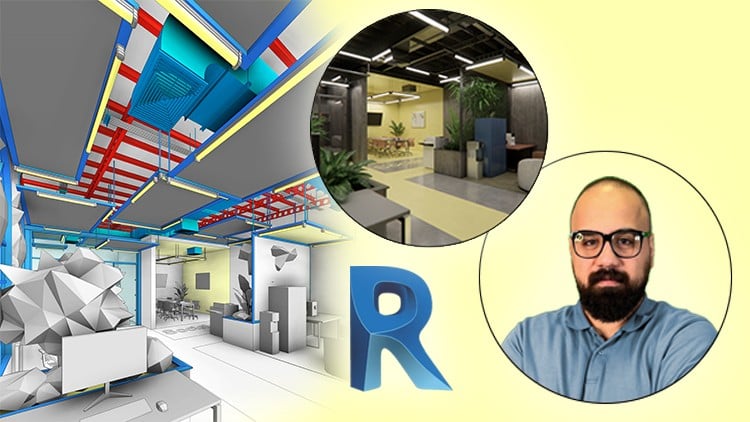
Create Flexible Parametric Families, Advanced HVAC System, Lighting Fixture, MEP Integration, Rendering with Enscape
What you will learn
Master the fundamentals of industrial-style office modeling using Revit.
Create detailed and accurate parametric families for architectural and MEP elements.
Model advanced components like honeycomb beams, IPE sections, and custom parametric lighting fixtures.
Design and implement realistic piping and HVAC systems with supports.
Develop customizable families for windows, ceiling hangers, and pendant lights to enhance flexibility in projects.
Learn professional material creation and lighting techniques with Enscape for high-quality rendering.
Add-On Information:
Note➛ Make sure your 𝐔𝐝𝐞𝐦𝐲 cart has only this course you're going to enroll it now, Remove all other courses from the 𝐔𝐝𝐞𝐦𝐲 cart before Enrolling!
- Navigate Complex Project Lifecycles: Understand how a Revit model evolves from conceptual design through detailed construction documentation, specifically tailored for the intricate demands of industrial office environments. This includes mastering phased project development and managing intricate design iterations with precision.
- Harmonize Multi-Disciplinary Design: Learn to effectively integrate architectural aesthetics, robust structural integrity, and efficient mechanical, electrical, and plumbing (MEP) systems within a single federated model. This ensures seamless coordination and minimizes costly conflicts across all disciplines, fostering a truly collaborative BIM environment.
- Optimize Space and Functionality: Develop sophisticated strategies for designing highly functional and adaptable industrial office interiors. Focus on meeting specific operational requirements while maintaining a modern, professional aesthetic, ensuring that form meets function in demanding industrial settings.
- Master BIM Collaboration Workflows: Explore advanced techniques for effective team collaboration, efficient model sharing, and systematic change management in a multi-user Revit environment. This is crucial for successful execution of large-scale, complex industrial projects, promoting efficient data exchange.
- Refine Model Precision for Fabrication: Gain expertise in creating models with the necessary Level of Detail (LOD) and accuracy required for direct fabrication and construction. This minimizes on-site errors and waste, ensuring that design translates precisely into tangible built structures and systems.
- Perform Intelligent Clash Detection: Utilize Revit’s inherent capabilities to proactively identify and resolve potential conflicts between structural, architectural, and MEP elements. Early detection of clashes saves significant time and cost during the construction phase, improving project efficiency and delivery.
- Automate Documentation and Schedules: Generate comprehensive drawing sets, detailed material schedules, and accurate quantity take-offs directly from your intelligent 3D model. This streamlines project deliverables, enhances accuracy, and significantly reduces manual documentation efforts, a cornerstone of effective BIM.
- Implement Sustainable Design Principles: Discover how to use Revit and its powerful integrations to analyze building performance, optimize energy efficiency, and strategically incorporate sustainable materials into your industrial office designs. This promotes environmentally responsible and cost-effective solutions.
- Craft Immersive Client Presentations: Leverage advanced visualization tools beyond static renders, producing compelling walkthroughs and interactive experiences. This allows clients to fully understand and confidently approve complex design concepts, enhancing communication and stakeholder engagement.
- Develop Advanced Parametric Logic: Go beyond basic family creation to build intelligent, adaptable components that respond dynamically to design changes and project parameters. This is critical for customizing and optimizing the unique elements found in industrial architectural and engineering projects.
- PROS:
- Holistic Skill Development: Acquire a comprehensive understanding and practical skills across architectural, structural, interior design, and MEP disciplines, specifically tailored for industrial environments.
- Industry-Specific Expertise: Gain highly sought-after expertise in designing and modeling complex industrial-style offices, positioning you as a specialist in a niche but growing market.
- Enhanced Project Efficiency: Learn advanced Revit techniques that directly translate into improved project coordination, reduced errors, and more streamlined workflows, boosting productivity.
- Career Advancement: Elevate your professional profile with a specialized skill set in advanced BIM modeling and visualization for industrial projects, opening doors to advanced roles.
- CONS:
- Significant Time Commitment: The breadth and depth of topics covered require dedicated effort and a substantial time investment, potentially challenging for those with limited availability.
English
language