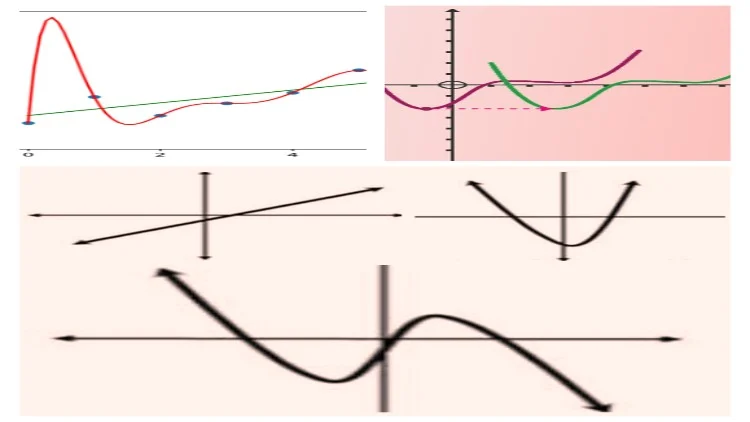
Identification, Interpretation, Transformation And Graphing Of Polynomial Functions.
⏱️ Length: 8.2 total hours
⭐ 5.00/5 rating
👥 72 students
🔄 January 2026 update
Add-On Information:
Note➛ Make sure your 𝐔𝐝𝐞𝐦𝐲 cart has only this course you're going to enroll it now, Remove all other courses from the 𝐔𝐝𝐞𝐦𝐲 cart before Enrolling!
- Course Overview
- Delve into the architectural backbone of modern mathematical analysis by exploring the structural integrity and long-term behavior of non-linear equations through a comprehensive, multi-dimensional lens.
- Explore the historical evolution of algebraic thought, understanding how polynomial patterns have served as the fundamental building blocks for centuries of scientific discovery and industrial engineering solutions.
- Bridge the conceptual gap between static numerical values and dynamic visual representation, fostering a deeper cognitive intuition for how variables interact across various planes of existence.
- Master the art of mathematical storytelling, where every individual coefficient and constant contributes significantly to the unique narrative of a curve’s journey across the Cartesian coordinate system.
- Focus on the synthesis of algebraic manipulation and geometric interpretation, ensuring that students view functions not merely as abstract equations, but as living maps of change and motion.
- Investigate the nuances of continuity and smoothness, learning why polynomial functions are the preferred choice for modeling natural phenomena over discrete or disjointed data sets.
- Establish a rigorous framework for logical deduction, where the student learns to predict complex outcomes based on the subtle clues hidden within the standard form of an equation.
- Requirements / Prerequisites
- A robust and foundational proficiency in basic algebraic operations, including the distribution property, the FOIL method, and the isolation of variables in multi-step equations.
- Prior familiarity with the Cartesian coordinate plane, specifically the ability to plot ordered pairs accurately and interpret the significance of the origin, axes, and various quadrants.
- A working knowledge of linear and quadratic systems, which provides the necessary conceptual scaffold for the transition into cubic, quartic, and higher-order mathematical expressions.
- The ability to perform arithmetic operations with negative numbers, fractions, and decimals without hesitation, as these are frequent components of sophisticated polynomial coefficients.
- A disciplined mindset geared toward iterative learning and patience, as complex graphing and analysis require careful attention to detail and multiple stages of logical verification.
- Access to a standard scientific calculator or a computer with high-speed internet capabilities to utilize digital graphing tools for comparative analysis and independent study.
- A basic understanding of set theory and inequality symbols, which will be instrumental when defining the boundaries and constraints of various mathematical relations.
- Skills Covered / Tools Used
- Utilization of Synthetic Division and the Remainder Theorem to efficiently decompose complex expressions into manageable binomial factors and check for root accuracy.
- Application of the Rational Root Theorem to narrow down potential solutions from an infinite field, significantly optimizing the problem-solving process during timed assessments.
- Mastery of Desmos and GeoGebra, leveraging these digital sandboxes to manipulate function parameters and observe real-time shifts in graphical topography and curvature.
- Deep dive into Multiplicity of Roots, learning how the specific power of a factor determines whether a graph tangentially bounces off or decisively crosses the horizontal axis.
- Defining Domain and Range using formal interval notation, ensuring mathematical precision when describing the horizontal and vertical boundaries of a function’s existence.
- Development of Mental Estimation techniques to predict the general shape, symmetry, and direction of a curve before a single physical point is ever plotted on paper.
- Instruction on the Factor Theorem, providing a vital shortcut for determining the roots of high-degree polynomials without the need for exhaustive and repetitive trial and error.
- Exploration of Symmetry Tests, allowing students to determine algebraically whether a function exhibits even, odd, or neither type of symmetry relative to the axes.
- Benefits / Outcomes
- Cultivate a distinct competitive edge for standardized academic assessments such as the SAT, ACT, and Advanced Placement (AP) mathematics examinations.
- Build a robust foundational infrastructure for Calculus, where a deep understanding of the behavior of functions is a mandatory prerequisite for mastering derivatives and integrals.
- Enhance data visualization skills, which are highly transferable to professional careers in data science, economics, and business analytics where trend forecasting is essential.
- Develop enhanced spatial intelligence, improving the brain’s ability to visualize abstract concepts and translate them into accurate physical or graphical representations.
- Strengthen critical thinking and logical deduction capabilities, as the course requires students to synthesize multiple pieces of abstract information to reach a singular, verified conclusion.
- Empower students to model complex real-world systems, such as the trajectory of projectiles in physics or the fluctuating market cycles found in sophisticated financial modeling.
- Gain academic self-confidence through the mastery of a topic often cited as a significant hurdle in the secondary and post-secondary mathematics curriculum.
- Foster interdisciplinary versatility, allowing for the application of polynomial logic in fields as diverse as computer graphics, biological growth modeling, and structural engineering.
- PROS
- Features a highly visual curriculum that caters specifically to students who often struggle with abstract algebraic concepts when they are presented only in text or numerical form.
- The course structure offers a logical and intuitive progression, ensuring that each individual lesson serves as a necessary and clear stepping stone for the next.
- Includes practical application scenarios that demonstrate the “why” behind the mathematics, significantly reducing student burnout by providing immediate real-world relevance.
- Provides comprehensive drill sets that reinforce theoretical knowledge through repeated, varied exposure to a wide array of different polynomial structures and challenges.
- CONS
- The instructional velocity assumes a baseline level of algebraic comfort that may require some students to engage in brief external remedial review of basic factoring techniques.
Learning Tracks: English,Teaching & Academics,Math
Found It Free? Share It Fast!