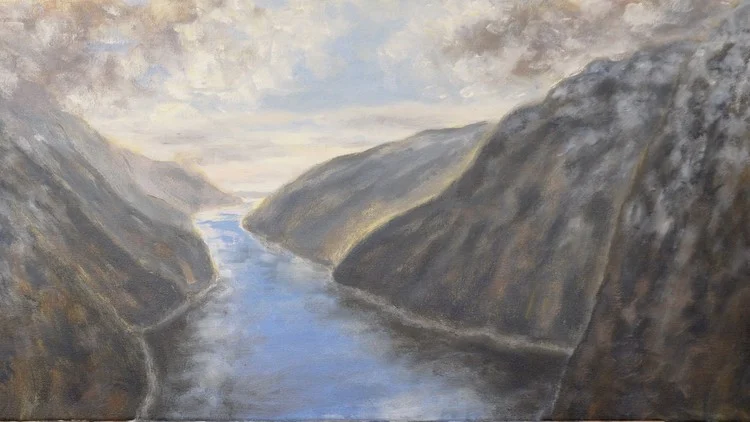
Learn how to Build Layers and Create Atmosphere in a painting
⏱️ Length: 1.1 total hours
⭐ 5.00/5 rating
👥 39 students
🔄 March 2026 update
Add-On Information:
Note➛ Make sure your 𝐔𝐝𝐞𝐦𝐲 cart has only this course you're going to enroll it now, Remove all other courses from the 𝐔𝐝𝐞𝐦𝐲 cart before Enrolling!
- Course Overview
- Explore the profound relationship between light, moisture, and distance to recreate the majestic scale of natural mountain ranges on a two-dimensional surface.
- Investigate the optical phenomenon of light scattering that causes distant geological features to lose their sharpness and shift in hue as they move toward the horizon.
- Study the structural anatomy of mountain peaks to ensure that your compositions feel grounded, realistic, and physically imposing to the viewer.
- Understand the psychological impact of landscape depth, learning how to guide the viewer’s eye from the immediate foreground into the infinite distance.
- Analyze how weather conditions, such as fog, mist, and sunlight, alter the clarity of the scenery and influence the overall mood of the artwork.
- Focus on the specific transition of visual clarity, moving from the high-contrast elements of the nearby terrain to the ghostly silhouettes of the far-off peaks.
- Develop a systematic approach to landscape painting that prioritizes the logic of nature, ensuring that every brushstroke contributes to a sense of vast, open air.
- Requirements / Prerequisites
- A selection of heavy-body acrylic or oil paints, specifically focusing on a range of blues, earthy ochres, and titanium white for tinting.
- Stretched canvas or high-quality archival paper that has been properly primed to handle multiple applications of pigment without warping.
- Natural or synthetic fiber brushes, including large flats for broad washes and fine rounds for defining the craggy silhouettes of the ridgelines.
- A stable easel or a dedicated flat workspace with neutral lighting to ensure that color accuracy is maintained throughout the creative process.
- Basic household items for maintenance, such as a palette for blending, water containers or solvents, and lint-free cloths for wiping away excess moisture.
- A patient mindset and a willingness to observe the natural world closely, as capturing the subtlety of the sky requires a delicate and attentive touch.
- Access to high-resolution reference photographs of mountain ranges at different times of day to serve as a guide for light direction and shadow placement.
- Skills Covered / Tools Used
- Mastering the concept of color temperature, specifically learning how to utilize cool tones to push objects away and warm tones to bring them forward.
- Perfecting edge control by differentiating between the crisp, hard lines of foreground rocks and the soft, diffused edges of distant summits.
- Implementing the scumbling technique to create the illusion of low-lying clouds or mountain mist clinging to the base of the peaks.
- Utilizing palette knives to apply thick, impasto textures that mimic the ruggedness of stone and the harshness of high-altitude environments.
- Developing a consistent light source across the entire composition to ensure that highlights and shadows align realistically across multiple layers of terrain.
- Practicing the “fat over lean” principle or thinning techniques to manage the transparency of the air between the observer and the subject.
- Gaining proficiency in negative space painting to define the shapes of the mountains against the backdrop of an evolving sky.
- Refining brushwork economy, learning how to suggest complex geological details with a few strategic strokes rather than overworking the surface.
- Benefits / Outcomes
- Gain the artistic confidence to tackle complex natural landscapes by breaking them down into manageable spatial zones.
- Produce a professional-grade mountain painting that demonstrates a sophisticated understanding of visual depth and environmental realism.
- Enhance your observational skills, allowing you to interpret the natural world more accurately and translate those observations into compelling art.
- Acquire a versatile set of techniques that can be applied to other genres of painting, such as seascapes, cityscapes, or any work requiring spatial logic.
- Build a more disciplined studio practice by learning how to pace your work according to the drying times and physical properties of your medium.
- Experience the meditative and stress-reducing qualities of landscape painting, focusing on the serene and timeless beauty of the wilderness.
- Expand your creative portfolio with a piece that showcases technical proficiency in handling complex lighting and environmental effects.
- Empower yourself to move beyond simple flat representations and start creating “breathable” art that feels three-dimensional and immersive.
- PROS
- The course is highly streamlined, offering a concentrated burst of knowledge that respects the student’s time while delivering high-impact results.
- The focus on a specific, repeatable workflow allows students to see immediate improvement in the physical depth of their paintings.
- The instruction is visually driven, providing clear demonstrations of how different pigment densities affect the perception of distance.
- Current updates ensure that the techniques remain relevant for modern materials and contemporary artistic styles.
- CONS
- The rapid pace and short duration of the lessons may require beginners to pause and re-watch sections several times to fully grasp the nuanced brushwork.
Learning Tracks: English,Design,Other Design
Found It Free? Share It Fast!