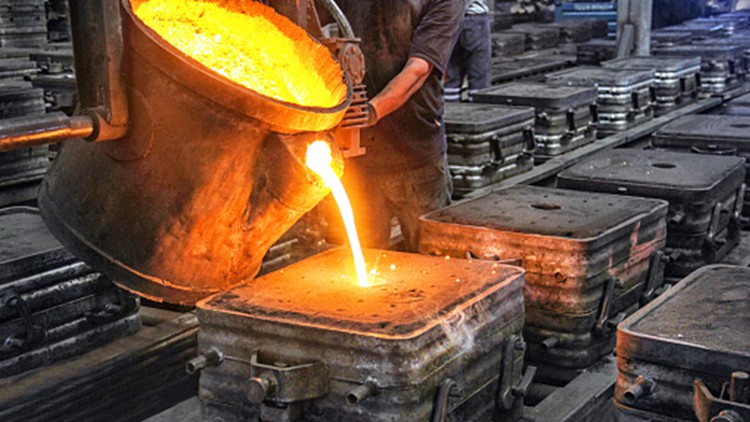
Get certified by the American Foundry Society (AFS) to advance your career in metal casting as professionalist.
What you will learn
Discover the fascinating world of metal casting and its crucial role in modern manufacturing
Explore the different types of metal casting, from the traditional ingot casting to the more modern shape casting techniques
Learn about the various molds used in metal casting, including the open, closed, expandable, and permanent molds, and understand their impact on casting process
Dive deep into the heating process of metal and discover the secrets to pouring molten metals into molds like a pro
Gain a comprehensive understanding of Bernoulli & Continuity Law and learn how to apply it to control the pouring of molten metal with ease
Understand the behavior of molten metals and alloys during solidification and cooling, including the critical concept of shrinkage and contraction during the co
Discover the different casting methods used in metal casting, including sand casting, permanent mold casting, and die casting
Learn how to identify and troubleshoot common casting defects and understand their root causes and possible solutions
Master the inspection methods used in metal casting to ensure high-quality and defect-free products
Gain insights into the various metals used in the metal casting process, and understand which metals are best suited for different casting methods
Explore the product design considerations for metal casting and understand how to design products that are optimized for the casting process.
Description
Metal casting is a critical process that has been used for centuries to create metal parts and objects. Today, it is an essential part of the manufacturing industry, and understanding the process is crucial for engineers, designers, and manufacturers.
If you are looking to gain a comprehensive understanding of metal casting, look no further than this in-depth video course. You will learn the fundamentals of metal casting, including the different types of metal casting, such as ingot casting and shape casting. You will also gain a deep understanding of the various types of molds used in metal casting, including open, closed, expandable, and permanent molds.
Heating the metal for pouring into molds is a crucial aspect of metal casting, and in this course, you will learn about the analysis of pouring molten metals into molds, including pouring temperature, pouring rate, and turbulence. You will also learn about the Bernoulli & Continuity Law and how fluidity affects the pouring of molten metal.
The behavior of molten metals and alloys during solidification and cooling is also an important concept to understand. In this course, you will learn about the shrinkage and contraction of molten metals during the cooling process.
This course covers various casting methods like sand casting, permanent mold casting, and die casting for metals, along with casting defects and their solutions, inspection methods for metal casting, metals used for the metal casting process, and product design considerations for metal casting.
Enrolling in this course is perfect for anyone looking to gain a deeper understanding of metal casting and its importance in the manufacturing industry. With our engaging and informative content, you will feel confident that you are getting the maximum knowledge available on this topic. Start your journey towards mastering the art of metal casting and maximizing organic traffic from Google today by enrolling in this course!
Content
- Course Overview
- This specialized program offers a deep dive into the metallurgical engineering and mechanical principles required to excel in the modern foundry industry.
- It integrates the American Foundry Society (AFS) body of knowledge with contemporary manufacturing trends, ensuring participants are equipped with industry-standard expertise.
- The curriculum focuses on the interdisciplinary approach of combining material science with geometric design to solve complex manufacturing challenges.
- Students will explore the economic landscape of metal casting, understanding how process selection impacts the final bottom line and production scalability.
- Detailed modules cover sustainable foundry practices, focusing on recycling metals and minimizing the environmental footprint of heavy industrial processes.
- The course emphasizes the digital transformation of the industry, showcasing how legacy techniques are being enhanced by modern automation.
- Requirements / Prerequisites
- A baseline proficiency in high school level physics and mathematics is necessary to navigate the thermal dynamics and fluid flow calculations presented in the course.
- Prior exposure to mechanical engineering fundamentals or industrial manufacturing environments is beneficial for contextualizing the practical applications.
- Students should possess a detail-oriented mindset for analyzing technical specifications and material safety data sheets (MSDS).
- Access to a computer capable of running basic technical rendering or simulation software is recommended for the design-focused modules.
- Skills Covered / Tools Used
- Application of Finite Element Analysis (FEA) principles to predict stress distribution and potential failure points in cast components.
- Hands-on methodology for Alloy Characterization, learning how to manipulate chemical compositions to achieve specific mechanical traits.
- Advanced use of Gating System Optimization to manage velocity and pressure, preventing sand erosion and air entrapment during the mold filling.
- Proficiency in Quality Assurance (QA) techniques, specifically utilizing liquid penetrant and magnetic particle inspection for surface defect detection.
- Implementation of Lean Manufacturing principles within a foundry setting to streamline workflows and significantly reduce production cycle times.
- Experience with Spectrometric Analysis to verify the chemical purity of molten batches before the pouring process begins.
- Benefits / Outcomes
- Achieve professional validation through AFS Certification, which serves as a benchmark for excellence in the global metalworking community.
- Cultivate the ability to troubleshoot casting defects in real-time, allowing you to reduce scrap rates and improve overall plant efficiency.
- Bridge the communication gap between design engineers and foundry technicians by speaking the technical language of both fields fluently.
- Position yourself for senior leadership roles such as Foundry Manager, Quality Control Lead, or specialized Metallurgical Consultant.
- Gain exclusive access to technical resources and a vast network of industry professionals through your affiliation with the American Foundry Society.
- PROS
- Direct alignment with current industry demands and the latest AFS professional benchmarks.
- Comprehensive coverage of both ferrous and non-ferrous metal behaviors in various industrial settings.
- Strong emphasis on practical problem-solving rather than just abstract theoretical concepts.
- CONS
- The high level of technical depth regarding metallurgical transformations may present a steep learning curve for individuals without any prior manufacturing background.