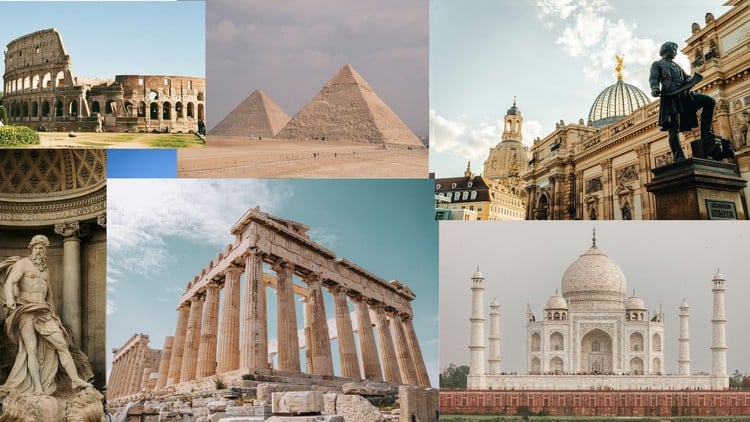
From early shelters to modern cities: understanding architectural transformation
⏱️ Length: 1.9 total hours
Add-On Information:
Note➛ Make sure your 𝐔𝐝𝐞𝐦𝐲 cart has only this course you're going to enroll it now, Remove all other courses from the 𝐔𝐝𝐞𝐦𝐲 cart before Enrolling!
- Course Overview
- Embark on a high-speed chronological odyssey that explores the very essence of human habitation and monumental expression, spanning from the dawn of civilization to the digital age.
- Dive deep into the transition from vernacular, earth-bound dwellings to the gravity-defying glass towers of the 21st century, examining the core philosophies that drove these changes.
- Uncover the hidden narratives of power, divinity, and social hierarchy etched into the stones of ancient pyramids and the reinforced steel of modern skyscrapers.
- Explore the intersection where raw artistry meets advanced structural engineering across diverse climates, topographies, and cultural landscapes.
- Witness the birth of “modernity” and how the Industrial Revolution fundamentally altered the way we perceive domestic, commercial, and public space.
- Gain a holistic understanding of how architectural “orders” and motifs migrated across borders and continents through trade, conquest, and the global exchange of ideas.
- Analyze the shift from craftsmanship-heavy, ornamental aesthetics to the minimalist, functionalist principles that define our contemporary urban environments.
- Investigate the “Spirit of the Age” (Zeitgeist) to see how every major building serves as a permanent mirror of the era’s scientific and philosophical breakthroughs.
- Study the evolution of the “master builder” role, tracking its transformation from anonymous craftsmen to the celebrity “starchitects” of the current era.
- Requirements / Prerequisites
- An inquisitive mind ready to deconstruct the buildings we often take for granted and a willingness to look at the world through a three-dimensional lens.
- A basic level of comfort with visual media, as the course relies heavily on photographic and illustrative evidence to explain complex spatial concepts.
- No specialized technical software like AutoCAD, Rhino, or Revit is required, making this survey accessible to hobbyists, travelers, and design enthusiasts alike.
- A fundamental grasp of world history timelines will significantly enhance your ability to contextualize the structures within their specific historical moments.
- Access to a device capable of streaming high-definition video is recommended to appreciate the intricate details of the masonry and textures discussed.
- A passion for uncovering the “why” behind the “what,” moving beyond aesthetic surface-level observations to understand structural intent.
- Skills Covered / Tools Used
- Architectural Taxonomy: Developing a sophisticated vocabulary to describe structural elements, from the Greek pediment to the Corbusian pilotis.
- The Comparative Method: Learning to contrast different historical periods—such as Romanesque versus Gothic—to identify subtle shifts in engineering and light.
- Spatial Literacy: Acquiring the ability to read and interpret how volume, mass, and void interact to create a specific emotional or functional atmosphere.
- Visual Decoding: Techniques for spotting symbolic and allegorical elements in classical, ecclesiastical, and even corporate architecture.
- Technological Tracking: Understanding the trajectory of material science, from the invention of the true arch to the development of carbon-fiber composites.
- Principles of Urbanism: Exploring how individual buildings contribute to the larger fabric of a city’s identity and the psychology of its inhabitants.
- Aesthetic Evaluation: Critically assessing design theories such as the “Golden Ratio” and how they have been applied or rejected throughout the centuries.
- Contextual Mapping: Using geographic and climatic data to understand why certain structures look and perform differently in varied global regions.
- Benefits / Outcomes
- Cultivate a Sophisticated Perspective on the built environment that enriches your personal travels, museum visits, and daily commutes.
- Boost your Cultural Capital by being able to speak intelligently about the evolution of global design movements and their social implications.
- Create a Mental Reference Catalog of historical precedents that can be applied to modern interior design, real estate, or creative projects.
- Understand the Psychological Impact of architecture, gaining insight into how the spaces we inhabit influence our productivity and mental well-being.
- Bridge the gap between Art History and Engineering, seeing buildings not just as static objects but as dynamic, functioning machines for living.
- Prepare for Advanced Specialization in related fields such as urban planning, heritage restoration, or architectural journalism.
- Unlock the Narrative of Human Progress, seeing how every innovation in material science led to a revolution in what was physically possible to build.
- Develop a Critical Eye for modern construction, allowing you to distinguish between meaningful design and generic commercial building practices.
- PROS
- Exceptional Efficiency: This course manages to distill millennia of complex human history into a digestible format under two hours, perfect for busy professionals.
- Global Scope: Unlike many traditional surveys, this course avoids a strictly Eurocentric view, offering a broader look at human ingenuity across the globe.
- Visual Clarity: The use of curated imagery and clear diagrams makes high-level architectural concepts instantly recognizable and memorable.
- Synthesized Knowledge: It expertly condenses massive amounts of historical data into actionable insights that can be applied immediately to real-world observation.
- CONS
- Breadth Over Depth: Given the concise 1.9-hour runtime, those seeking an exhaustive, deep-dive analysis of specific niche architects or local regional movements may find the pace extremely fast and high-level.
Learning Tracks: English,Teaching & Academics,Humanities
Found It Free? Share It Fast!