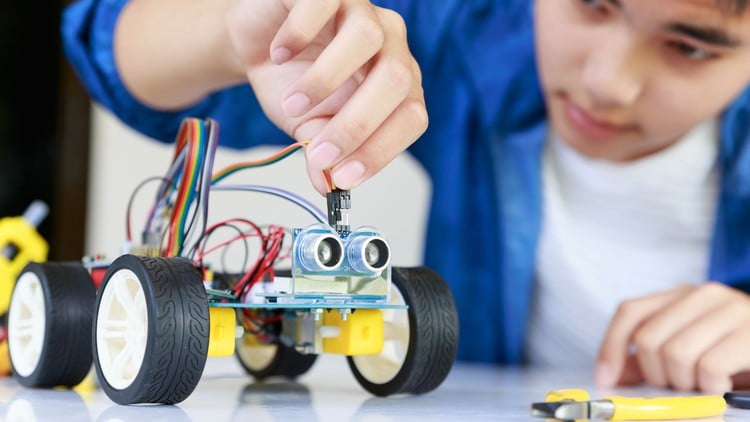
Learn To Create Arduino UNO Based Obstacle Avoiding Robot Car & RC-Control
⏱️ Length: 1.9 total hours
⭐ 4.20/5 rating
👥 39,027 students
🔄 May 2022 update
Add-On Information:
Note➛ Make sure your 𝐔𝐝𝐞𝐦𝐲 cart has only this course you're going to enroll it now, Remove all other courses from the 𝐔𝐝𝐞𝐦𝐲 cart before Enrolling!
-
Course Overview
- This course offers an engaging dive into the exciting world of hobby robotics and embedded systems, perfect for curious minds.
- It provides a structured, hands-on pathway for absolute beginners to transform theoretical concepts into tangible, functional machines.
- You will experience the thrill of bringing a robot to life, capable of intelligent interaction with its environment through autonomous and remote control.
- The curriculum emphasizes practical application, moving swiftly from foundational electronic principles to complex system integration.
- It serves as an excellent introduction to mechatronics, seamlessly blending electronics, programming logic, and basic mechanical assembly.
- The course design ensures a clear understanding of how various hardware components collaborate within a cohesive robotic system.
- Discover the power and versatility of open-source hardware, specifically the widely adopted Arduino UNO microcontroller, as the intelligent core of your robot.
- Engage in a rewarding learning journey that culminates in the creation of a robot with dual functionalities: proactive obstacle avoidance and user-commanded remote control.
- Explore the iterative design process, from initial circuit conceptualization and assembly to final code deployment, testing, and refinement.
- Learn to bridge the gap between digital instructions and physical actions, observing your code translate directly into robotic movement.
-
Requirements / Prerequisites
- Basic Computer Literacy: Familiarity with operating a personal computer (Windows, macOS, or Linux) including fundamental file management and internet browsing.
- Enthusiasm for Learning: A genuine interest in electronics, robotics, and hands-on problem-solving is the most crucial prerequisite.
- No Prior Programming Experience: While prior coding background is beneficial, it is not strictly required, as the course initiates with fundamental programming concepts tailored for Arduino.
- No Prior Electronics Knowledge: The course is specifically designed for absolute beginners in electronics, guiding you through essential circuit building and component understanding from the ground up.
- Arduino UNO Board: Access to an Arduino UNO R3 microcontroller board or a compatible clone is essential for executing all hands-on exercises and project builds.
- Robot Car Chassis Kit: A basic 2WD or 4WD robot car chassis kit, typically including the platform, DC motors, and wheels, is needed for the physical robot construction.
- Ultrasonic Sensor (HC-SR04): This crucial sensor is required for enabling the robot’s obstacle detection and avoidance capabilities.
- L298N Motor Driver Module: Necessary for effectively controlling the direction and speed of the DC motors that power the robot car.
- Jumper Wires & Breadboard: Essential for making temporary circuit connections, prototyping, and testing various electronic setups.
- USB A-B Cable: Used to connect your Arduino UNO to your computer for uploading code and serial communication.
- Power Source: Batteries (e.g., 9V battery or AA battery pack with appropriate holder) suitable for independently powering the Arduino board and the motor driver.
- Basic Hand Tools: A small screwdriver set, wire strippers, and potentially a multimeter can be helpful for assembly, wiring, and basic troubleshooting.
-
Skills Covered / Tools Used
- Microcontroller Interfacing: Learn to effectively connect and establish communication between various electronic components and the Arduino UNO’s digital and analog pins.
- Digital I/O Control: Master the manipulation of digital inputs (e.g., from switches or sensors) and digital outputs (e.g., controlling LEDs or relays).
- Pulse Width Modulation (PWM): Understand and implement PWM techniques for precise control over motor speed, light intensity, and servo motor angles, enabling nuanced robot movement.
- Ultrasonic Ranging Principles: Grasp the fundamental physics behind ultrasonic distance measurement and integrate the HC-SR04 sensor for environmental awareness and object detection.
- Motor Control with L298N: Gain proficiency in utilizing a motor driver module to accurately command the direction and velocity of DC geared motors, forming the propulsion system of the robot.
- Basic Robotics Navigation Algorithms: Develop foundational logic for autonomous decision-making, specifically designed for detecting obstacles and executing appropriate maneuvers to avoid collisions.
- Serial Communication: Utilize the Arduino IDE’s serial monitor for robust debugging, receiving real-time sensor data, and sending diagnostic messages or commands to the Arduino from your computer.
- C++ Programming for Embedded Systems: Acquire foundational programming skills within the Arduino IDE environment, including variable declaration, conditional statements (if/else), iterative loops (for/while), and defining custom functions.
- Library Utilization: Learn to efficiently incorporate and effectively use pre-written code libraries to simplify complex tasks and facilitate interaction with various sensors and actuators.
- Circuit Assembly & Prototyping: Develop practical skills in breadboarding, secure wiring techniques, and the systematic mounting of electronic components onto a robot chassis.
- Troubleshooting & Debugging: Hone your ability to systematically identify and resolve common hardware connection issues and software bugs encountered in robotic projects.
- Remote Control System Integration: Explore the principles and practical implementation of basic remote control mechanisms (e.g., using an IR receiver and remote) to manually steer your robot.
- System Integration: Learn how to seamlessly combine disparate electronic modules, sensor inputs, and actuator controls with software routines into a cohesive, functional robotic system.
-
Benefits / Outcomes
- Practical Robotics Competence: Emerge with the distinct ability to confidently design, build, and program a fully functional, intelligent robot car from initial concept to operation.
- Enhanced Problem-Solving Skills: Develop a systematic and analytical approach to debugging hardware connections, optimizing code logic, and overcoming technical challenges in real-world projects.
- Foundational Electronics & Programming Knowledge: Establish a strong, practical understanding of fundamental concepts in embedded systems, preparing you for more advanced topics in robotics and IoT.
- Tangible Project Portfolio: Possess a demonstrably functional robot car that serves as a valuable, hands-on asset to showcase your practical engineering and programming capabilities.
- Entry Point to IoT & Automation: The core skills acquired in this course provide an excellent stepping stone into the vast and growing fields of the Internet of Things (IoT), home automation, and industrial control.
- Cultivation of Creativity & Innovation: Gain the confidence and technical know-how to conceptualize and execute your own unique electronic and robotic projects beyond the course material.
- Understanding of Sensor-Actuator Interaction: Comprehend the critical interplay between how sensors gather data from the environment and how actuators execute physical actions based on that processed data.
- Empowerment through Creation: Experience the profound satisfaction and intellectual reward of transforming an abstract idea into a working physical product that interacts with the real world.
- Career Advantage: Develop highly sought-after, hands-on skills in embedded programming, hardware interfacing, and mechatronics, beneficial for various engineering, tech, and educational roles.
- Community Engagement: Gain the foundational knowledge base to confidently engage with the vast and supportive Arduino and robotics online communities for further learning, collaboration, and inspiration.
-
PROS
- Highly Practical & Project-Driven: The course is intensely focused on building a real, tangible robot, providing immediate and satisfying application of learned concepts.
- Beginner-Friendly Approach: Specifically designed to cater to individuals with no prior experience in coding or electronics, ensuring a smooth and accessible learning curve.
- Proven Success Rate: A high rating (4.20/5) and substantial student count (39,027 students) indicate the course’s effectiveness, quality, and widespread popularity.
- Concise Learning Curve: The short duration (1.9 total hours) allows for quick acquisition of essential skills and the rapid completion of a complex project.
- Cost-Effective Learning: Utilizes readily available and affordable Arduino components, minimizing the initial investment required to get started in robotics.
- Dual Functionality Project: Teaches both autonomous obstacle avoidance and remote control capabilities, providing a versatile and engaging robot project.
-
CONS
- Limited Depth on Advanced Topics: Due to its concise and beginner-focused nature, the course may not delve deeply into highly complex algorithms, advanced electronic theories, or optimization techniques.
Learning Tracks: English,IT & Software,Hardware
Found It Free? Share It Fast!