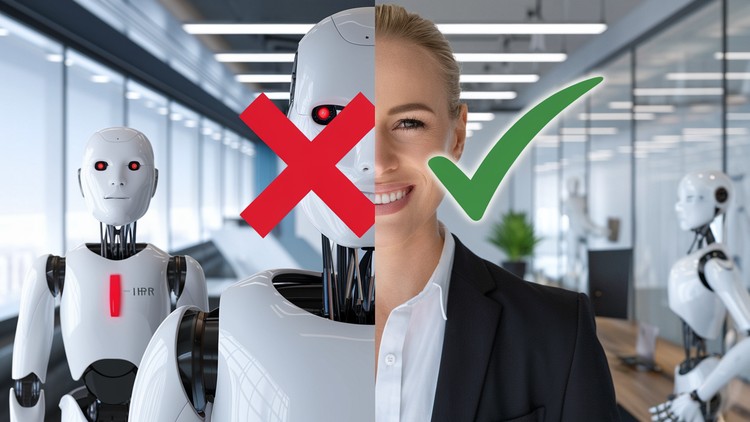
Become an AI-Ready HR Leader: From Compliance Expert to Innovation Champion
⏱️ Length: 7.2 total hours
⭐ 3.88/5 rating
👥 6,713 students
🔄 February 2025 update
Add-On Information:
Note➛ Make sure your 𝐔𝐝𝐞𝐦𝐲 cart has only this course you're going to enroll it now, Remove all other courses from the 𝐔𝐝𝐞𝐦𝐲 cart before Enrolling!
- Comprehensive Course Overview
- This specialized training provides a deep dive into the Strategic AI Lifecycle within human resources, moving far beyond basic automation to explore how predictive analytics and machine learning are fundamentally reshaping the employee-employer relationship in 2025.
- Participants will explore the Global Regulatory Landscape, including a thorough breakdown of the EU AI Act’s extraterritorial impact, New York City’s Local Law 144 on automated employment decisions, and the evolving EEOC guidelines regarding algorithmic discrimination.
- The curriculum focuses on the Ethical Architecture of HR, teaching leaders how to balance the drive for operational efficiency with the moral imperative of maintaining privacy, dignity, and equity for a diverse workforce.
- The course outlines the creation of a Corporate AI Charter, a foundational document that defines the organization’s stance on transparency, accountability, and the “Human-in-the-Loop” requirement for high-stakes decisions.
- HR leaders will learn to identify Algorithmic Drift, understanding how AI models that were once fair can become biased over time as they ingest new, unvetted data from the labor market.
- The content emphasizes Cross-Departmental Synergy, providing a roadmap for HR to act as the central nervous system between IT, Legal, and Finance departments when vetting and deploying enterprise-wide AI solutions.
- Requirements / Prerequisites
- A Foundational Understanding of HR Management is essential, as the course builds upon existing knowledge of recruitment, performance evaluation, and employee relations to show where AI interventions occur.
- Candidates should possess Basic Legal Literacy, specifically a familiarity with existing labor laws like GDPR or the Civil Rights Act, which serve as the baseline for new AI-specific compliance measures.
- A Growth-Oriented Tech Mindset is required; while no programming knowledge is needed, students must be comfortable discussing technical concepts like data sets, neural networks, and model outputs.
- Professional experience in Risk Management or Talent Strategy is highly recommended to help contextualize the high-stakes scenarios and case studies presented throughout the 7.2 hours of content.
- No Coding or Data Science Background is necessary, making this course accessible to senior HR executives, mid-level managers, and independent HR consultants who are not tech-specialists.
- Skills Covered / Tools Used
- Algorithmic Bias Auditing: Learn the specific methodologies for testing whether a resume-parsing tool or a performance-scoring algorithm is inadvertently filtering out candidates based on protected characteristics.
- Vendor Risk Assessment Frameworks: Mastering the use of specialized “Due Diligence Checklists” designed to grill AI software providers on their training data transparency and security protocols.
- Generative AI Policy Drafting: Developing the skill to write enforceable internal policies that dictate how employees can use tools like ChatGPT or Gemini without exposing sensitive corporate data or violating intellectual property.
- Explainable AI (XAI) Communication: The ability to translate complex “black box” algorithmic outputs into plain language that can be defended in court or explained to an inquiring employee.
- Statistical Parity Analysis: Utilizing basic mathematical tools to measure the impact of automated tools on different demographic groups, ensuring compliance with “Four-Fifths” rules and other fairness metrics.
- Impact Assessment Documentation: Proficiency in creating “Data Protection Impact Assessments” (DPIA) specifically tailored for AI systems, a critical requirement for compliance in many modern jurisdictions.
- Benefits / Outcomes
- Attain the status of an AI-Ready HR Leader, positioning yourself as an indispensable strategist who can guide a company through the turbulence of digital transformation without incurring legal penalties.
- Establish a Robust Compliance Infrastructure that protects your organization from the multi-million dollar fines and reputational disasters associated with biased or non-transparent AI deployment.
- Unlock Enhanced Talent Acquisition Quality by learning how to optimize AI tools to find “hidden gems” in the candidate pool that human recruiters or poorly governed algorithms might overlook.
- Foster Higher Employee Trust by demonstrating a commitment to ethical automation, ensuring that workers feel secure and valued in an environment where technology assists rather than replaces human judgment.
- Drive Operational Cost Savings by confidently identifying which HR processes are safe for full automation and which require human oversight, preventing the waste of resources on high-risk, low-reward tech.
- Receive a Future-Proof Career Advantage, as the demand for HR professionals who understand the intersection of data ethics and labor law is projected to grow exponentially through the end of the decade.
- PROS
- Highly Current Curriculum: The February 2025 update ensures that students are learning about the very latest legal precedents and the most recent versions of Generative AI tools.
- Scalable Governance Models: The course provides templates and frameworks that can be scaled for small startups or massive multinational corporations, making it versatile across different industry sectors.
- Peer-Validated Quality: A solid 3.88/5 rating from over 6,700 students indicates that the material is both practical and well-received by a large community of active HR practitioners.
- CONS
- Regulatory Volatility: Because AI legislation is changing almost monthly in some regions, students may need to actively supplement this course with their own local legal updates to remain 100% compliant in specific micro-jurisdictions.
Learning Tracks: English,Business,Management
Found It Free? Share It Fast!