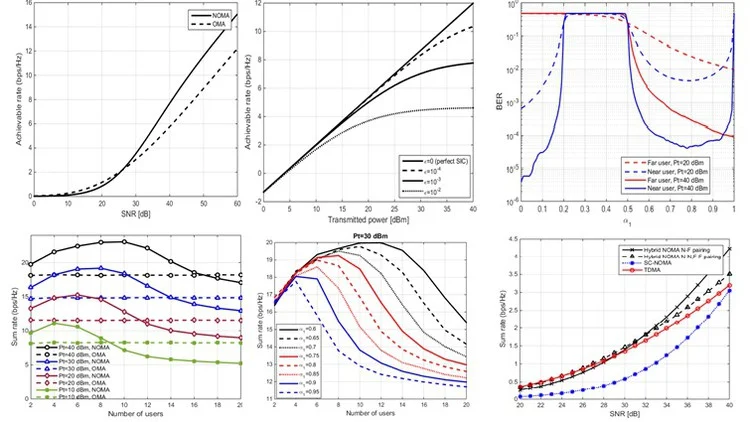
A step by step the Matlab codes for capacity, BER, and outage probability estimations for NOMA communication system
⏱️ Length: 4.5 total hours
⭐ 4.43/5 rating
👥 12,844 students
🔄 August 2021 update
Add-On Information:
Note➛ Make sure your 𝐔𝐝𝐞𝐦𝐲 cart has only this course you're going to enroll it now, Remove all other courses from the 𝐔𝐝𝐞𝐦𝐲 cart before Enrolling!
- Course Overview
- This comprehensive course offers a practical, hands-on introduction to the core concepts of 5G communication systems, specifically focusing on their implementation and analysis using MATLAB.
- Through a series of guided, step-by-step exercises, students will develop a deep understanding of how to model and simulate key performance indicators (KPIs) of 5G technologies, with a particular emphasis on Non-Orthogonal Multiple Access (NOMA).
- The curriculum is designed to demystify complex theoretical concepts by translating them into tangible, executable MATLAB code, enabling learners to observe and analyze system behavior firsthand.
- The course progresses logically, building foundational knowledge before diving into advanced simulations and performance evaluations, ensuring a smooth learning curve for participants.
- It provides a unique opportunity to bridge the gap between theoretical knowledge of wireless communications and practical, code-driven simulation techniques.
- Participants will gain proficiency in generating and interpreting simulation results related to crucial performance metrics, such as data throughput, signal reliability, and network coverage limitations.
- The focus on NOMA within the 5G framework highlights a critical enabling technology for future wireless networks, offering enhanced spectral efficiency and user capacity.
- The course is updated to reflect recent advancements in the field, ensuring its relevance and applicability to current industry trends.
- Requirements / Prerequisites
- A foundational understanding of digital communication principles is recommended, including concepts like modulation, demodulation, and error detection/correction.
- Familiarity with basic signal processing concepts will be beneficial for grasping the underlying principles of 5G signal transmission and reception.
- Prior experience with the MATLAB environment is essential, including basic syntax, data handling, and plotting capabilities.
- While not strictly mandatory, a basic grasp of probability and statistics will aid in understanding the analytical aspects of BER and outage probability.
- No prior specialized knowledge of 5G or NOMA is required, as these concepts will be introduced and explained within the context of the course.
- Access to a licensed or student version of MATLAB with relevant toolboxes (e.g., Communications Toolbox) is necessary for completing the practical exercises.
- Skills Covered / Tools Used
- MATLAB Programming: Development of custom scripts and functions for simulating complex communication systems.
- 5G NOMA Simulation: Practical implementation of NOMA principles in a simulated 5G environment.
- Performance Analysis: Calculation and visualization of key 5G KPIs, including:
- Capacity Estimation: Understanding and simulating the data handling capabilities of 5G systems.
- Bit Error Rate (BER) Calculation: Quantifying the reliability of signal transmission.
- Outage Probability Determination: Assessing the likelihood of communication link failure.
- Wireless Communication Modeling: Creating realistic models for channel effects, fading, and interference.
- Data Visualization: Effectively presenting simulation results through plots and graphs for clear interpretation.
- Algorithm Implementation: Translating theoretical communication algorithms into executable MATLAB code.
- MATLAB Communications Toolbox: Leveraging specialized functions and blocks for efficient wireless system design and simulation.
- System Design Principles: Gaining insights into the architectural considerations of modern wireless networks.
- Benefits / Outcomes
- Develop the practical skills to independently simulate and analyze 5G communication systems using MATLAB.
- Gain a competitive edge in the job market by acquiring in-demand skills in 5G technology and simulation.
- Deepen your theoretical understanding of NOMA and its role in enhancing 5G performance through practical application.
- Acquire the ability to predict and optimize the performance of 5G networks based on simulation results.
- Build a strong foundation for further studies or research in advanced wireless communication technologies.
- Enhance your problem-solving capabilities by tackling real-world challenges in wireless system design through coding.
- Become proficient in using MATLAB as a powerful tool for research, development, and testing in the telecommunications industry.
- The ability to translate abstract communication theory into concrete, verifiable simulation outcomes.
- PROS
- Highly practical and code-centric approach, making abstract concepts concrete.
- Focus on NOMA, a key component for future 5G advancements.
- Step-by-step guidance simplifies complex simulations.
- Large student base and positive rating indicate high course quality and student satisfaction.
- Recent update ensures content is current.
- CONS
- Course depth may be limited for advanced researchers seeking highly specialized simulations beyond the core KPIs covered.
Learning Tracks: English,Teaching & Academics,Engineering
Found It Free? Share It Fast!