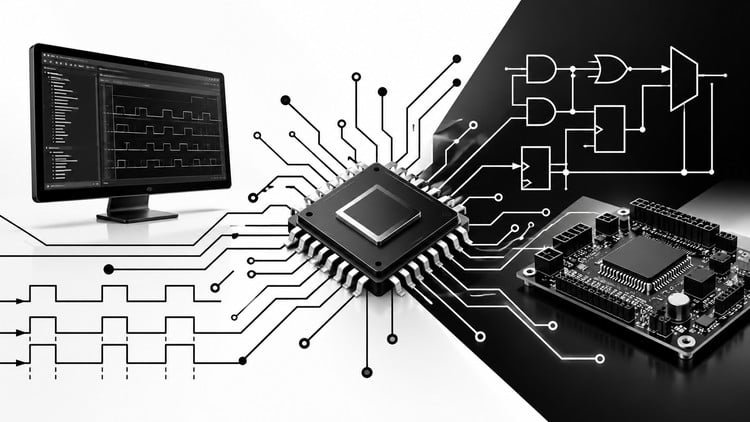
Learn Verilog HDL, RAM, ROM, FIFO Design, FPGA Block RAM (BRAM), UART Protocol, Transmitter, Receiver and Baud Rate Gene
What You Will Learn:
- Understand memory arrays, RAM, ROM, and FIFO buffers used in digital systems and FPGA designs.
- Describe memory structures using Verilog HDL and understand BRAM templates and FPGA memory implementation.
- Explain UART protocol fundamentals, including serial data framing, start and stop bits, and baud rate.
- Understand UART transmitter, receiver, and baud-rate generator architectures and how to test UART using a terminal.
Stepping into the world of advanced digital design can often feel like navigating a dense forest, but courses like ‘Advanced Verilog HDL — Memory Design, FIFO & UART’ serve as a well-lit path. As someone who’s been entrenched in the tech industry for a while, I’ve seen countless resources, and this one genuinely stands out for its practical approach to core digital system components. It’s not just about learning Verilog syntax; it’s about understanding the architectural nuances of fundamental IP blocks and how to implement them efficiently in real-world scenarios, particularly on FPGAs.
This course goes beyond theoretical concepts, diving deep into the implementation of various memory structures – from simple memory arrays to sophisticated RAM, ROM, and the critical FIFO buffers. It then broadens its scope to essential communication protocols, specifically the UART protocol, detailing its transmitter, receiver, and baud rate generator. The true value here is in bridging the gap between theoretical knowledge and practical application, showing you how to translate abstract ideas into functional Verilog HDL code optimized for FPGA designs. This practical slant is what truly prepares you for building complex digital systems and is a significant step toward developing robust, job-ready skills.
Prerequisites
Let’s be clear: the “Advanced” in the title isn’t just for show. This isn’t a course for someone just starting their journey from beginner to advanced in digital design. You absolutely need a solid foundation in basic Verilog HDL. This means comfort with modules, ports, assignments, different data types, behavioral modeling (always blocks, if/else, case statements), and a decent understanding of sequential logic (flip-flops, registers) and combinational logic. A basic grasp of finite state machines (FSMs) would also be highly beneficial. If you’re still wrestling with basic gates or simple counters, I’d strongly recommend shoring up those fundamentals first. Diving in unprepared will likely lead to frustration rather than profound career growth.
Skills & Tools
Upon completing this course, you’ll gain a suite of highly marketable skills. You’ll master the art of designing complex memory structures, including single-port and dual-port RAMs, ROMs, and efficient FIFO buffers using Verilog HDL. A significant portion focuses on understanding FPGA Block RAM (BRAM) templates and how to effectively utilize these hardened IP blocks within actual FPGA architectures. Furthermore, you’ll become proficient in implementing the full UART protocol, from data framing to building robust UART transmitter and receiver modules, complete with a precise baud rate generator. You’ll also learn how to test these designs using terminal software, giving you a complete design-to-test workflow.
The course implicitly requires and strengthens your familiarity with industry-standard tools. Expect to use a Verilog simulator (like Icarus Verilog, ModelSim, or QuestaSim) for verification and possibly an FPGA synthesis tool (such as Xilinx Vivado or Intel Quartus) for mapping your designs to hardware. The emphasis on hands-on labs will hone your debugging and verification skills, which are invaluable in the real world.
Career Benefits & Job Roles
This course delivers significant value for your career growth. The skills you acquire are directly applicable to demanding roles in the semiconductor and electronics industries. You’ll be well-positioned for roles such as an FPGA Design Engineer, ASIC Design Engineer, Digital Design Engineer, or even an Embedded Systems Developer, particularly those focused on hardware-software co-design. The ability to design, implement, and test fundamental IP blocks like memories and communication interfaces is a core competency that employers actively seek. This course provides excellent foundational knowledge for anyone considering certification prep for industry-recognized hardware design certifications. The practical nature of the real-world projects ensures that you’re not just learning theory but building truly job-ready skills that translate directly into impactful contributions.
Pros
- Deep Dive into Core IP Blocks: The course doesn’t just skim the surface. It provides an excellent, detailed exploration of RAM, ROM, and especially FIFO buffers, including advanced considerations for FPGA Block RAM (BRAM) implementation. This depth is crucial for anyone working on complex digital systems.
- Comprehensive UART Implementation: From understanding the protocol fundamentals like start/stop bits and baud rate to designing fully functional UART transmitter, receiver, and baud rate generator, the coverage is thorough. The practical aspect of testing with a terminal is a massive plus, offering invaluable hands-on labs experience.
- Practical, Project-Oriented Learning: This isn’t just theoretical exposition. The course emphasizes actual Verilog HDL coding for each component, promoting a strong understanding of how to translate concepts into working hardware. This focus on real-world projects is what truly builds job-ready skills.
- Directly Applicable to FPGA Development: By focusing on memory structures and protocols commonly used in FPGA designs, the course directly equips you with the knowledge needed to leverage these powerful devices for rapid prototyping and system development, directly aiding your career growth in hardware engineering.
Cons
- Scope Limited to Design, Less on Advanced Verification: While the course excels at teaching the design and implementation of these crucial blocks in Verilog, it doesn’t appear to delve into more advanced verification methodologies like those using SystemVerilog or UVM (Universal Verification Methodology). In today’s industry, complex digital designs demand equally complex verification strategies, and while this course provides robust design skills, you’d need supplementary learning for a truly complete job-ready skills set in modern ASIC/FPGA development verification.