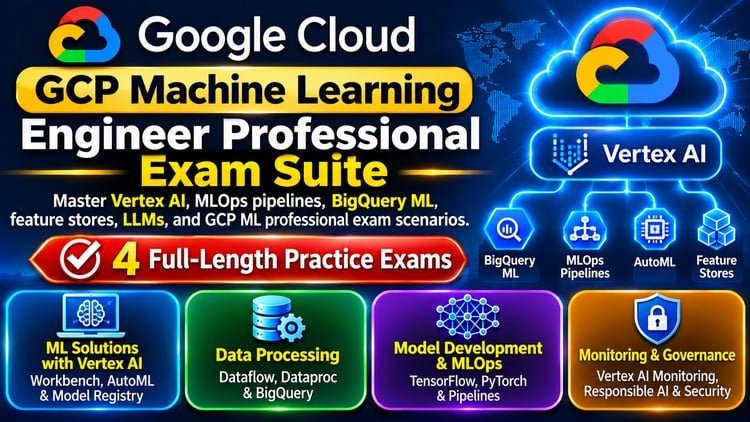
Master Vertex AI, MLOps pipelines, BigQuery ML, feature stores, LLMs, and GCP ML professional exam scenarios.
What You Will Learn:
- Architect, build, and productionize scalable ML systems on Google Cloud using Vertex AI, BigQuery ML, and Dataflow
- Master MLOps practices, Vertex AI Pipelines, Model Registry, automated CI/CD retraining, and continuous monitoring.
- Design advanced data ingestion and feature engineering pipelines using BigQuery, Dataproc, and Vertex AI Feature Store
- Deploy generative AI, LLMs, fine-tuning, and custom models with optimized latency, cost, and security governance
The Reality of Becoming a GCP-Certified ML Engineer
Let’s be honest: the bridge between building a cool model in a Jupyter Notebook and actually running that model at scale in a production environment is more like a massive canyon. Most people fall into the gap because they focus on algorithms while ignoring the “plumbing”—the data pipelines, the serving infrastructure, and the monitoring. That’s why I dove into the GCP Machine Learning Engineer Professional Exam Suite. It’s not just another theoretical deep dive; it’s a blueprint for anyone trying to stop playing with “toy” models and start building industry-standard tools that actually generate business value.
What I appreciated most about this suite is that it doesn’t coddle you. It treats you like someone who needs to solve problems at 3:00 AM when a pipeline breaks. While other platforms might give you a high-level overview of neural networks, this course focuses on the “engineering” part of Machine Learning Engineering. It’s about the “glue code,” the automated CI/CD retraining, and the cost-governance that keeps the CFO from breathing down your neck. If you’re serious about career growth in the cloud space, you need to understand how Google Cloud views the ML lifecycle, and this course delivers that perspective in spades.
What You Need Before You Start
I wouldn’t recommend jumping into this if you’ve never touched a line of Python. While the course covers a beginner to advanced spectrum, it moves fast. You should have a baseline understanding of:
- Python Programming: You don’t need to be a software architect, but you should be comfortable with libraries like Pandas and Scikit-Learn.
- Cloud Basics: A passing familiarity with GCP (or even AWS/Azure) helps. If you know what a Virtual Machine or a Storage Bucket is, you’ll be fine.
- Basic ML Theory: You should know the difference between supervised and unsupervised learning. The course won’t spend two hours explaining what a linear regression is; it expects you to know the “what” so it can teach you the “how” at scale.
The Toolkit: Skills & Tools You’ll Actually Use
The curriculum is a powerhouse of job-ready skills. You aren’t just learning tools; you’re learning workflows.
- Vertex AI: This is the heart of the course. You’ll learn to navigate the Model Registry, Vertex AI Pipelines, and the Feature Store—which is essentially the holy grail for keeping features consistent between training and serving.
- Data Engineering at Scale: You’ll spend significant time with BigQuery ML and Dataflow. Learning how to run SQL-based ML models is a game-changer for quick prototyping.
- MLOps & Automation: This was my favorite part. Setting up continuous monitoring to catch data drift before it ruins your model’s performance is a skill that separates the juniors from the seniors.
- Generative AI: Given the current market, the addition of LLM fine-tuning and security governance for GenAI models makes this course incredibly relevant for today’s hiring landscape.
Career Benefits & Job Roles
Investing time in this certification prep isn’t just about getting a badge for your LinkedIn profile—though that certainly helps with recruiters. It’s about the real-world projects you can talk about in interviews. Completing this suite positions you for high-paying roles such as:
- MLOps Engineer: Specializing in the deployment and maintenance of model lifecycles.
- Cloud AI Architect: Designing complex, multi-tool systems on Google Cloud.
- Machine Learning Engineer: A role that currently commands some of the highest salaries in tech due to the massive talent shortage in production-grade ML.
The career growth potential here is massive because Google Cloud is rapidly gaining market share in the enterprise AI space.
Pros: Why This Suite Wins
- Hands-on Labs: You aren’t just watching videos. The hands-on labs place you directly in the GCP console, forcing you to troubleshoot real scenarios. This is where the real learning happens.
- Exam-Targeted Content: The practice professional exam scenarios are eerily similar to the actual certification questions. It builds the right “muscle memory” for the test.
- Modern GenAI Focus: It doesn’t ignore the elephant in the room. The modules on LLMs and latency optimization for generative models are worth the price of admission alone.
Cons: The Honest Truth
- The GCP Interface Lag: Google updates their UI faster than any course creator can keep up. You will occasionally find that a button in the lab has moved or been renamed in the actual GCP console. It requires you to be a bit patient and use your head rather than just following a step-by-step click guide.