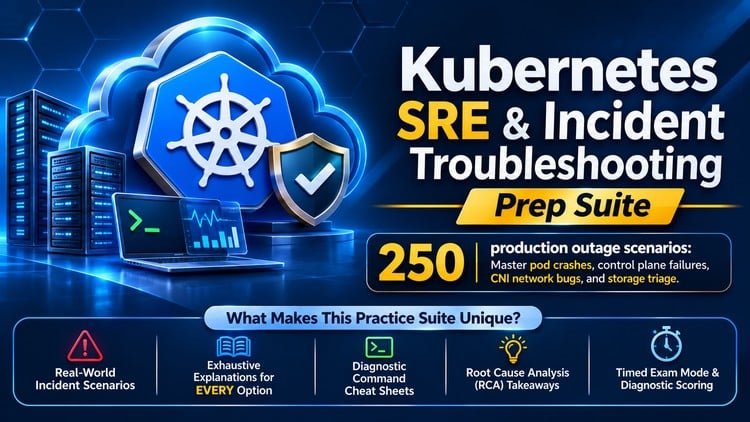
250 production outage scenarios: Master pod crashes, control plane failures, CNI network bugs, and storage triage.
What You Will Learn:
- Triage and resolve complex Kubernetes production incidents including CrashLoopBackOff, OOMKilled, and ingress failures.
- Diagnose control plane, kubelet, CNI network, DNS, and persistent volume failures under strict SLA/SLO constraints.
- Master kubectl troubleshooting commands, log analysis, event inspection, and metric-driven root cause analysis.
- Build hands-on incident response confidence for SRE, DevOps, and Senior Platform Engineering technical interviews.
Overview
This ‘Kubernetes SRE & Incident Troubleshooting Prep Suite’ isn’t just another online course; it’s a full-blown combat simulation for anyone serious about mastering Kubernetes reliability. Seriously, if you’ve ever been paged at 3 AM by a failing K8s cluster and felt that cold dread, this suite is your therapy session. It’s not just a theoretical deep dive; it’s a brutal, yet incredibly effective, gauntlet of `250 production outage scenarios`. We’re talking real-deal stuff here: `CrashLoopBackOff` that won’t quit, `OOMKilled` pods playing hide-and-seek, or ingress failures that make your users scream.
What sets this apart is the sheer volume of `hands-on labs` and the relentless focus on `incident troubleshooting` under strict, real-world `SLA/SLO constraints`. This isn’t for the faint of heart, but for anyone serious about `career growth` in the K8s SRE or platform engineering space, it’s an absolute goldmine for building `job-ready skills`. It doesn’t just teach you *what* to do, but *how* to think and act under pressure, turning abstract knowledge into concrete, actionable expertise. This `prep suite` is designed to forge `site reliability engineers` who aren’t just familiar with Kubernetes, but who can genuinely `diagnose` and `resolve complex production incidents` with confidence and speed.
Prerequisites
Let’s be blunt: this isn’t your ‘Kubernetes 101’ course. You’ll need a solid foundational understanding of Kubernetes concepts – pods, deployments, services, namespaces, basic networking, and perhaps a high-level grasp of `control plane` components. If you’re still fuzzy on what a Kubelet does or how a CNI plugin functions at a high level, spend some time with a foundational course first. A decent grasp of Linux commands, networking fundamentals, and perhaps some familiarity with a cloud provider’s console will also save you a lot of headaches. This suite is designed to take you from a strong intermediate K8s user to someone who can confidently tackle `advanced troubleshooting` and `production incidents`. It’s definitely not `beginner to advanced` in the sense of starting from scratch; it assumes you’re already past the beginner stage.
Skills & Tools
By the time you’re through with these intensive `hands-on labs`, you’ll practically be able to troubleshoot K8s in your sleep. Expect to master `kubectl troubleshooting commands` like you were born with them – `kubectl get events`, `kubectl describe`, `kubectl logs`, and more esoteric ones crucial for `control plane diagnosis`. You’ll become a wizard at `log analysis`, parsing through `kubelet` logs, `controller manager` logs, and application logs with speed and precision. The emphasis on `metric-driven root cause analysis` is a huge win, teaching you how to leverage Prometheus/Grafana (or similar `industry-standard tools`) insights to pinpoint issues rather than just guessing. You’ll also sharpen your skills in `network troubleshooting` within a cluster, tackling tricky `DNS` and `CNI network bugs`, along with `persistent volume failures`. This isn’t just about knowing the tools; it’s about building a robust `incident response` workflow.
Career Benefits & Job Roles
If you’re eyeing roles like `Site Reliability Engineer (SRE)`, `DevOps Engineer`, `Cloud Engineer`, or `Senior Platform Engineer`, this course is essentially a fast-track to `job-ready skills` and significant `career growth`. The `250 production outage scenarios` aren’t just academic exercises; they are direct `real-world projects` designed to prepare you for the brutal technical interviews that these roles demand. Think of it as intense `certification prep` for your brain, not just for a specific exam. You’ll gain the confidence to walk into any `technical interview` and articulate exactly how you’d diagnose and resolve a `production outage`, making you an incredibly attractive candidate in a competitive market. It’s about moving beyond just deploying K8s to actually owning its reliability, giving you an edge in securing those high-impact, high-paying roles.
Pros
- Unparalleled Scenario Breadth & Depth: The sheer volume of `250 production outage scenarios` is unmatched. It covers everything from basic `pod crashes` to complex `control plane failures`, `CNI network bugs`, and `storage triage`, ensuring you’re exposed to a vast array of real-world problems.
- Real-World, Time-Sensitive Application: The focus on resolving incidents under `SLA/SLO constraints` forces you to think critically and efficiently, simulating the high-pressure environment of actual `production incident response`. This isn’t theoretical; it’s about practical, rapid problem-solving.
- Direct Interview & Job Readiness: This suite is essentially a `technical interview prep` bootcamp. The scenarios directly reflect common questions and challenges posed in interviews for SRE, DevOps, and Platform Engineering roles, directly translating into highly sought-after `job-ready skills`.
- Mastery of Diagnostic Workflow: Beyond just `kubectl commands`, the course instills a systematic approach to `root cause analysis`, combining `log analysis`, `event inspection`, and `metric-driven troubleshooting`. You learn not just the tools, but the `incident response` methodology.
Cons
- Not for Kubernetes Novices: As mentioned, this course makes significant assumptions about your existing Kubernetes knowledge. If you’re still wrestling with basic deployments or core concepts, you’ll find yourself struggling. It’s a specialized suite designed for intermediate to `advanced troubleshooting`, and lacking the foundational knowledge will lead to frustration rather than learning.