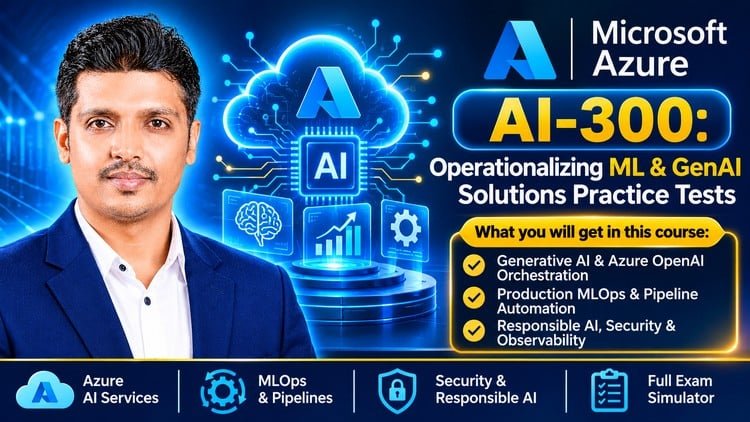
Master Azure OpenAI, MLOps, LLM pipelines, prompt flow, RAG, and Responsible AI governance with scenario-based tests
What You Will Learn:
- Deploy and manage generative AI models, LLMs, and Azure OpenAI Service endpoints at enterprise scale
- Build production MLOps pipelines using Azure Machine Learning, prompt engineering, and automated workflows.
- Implement responsible AI frameworks, content safety filters, model monitoring, and governance in Azure.
- Optimize LLM performance, RAG architecture, vector search, latency, cost, and security for GenAI apps.
The “Day 2” Reality Check for AI: An Honest Look at AI-300
Let’s be real for a second: the internet is currently drowning in tutorials that show you how to build a basic chatbot in five minutes. That’s fine for a weekend hobby, but if you’re trying to build a career in a corporate environment, those “Hello World” scripts won’t cut it. I recently dove into the Microsoft Azure AI-300: Operationalizing ML & GenAI Solution course, and it is a refreshing departure from the surface-level fluff we usually see.
The biggest challenge in the industry right now isn’t just “making AI work”—it’s making it work at scale, making it secure, and keeping the costs from spiraling out of control. This course tackles the “Day 2” problems: what happens after the model is trained? How do you maintain a RAG architecture when your data source changes every hour? How do you ensure your LLM pipelines don’t start hallucinating offensive content in a production environment? This isn’t just about code; it’s about the industry-standard tools and the “plumbing” of modern AI. It’s an advanced look at LLMOps that moves you away from experimental notebooks and into the world of real-world projects and enterprise reliability.
Prerequisites: Don’t Walk in Blind
This is not a “zero to hero” course for someone who has never touched a command line. To get the most out of these hands-on labs, you need a baseline. I’d suggest having a solid handle on Python programming—specifically how to handle environment variables and basic API calls. You should also have a functional understanding of Azure fundamentals. If you don’t know the difference between a Resource Group and a Managed Identity, you’re going to spend more time fighting the Azure Portal than learning AI. Finally, while you don’t need to be a PhD-level mathematician, knowing the difference between supervised and unsupervised learning will save you a lot of scratching your head during the MLOps modules.
Skills & Tools: The Modern AI Stack
The curriculum is a deep dive into the Azure OpenAI Service, but it’s the supporting cast of tools that makes this course valuable for career growth. You’ll be spending a lot of time in:
- Azure Machine Learning (AML) Studio: The hub for your automated workflows and model management.
- Prompt Flow: This is arguably the star of the show. It’s Microsoft’s answer to LangChain, allowing you to visualize and iterate on prompt engineering logic.
- Vector Search & AI Search: Crucial for building RAG (Retrieval-Augmented Generation) systems that actually provide relevant context.
- Content Safety Filters: Learning how to programmatically block jailbreak attempts and PII leaks.
- CI/CD for AI: Using GitHub Actions or Azure DevOps to trigger model monitoring and redeployment.
Career Benefits & Job Roles
In today’s market, a certification prep course like this is a massive signal to recruiters. We are seeing a shift where “Data Scientist” roles are evolving into “AI Engineers” or “MLOps Architects.” By mastering these job-ready skills, you position yourself for high-paying roles that focus on GenAI implementation. Whether you’re aiming to be a Solutions Architect, a DevOps Engineer specializing in AI, or a Lead AI Developer, the ability to operationalize a model is what separates the high earners from the hobbyists. Companies are desperate for people who understand Responsible AI governance because, quite frankly, their legal departments are terrified of AI. If you can prove you know how to build guardrails, you become an indispensable asset.
The Pros: Why This Course Hits the Mark
- Scenario-Based Testing: Instead of just asking you to memorize definitions, the labs put you in the shoes of a lead engineer solving real-world projects. This is the best way to develop beginner to advanced proficiency quickly.
- Deep Focus on LLMOps: Most courses stop at “deployment.” This course dives into model monitoring and latency optimization, which is where the real engineering happens.
- Responsible AI Integration: Microsoft doesn’t treat ethics as an afterthought. The focus on content safety filters and governance is probably the most practical “enterprise” skill you’ll walk away with.
- Practical RAG Architectures: The course goes beyond the basics, showing you how to tune vector search and index management for performance and cost optimization.
The Cons: One Honest Reality Check
If there’s one gripe I have, it’s the “Azure Velocity” problem. Microsoft updates the Azure OpenAI UI and the AML Studio interface faster than any course creator can record videos. You will occasionally find a button has moved or a feature has been renamed. It requires you to have a bit of a “hacker mindset” to navigate minor UI discrepancies. It’s not a dealbreaker, but it means you can’t just follow the labs on autopilot; you have to actually understand the underlying industry-standard tools to stay on track.