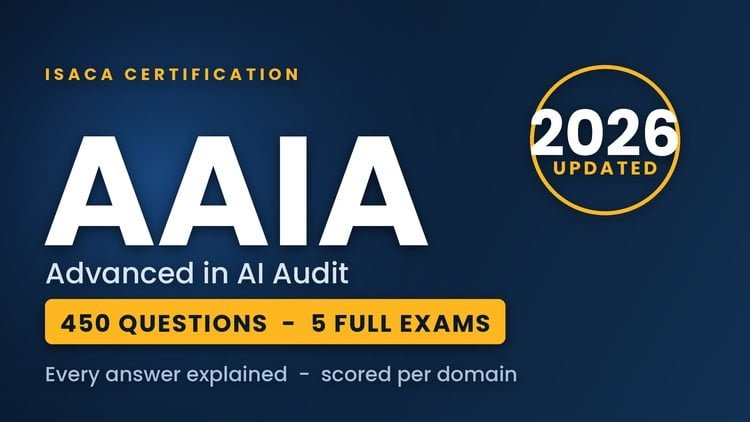
Five full-length 90-question exams on AI governance and risk, AI operations, and AI auditing tools and techniques
What You Will Learn:
- Test yourself against the full AAIA blueprint with five timed exams that match the real format: 90 questions in 150 minutes
- Tell apart the concepts that AAIA items are built to confuse, from drift types to sampling methods and evidence quality
- Learn from every answer: each option carries its own feedback, plus an overall explanation with a source link
- Build up from single-concept recall to full scenario simulation, so exam day is the fifth time you sit this format
- See your score per domain, so revision goes where the gap is instead of over the whole syllabus
- Practise the audit judgement the exam rewards: what to do first, what evidence is best, what risk weighs heaviest
Alright, let’s talk about the ‘AAIA Practice Tests: Advanced in AI Audit – 450 Questions.’ As someone who’s navigated the trenches of tech audit and risk management for years, I’ve seen countless “certification prep” materials. Many miss the mark, offering rote memorization instead of genuine understanding. This one, however, is a different beast entirely. If you’re serious about the AAIA certification and want to truly validate your expertise in a rapidly evolving field, you need to pay attention.
Overview
Forget your run-of-the-mill quiz banks. This practice test suite is designed for a singular purpose: to sharpen your critical thinking and audit judgment in the complex landscape of AI. It’s not just about knowing the answers; it’s about understanding *why* an answer is correct and, more importantly, *why* the others are not. The AI audit domain is fraught with subtleties, from distinguishing different types of model drift to evaluating the quality of AI-specific evidence. This course dives deep into those nuances, forcing you to confront the tricky scenarios that the real AAIA exam is notorious for. It acts as a crucial bridge, transforming theoretical knowledge into practical, examinable insight, preparing you for the kind of tough questions that demand more than just recall. It’s a high-stakes arena, and these tests are your sparring partners, building the mental muscle required to thrive in a specialized domain where precision is paramount.
Prerequisites
Let’s be clear: this isn’t for the faint of heart or the completely uninitiated. This is firmly in the ‘advanced’ category for a reason. Before you even think about diving into these 450 questions, you should ideally have a solid foundation in traditional IT audit principles and a demonstrable understanding of artificial intelligence and machine learning concepts. Think hands-on experience or significant theoretical knowledge in areas like data science, ML model lifecycles, and common AI frameworks. Familiarity with AI governance and risk management frameworks (e.g., NIST AI RMF, ISO 42001) is absolutely essential. This isn’t a “beginner to advanced” course; it assumes you’re already advanced in your knowledge and are looking to refine it for a specific, demanding certification. Without that base, you’ll find yourself overwhelmed rather than challenged.
Skills & Tools
While this practice test isn’t about teaching you how to use specific industry-standard tools through hands-on labs, it implicitly demands familiarity with a range of concepts and techniques central to AI auditing. On the skills front, it significantly hones your ability to perform rigorous risk assessment, interpret complex technical documentation, evaluate evidence critically, and apply sound audit judgment. You’ll be constantly exercising your analytical reasoning to differentiate between various control types, data quality issues, and ethical considerations. In terms of tools, while not directly interactive, the questions will test your conceptual understanding of how various AI/ML platforms (e.g., cloud-based ML services, open-source frameworks), GRC solutions, data integrity tools, and bias detection/explainability frameworks (like LIME or SHAP) are employed and audited in real-world scenarios. It’s about knowing *what* tools exist and *how* they fit into an AI audit, rather than coding with them.
Career Benefits & Job Roles
Frankly, mastering the content of these practice tests and ultimately achieving the AAIA certification is a massive boost for your career growth. The demand for professionals who can effectively audit AI systems is skyrocketing. Businesses are grappling with the ethical, regulatory, and operational risks of AI, and they desperately need qualified individuals to ensure trust and compliance. Successfully navigating these tests means you’re building direct job-ready skills that are in high demand.
Potential job roles that would heavily benefit from this expertise include:
- AI Auditor: Specializing in assessing AI model performance, fairness, robustness, and security.
- AI Risk Manager: Identifying, evaluating, and mitigating AI-specific risks across an organization.
- Data Governance Specialist (AI Focus): Ensuring data used for AI is compliant, high-quality, and ethically sourced.
- Senior IT Auditor / Digital Trust Professional: Expanding existing audit capabilities to include advanced AI systems.
- AI Compliance Officer: Ensuring AI deployments adhere to emerging regulations and internal policies.
This certification signals to employers that you possess a unique, invaluable skill set, positioning you for leadership roles in a critical and emerging domain.
Pros
- Unparalleled Conceptual Clarity: The ability to differentiate between subtly confusing concepts like various drift types (data, concept, feature), sampling methods, and evidence quality is a standout feature. The detailed feedback for each option, complete with source links, transforms incorrect answers into powerful learning opportunities.
- Authentic Exam Simulation: With five full-length, timed 90-question exams, you’re not just memorizing facts; you’re building stamina, practicing time management, and getting comfortable with the exact format of the real AAIA exam. This is certification prep done right, reducing exam day anxiety significantly.
- Targeted Revision: The domain-specific scoring is incredibly useful. Instead of blindly reviewing the entire syllabus, you can pinpoint your weak areas (AI Governance & Risk, AI Operations, AI Auditing Tools & Techniques) and focus your revision efforts efficiently. This saves valuable study time and makes your efforts more productive.
- Real-World Audit Judgment: The questions are crafted to test your audit judgment – what action to take first, what constitutes the best evidence, and which risks carry the most weight. This pushes you beyond theoretical recall, simulating the practical decision-making required in actual real-world projects.
Cons
- Not for Foundational Learning: This is purely a practice test suite, not an instructional course. It provides no actual teaching material, lectures, or modules to explain core concepts from scratch. If you lack a strong existing foundation in AI and auditing, you’ll struggle significantly and would be better off investing in a dedicated learning course before tackling these questions. It assumes your foundational knowledge is already robust.