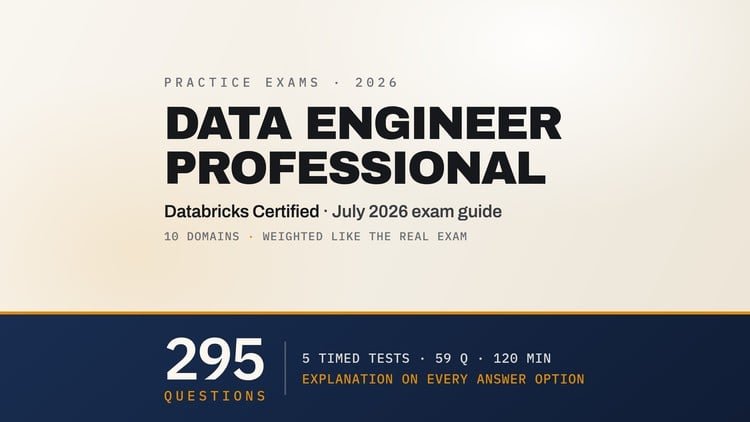
5 full-length tests, 295 questions, aligned with the July 2026 exam guide. An explanation for every answer option.
What You Will Learn:
- Test yourself against 295 exam-style questions covering all ten sections of the July 2026 Databricks Data Engineer Professional exam guide.
- Tell neighbouring features apart: streaming tables vs materialized views, Auto Loader vs COPY INTO, liquid clustering vs partitioning vs ZORDER.
- Read every answer option and learn why it is right or wrong, with a link to the official Databricks documentation on every question.
- Work up from single-concept questions to a full-length 59-question simulation under the real 120-minute exam clock.
- Use the per-domain score report after each attempt to find which of the ten exam sections still needs your study time.
- Show more
Alright, let’s dive into this Databricks Data Engineer Professional: 5 Practice Tests. As someone who’s been in the data trenches for a while, navigating the ever-evolving landscape of big data platforms, I’m always on the lookout for resources that can actually move the needle for career growth. Certification prep, especially for platforms as crucial as Databricks, is no joke. It’s not just about collecting badges; it’s about solidifying those job-ready skills that employers are actively seeking. This course promises a deep dive into the Databricks Data Engineer Professional exam, and I’ve put it through its paces.
Overview
First off, the sheer volume here is impressive. 5 full-length tests, clocking in at a hefty 295 questions, all meticulously aligned with the July 2026 exam guide. This isn’t some superficial cram session; it’s designed to simulate the real deal. What really caught my eye was the commitment to understanding the ‘why’ behind each answer. Every single option, right or wrong, comes with a detailed explanation. This is crucial for truly grasping the nuances of Databricks, especially when it comes to those devilishly similar concepts. Think distinguishing between streaming tables and materialized views, or the subtle but significant differences between Auto Loader and COPY INTO. The ability to differentiate between liquid clustering, partitioning, and ZORDER is precisely the kind of granular knowledge you need for real-world projects.
Prerequisites
Let’s be clear: this isn’t a beginner’s guide to data engineering. To get the most out of this practice test suite, you should already have a foundational understanding of data engineering principles and, ideally, some hands-on experience with the Databricks platform. Familiarity with SQL, Python, and Spark is practically a given. If you’re coming in as a complete novice, you’ll likely find yourself overwhelmed. This is more for intermediate to advanced practitioners looking to validate and refine their expertise for the professional certification.
Skills & Tools
The course directly targets the skills and tools required for the Databricks Data Engineer Professional certification. You’ll be tested on your understanding of data ingestion techniques, ETL/ELT processes, data modeling, performance optimization, and data governance within the Databricks ecosystem. The questions cleverly work you up from single-concept scenarios to full-length simulations, mimicking the pressure of a 120-minute exam. This progressive difficulty is key to building confidence and stamina. It effectively prepares you for the kind of complex, multi-faceted problems you’ll encounter when working with industry-standard tools on real-world projects.
Career Benefits & Job Roles
Earning the Databricks Data Engineer Professional certification is a significant career booster. It signals to potential employers that you possess a deep, practical understanding of one of the leading data platforms. This can open doors to a variety of high-demand job roles, including Senior Data Engineer, Data Architect, Cloud Data Engineer, and even roles focused on MLOps infrastructure. In today’s competitive job market, having a recognized certification like this can set you apart and lead to significant career growth, often with a bump in salary and access to more challenging and rewarding projects.
Pros
- Comprehensive Coverage: The breadth and depth of topics covered, directly aligned with the exam guide, are exceptional. You’re genuinely testing yourself against the real certification material.
- In-depth Explanations: The detailed explanations for every answer option, coupled with links to official Databricks documentation, are invaluable for true learning, not just memorization. This is where you really solidify your understanding.
- Realistic Simulation: The progression from single-concept questions to full-length, timed exams provides an authentic testing experience, preparing you mentally and practically for the actual certification.
- Targeted Feedback: The per-domain score reports after each attempt are gold. They immediately highlight your weak areas, allowing you to focus your study time efficiently.
Cons
- Steep Learning Curve for Beginners: As mentioned, this resource is best suited for those with prior experience. Beginners might find it too challenging and disheartening without a foundational understanding of Databricks and data engineering concepts.
Overall, if you’re serious about achieving your Databricks Data Engineer Professional certification and want a robust, well-structured, and informative preparation resource, this practice test suite is a no-brainer. It’s the kind of tool that helps you bridge the gap from beginner to advanced, and from aspiring professional to certified expert.