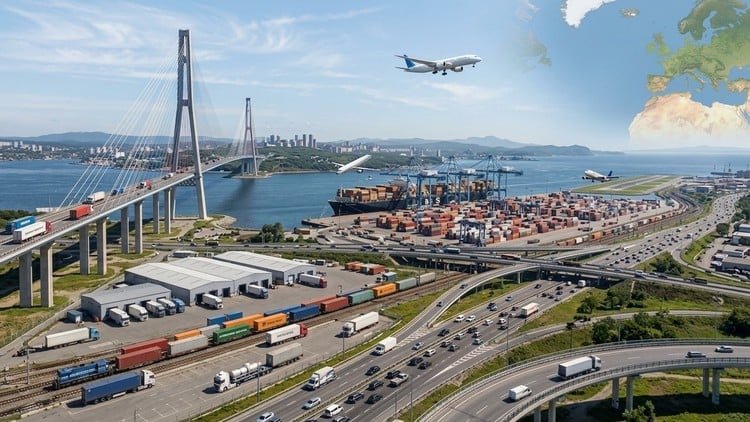
Learn how road, rail, air, and sea freight work together to plan, move, distribute, and deliver goods efficiently.
What You Will Learn:
- Understand the fundamentals of transportation logistics and how goods move from suppliers to customers through global supply chains.
- Compare road, rail, air, and sea transport and identify the factors that influence the selection of each transportation mode.
- Learn freight-planning principles, including shipment requirements, capacity, routing, scheduling, cost, and service considerations.
- Explore distribution networks and understand how warehouses, hubs, terminals, carriers, and transportation links work together.
- Understand intermodal transportation and how multiple transport modes can be coordinated to improve freight movement and efficiency.
- Learn the fundamentals of last-mile delivery, including route challenges, delivery density, customer expectations, and delivery costs.
- Show more
A Deep Dive into ‘Transportation and Freight Logistics: Moving Goods Worldwide’
As someone who’s spent years navigating the intricate world of supply chains, I’ve seen firsthand how crucial effective transportation and freight logistics are. This course, ‘Transportation and Freight Logistics: Moving Goods Worldwide,’ promises to demystify the complex web that gets everything from microchips to mattresses from point A to point B. I dove in with a critical eye, looking for genuine insights that go beyond the textbook definitions.
Overview
This course really shines in its ability to connect the dots between the different modes of transport and their strategic application. It doesn’t just present you with facts about ships and planes; it delves into the *why* behind choosing one over the other, touching on critical factors like transit time, cost per unit, and cargo type. The exploration of distribution networks, from the role of a strategic warehouse to the critical function of a hub, is particularly well-handled. They lay out how these seemingly disparate elements coalesce into a functional, efficient system. What impressed me most was the practical approach to understanding intermodal transportation. It’s not just a concept here; it’s presented as a vital strategy for optimizing global trade, highlighting how seamless transitions between different carriers and modes can unlock significant efficiencies and reduce overall supply chain costs. The attention given to the often-overlooked last-mile delivery, acknowledging its inherent challenges and impact on customer satisfaction, is another strong suit.
Prerequisites
Honestly, you don’t need a degree in engineering or a PhD in economics to get started. However, a basic understanding of business concepts and a general awareness of how goods are produced and consumed would be beneficial. If you’ve ever wondered how that Amazon package gets to your door so quickly or what goes into shipping a car overseas, you’re already on the right track. This course is well-suited for those looking to transition into logistics, operations, or supply chain management, regardless of their prior experience. It’s accessible for those looking to build foundational knowledge for entry-level roles, and potentially offers a good refresher for those already in the field wanting to solidify their understanding.
Skills & Tools
The course excels at building job-ready skills. You’ll gain a solid grasp of freight planning principles, including understanding shipment requirements, assessing capacity, and the art of routing and scheduling. While the course itself doesn’t focus on specific industry-standard tools (think TMS software or advanced analytics platforms), it provides the foundational knowledge that makes learning those tools much easier. The emphasis on understanding cost and service considerations is paramount. The content is presented in a way that empowers you to make informed decisions, which is the real skill in logistics. Think of it as learning the language and strategy before you master the specific software interface. It’s about building that mental model for effective freight optimization.
Career Benefits & Job Roles
This course is an excellent stepping stone for career growth in the logistics and supply chain sector. It equips you with the fundamental knowledge required for a variety of roles, including:
* Logistics Coordinator
* Supply Chain Analyst
* Freight Forwarder
* Warehouse Supervisor
* Transportation Planner
* Operations Specialist
For those looking for certification prep in related fields, this course provides a strong theoretical backbone. It’s about building the comprehensive understanding that employers are actively seeking.
Pros
* Comprehensive Coverage: It effectively covers the entire lifecycle of freight movement, from initial planning to final delivery, offering a holistic view of global logistics.
* Practical Application Focus: The course consistently links theoretical concepts to real-world scenarios, making the learning immediately applicable.
* Clear Explanation of Intermodalism: The detailed breakdown of how different transport modes work together is a significant strength, crucial for modern logistics.
* Accessible for Beginners: It breaks down complex topics into understandable segments, making it ideal for those new to the field or looking to gain a foundational understanding.
Cons
* Lack of Hands-On Labs/Specific Tools: While the theoretical grounding is excellent, the absence of direct engagement with actual logistics software or simulated hands-on labs means that some learners might need to seek out supplementary resources to bridge the gap to practical tool implementation. This is a common trade-off in many introductory courses, but worth noting for those seeking immediate tool proficiency.
Overall, ‘Transportation and Freight Logistics: Moving Goods Worldwide’ is a solid investment for anyone looking to understand, enter, or advance within the critical field of logistics. It provides the essential framework upon which deeper expertise can be built.