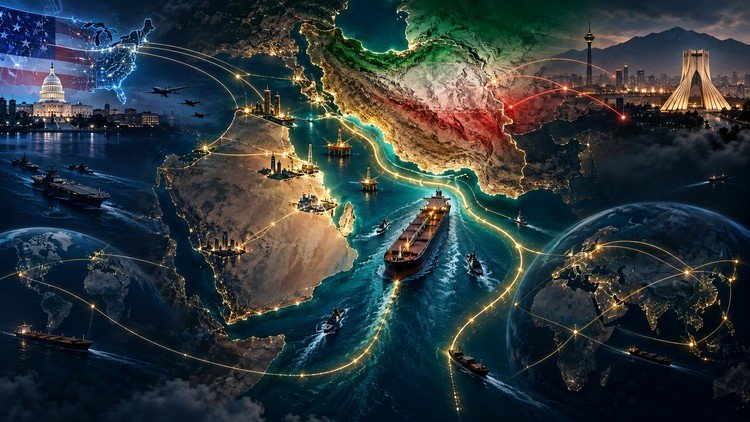
Understand the power, psychology, alliances, energy risks, and strategic realities shaping the U.S.–Iran conflict.
What You Will Learn:
- Analyze the political, psychological, military, and economic forces driving the U.S.–Iran conflict.
- Distinguish tactical military success from strategic victory and long-term political outcomes.
- Explain how the Strait of Hormuz connects regional conflict to global energy markets and economic stability.
- Evaluate how national interests, private priorities, and political pressure influence international alliances.
- Compare how the United States, Iran, Gulf states, and other major actors define victory and security.
- Assess geopolitical claims using evidence, competing perspectives, and systems-based analysis.
- Identify potential escalation pathways, diplomatic exit ramps, and unintended consequences of military pressure.
Alright, so I just wrapped up “The Truth About the U.S.–Iran War,” and honestly, as someone who spends most of their time optimizing cloud architecture and debugging distributed systems, diving into geopolitics felt like a refreshing, albeit intense, lateral move. Forget your typical dry history lesson; this course is less about memorizing dates and more about understanding the complex algorithms that drive international relations. If you’re looking for an honest, no-BS review from someone who values actionable insights over academic jargon, read on.
Overview
This isn’t your grandfather’s news report. What truly impressed me about this course is how it systematically dismantles the often-simplistic narratives we’re fed about the U.S.-Iran conflict. It’s like peering under the hood of a complex machine, examining every interlocking gear and circuit. Instead of just outlining historical events, it forces you to question *why* things happened, exploring the underlying motivations, the psychological drivers of leaders, and the quiet machinations of various stakeholders. My biggest takeaway wasn’t just a deeper understanding of this specific conflict, but a whole new framework for analyzing *any* global flashpoint. It taught me to look beyond immediate actions to the second and third-order effects, to connect seemingly unrelated dots, and to recognize the long game being played by all sides. This course doesn’t give you answers as much as it equips you with the tools to formulate your own, well-reasoned conclusions, which is a rare and valuable skill in an age of information overload.
Prerequisites
You don’t need a Ph.D. in international relations to get value here, but come prepared to think. Seriously. This isn’t a course where you passively absorb information. I’d say the main prerequisites are an **open mind** and a genuine **curiosity about how the world actually works**, beyond what the headlines tell you. A basic understanding of modern history or international politics helps, but isn’t strictly necessary – they do a good job of setting the stage. More importantly, be ready to challenge your own assumptions, potentially uncomfortable truths, and to engage with multiple, often conflicting, perspectives. If you’re someone who thrives on problem-solving and dissecting complex systems, you’re perfectly primed. No specific **industry-standard tools** or **certification prep** is needed beforehand, just a willingness to apply rigorous analytical thought.
Skills & Tools
This course doesn’t teach you how to code, but it absolutely develops crucial **job-ready skills** that translate across industries. You’ll sharpen your ability to perform **systems-based analysis**, breaking down incredibly complex situations into their constituent parts and understanding their interdependencies. It’s fantastic for **critical thinking**, forcing you to evaluate evidence from diverse sources and identify biases. You’ll gain a knack for **strategic decision-making** by learning to anticipate escalation pathways and unintended consequences. While there aren’t traditional **hands-on labs** in a software sense, the constant analysis of real-world scenarios and competing claims acts as a powerful simulation for developing **geopolitical forecasting** and **risk assessment** capabilities. Essentially, you walk away with a robust analytical toolkit that’s applicable far beyond the specific conflict itself, moving you from a passive observer to an active interpreter of global events.
Career Benefits & Job Roles
Okay, so how does understanding the U.S.-Iran conflict help my **career growth** as a tech professional? More than you might think. In today’s interconnected world, geopolitical stability directly impacts everything from global supply chains and energy markets to cybersecurity threats and investment strategies. The **job-ready skills** you gain here – **strategic thinking**, **risk mitigation**, **data-driven decision-making** in ambiguous situations, and understanding complex incentives – are invaluable. This course provides a significant edge for roles in:
- Business Intelligence & Strategy: Interpreting geopolitical shifts for market analysis and expansion.
- Cybersecurity & Threat Intelligence: Understanding state-sponsored actors and their motivations.
- Supply Chain Management: Anticipating disruptions due to regional instability.
- Investment & Financial Analysis: Assessing geopolitical risk in emerging markets.
- Leadership Roles: Making informed decisions in a globalized business environment.
It helps you develop a holistic view that often gets missed when focusing purely on technical details, offering a pathway from **beginner to advanced** strategic insight, making you a more well-rounded and valuable asset in any organization that operates globally.
Pros
- Unflinching Realism: It cuts through the political rhetoric and media spin like a hot knife through butter, focusing on evidence and strategic realities rather than emotional appeals.
- Multidimensional Analysis: The course masterfully weaves together political, psychological, military, and economic factors, providing a truly comprehensive picture that goes far beyond surface-level analysis. It’s a masterclass in seeing the whole board.
- Empowers Critical Thinking: Rather than spoon-feeding you facts, it teaches you *how* to analyze, *how* to question, and *how* to build your own informed perspectives on incredibly complex issues. This is true intellectual empowerment.
- Connects Global Dots: It brilliantly illustrates how seemingly regional conflicts, like those involving the Strait of Hormuz, have direct and profound impacts on global energy markets and economic stability, highlighting the interconnectedness of our world.
Cons
My one honest “con” is that this course is mentally demanding. It’s not something you can just put on in the background while you’re doing other things. It requires active engagement, a willingness to confront uncomfortable truths, and a commitment to processing dense, often conflicting, information. If you’re looking for light entertainment or a quick fix, this isn’t it. But if you’re prepared to put in the intellectual work, the rewards are immense.