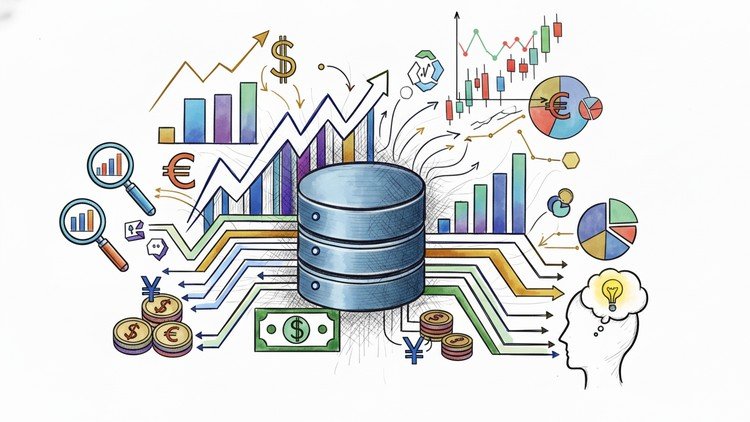
A Practical Guide to Big Data in Finance: Tools, Techniques, and Real-World Applications
What You Will Learn:
- Understand the fundamentals of big data analytics and its relevance in finance.
- Apply big data tools and techniques for risk assessment and management.
- Develop strategies for customer segmentation using data-driven insights.
- Implement effective fraud detection systems using advanced analytics.
Course Review: Big Data in Finance: The Guide to Fintech, Hadoop & Python
Overview
Alright, let’s talk about "Big Data in Finance: The Guide to Fintech, Hadoop & Python." In an era where data is king and finance is undergoing a digital revolution, a course like this isn't just nice to have—it's essential. This isn't your average theoretical deep dive; it’s a pragmatic expedition into the confluence of big data methodologies and financial applications. What I found particularly refreshing is how it cuts through the hype to focus on the tangible. It elegantly demonstrates how to translate sprawling datasets into actionable intelligence within a financial context, whether you're grappling with market trends, regulatory compliance, or optimizing trading strategies. It’s less about just learning definitions and more about getting your hands dirty with the kind of problems financial institutions face daily. This course genuinely delivers on its promise of being a practical guide, bridging the often-wide gap between pure data science and specialized financial domain knowledge.
Note➛ Make sure your 𝐔𝐝𝐞𝐦𝐲 cart has only this course you're going to enroll it now, Remove all other courses from the 𝐔𝐝𝐞𝐦𝐲 cart before Enrolling!
Prerequisites
While the course aims to be comprehensive, don't walk in cold expecting a full Python 101 or a "Finance for Dummies" primer. Ideally, you should have a foundational understanding of Python programming—think basic syntax, data structures, and perhaps a familiarity with libraries like Pandas. A rudimentary grasp of financial concepts (what's a stock, how do markets work at a high level) would also be hugely beneficial. While it does cover fundamentals, having these basics down will allow you to maximize the practical sections and truly benefit from the more complex applications rather than getting bogged down by the very initial setup. If you’re a complete novice to both, prepare for a steep but rewarding learning curve.
Skills & Tools Acquired
This course arms you with a formidable toolkit, making you proficient in several industry-standard tools. You'll gain practical expertise in setting up and navigating Hadoop ecosystems, understanding its core components like HDFS and MapReduce for distributed data processing. Beyond Hadoop, a significant portion focuses on leveraging Python's powerful libraries for data manipulation, analysis, and machine learning. Expect to get comfortable with NumPy and Pandas for data wrangling, Scikit-learn for building predictive models, and even some visualization libraries to communicate insights effectively. You'll learn to apply these tools specifically to financial datasets, tackling challenges ranging from processing massive transaction logs to developing sophisticated quantitative models. The emphasis is squarely on application, meaning you’re not just learning about the tools, but actively using them to solve real-world financial problems.
Career Benefits & Job Roles
The skills honed here are directly transferable and highly sought after in the burgeoning fintech landscape. Successfully completing this course significantly boosts your job-ready skills, opening doors to various roles. You could be looking at positions like a Fintech Analyst, a Big Data Engineer with a financial specialization, a Quantitative Analyst focusing on data-driven strategies, or even a Risk Management Specialist leveraging big data for predictive analytics. For existing finance professionals, this course offers a powerful avenue for significant career growth, transforming you into a data-savvy decision-maker. For tech professionals, it provides a crucial specialization, making you a hot commodity in a niche that desperately needs individuals who can speak both the language of data and the language of finance. It essentially positions you as a bridge between data science and financial strategy, a role that's only growing in demand.
Pros
- Highly Practical and Application-Oriented: This isn't just theory; the course is packed with hands-on labs and prompts for real-world projects. You’re not just watching; you're doing. This practical approach solidifies learning and ensures you can actually apply what you've learned in a professional setting.
- Strong Blend of Technologies and Domain Knowledge: It skillfully merges the power of big data technologies like Hadoop and Python with critical financial concepts. This dual focus is rare and invaluable, equipping you to tackle specific challenges within fintech, rather than just generic data problems.
- Relevant for Certification Prep: While not a direct certification course, the robust foundational knowledge in big data, Python, and financial analytics gained here provides an excellent springboard for broader data science or cloud big data certification prep. The structured learning helps build a solid base for advanced exams.
- Focus on Key Financial Use Cases: Instead of vague examples, the course zeroes in on specific financial applications—be it risk modeling, fraud detection, or customer segmentation. This targeted approach makes the learning immediately relevant and impactful for anyone aiming for a career in finance-tech.
Cons
- Pacing Can Be Intense for True Beginners: While it attempts to cover a broad spectrum from beginner to advanced topics, the sheer volume and pace can be overwhelming if you lack a solid pre-existing foundation in either Python programming or fundamental financial concepts. You might find yourself needing to pause frequently to catch up on basics, which could detract from the overall flow and the specific financial applications being taught. It’s manageable, but don't expect a gentle stroll if you're starting from scratch in both domains.