Rebuild your software lifecycle around agentic AI – with gates, evals and audit evidence that actually hold.
What You Will Learn:
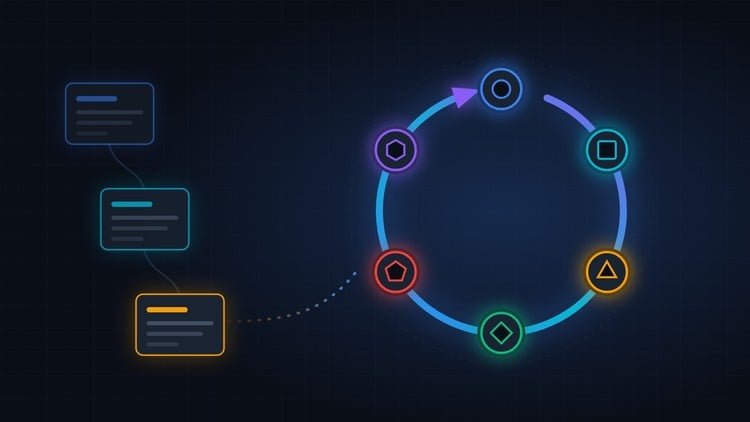
- Run the six-stage AI-native SDLC loop, where every stage commits an artifact the next stage reads
- Write an intent file, a spec file, a plan file and a review-policy file that an agent can act on, not just a human can read
- Choose the right strength of control – hook, managed permission, skill, the CLAUDE context file or human gate
- Build PreToolUse hooks that block protected paths and name the route to approval
- Give a Claude Code session a feedback loop so it verifies its own work before you see it
- Stand up a continuous eval suite that regression-tests your agent configuration, not your app
- Show more
Overview: Moving from Chatbots to Agentic Systems
Let’s be honest: most of us have been using AI all wrong. We treat LLMs like a better version of Google or a slightly more capable autocomplete. We paste snippets, get a bugfix, and move on. This course, “The AI-Native SDLC with Claude Code,” is the first time I’ve seen a curriculum that actually treats AI as a foundational layer of the engineering process rather than just a shiny accessory. It’s an aggressive, opinionated shift from “AI as a helper” to “AI as a system of record.”
The core epiphany here is the transition from human-readable documentation to machine-actionable artifacts. Instead of writing a Jira ticket that a human might interpret differently on a Friday afternoon, you’re learning to architect intent files, spec files, and plan files that an agentic tool like Claude Code can parse, execute, and validate. It’s about building a six-stage AI-native SDLC loop where the output of one stage is the strict programmatic input for the next. This isn’t just about coding faster; it’s about creating audit evidence and reproducible workflows that satisfy even the most paranoid compliance teams. This is a massive leap forward for anyone looking to stay relevant in an industry-standard tools landscape that is rapidly moving toward autonomous agents.
Prerequisites
This isn’t a “Hello World” course. To get the most out of these hands-on labs, you should be a mid-to-senior dev or an ambitious architect. You need a solid handle on the CLI (Command Line Interface), basic shell scripting, and a deep understanding of the traditional software development lifecycle. Familiarity with Git workflows is non-negotiable. While the course scales from beginner to advanced in terms of AI orchestration, you won’t survive the real-world projects if you don’t already understand how a standard CI/CD pipeline functions.
Skills & Tools
The toolkit here is surprisingly lean but incredibly deep. You’ll be living in Claude Code—Anthropic’s high-powered CLI agent—and learning how to configure its behavior through CLAUDE.md files and PreToolUse hooks. You’ll master the art of agentic evals, which was a huge takeaway for me: learning how to test the *agent’s configuration* rather than just the application code.
- Agentic Orchestration: Mastering managed permissions and human-in-the-loop gates.
- Documentation as Code: Writing machine-readable specs that serve as truth for AI agents.
- Security & Guardrails: Building PreToolUse hooks to block protected paths (like production DBs or sensitive environment variables).
- Automated Validation: Setting up feedback loops so the agent self-corrects before it ever asks for a human review.
- Continuous Evals: Deploying regression-testing suites for your agent’s logic and tool-use accuracy.
Career Benefits & Job Roles
If you’re worried about AI taking your job, this course is the antidote. It prepares you for the next generation of high-paying roles like AI Engineer, Agentic Systems Architect, and Platform Engineer (AI-Ops). By focusing on job-ready skills like building audit-ready AI workflows, you position yourself as the person who *manages* the fleet of agents. This is a significant career growth opportunity for those looking to move into leadership roles within AI-native organizations. It also serves as excellent certification prep for anyone eyeing emerging AI engineering credentials, as it focuses on real-world projects rather than theoretical fluff.
The Pros
- The Shift to Agent-First Logic: Most courses teach you how to prompt. This course teaches you how to architect. Learning to write review-policy files that an agent actually respects is a game-changer for technical leadership.
- Rigorous Safety Controls: I loved the focus on PreToolUse hooks. It’s the most practical approach I’ve seen to prevent an agent from accidentally nuking a repository or accessing protected paths. It provides the audit evidence required for enterprise-grade deployments.
- Testing the Meta-Layer: The section on continuous eval suites is worth the price of admission alone. We’re finally moving past “vibes-based” testing and toward industry-standard regression testing for agent behavior.
- Efficiency Gains: By moving to a six-stage loop where artifacts are auto-committed, you significantly reduce the “context-switching tax” that kills developer productivity.
The Cons
The only real “gotcha” is the heavy reliance on the Claude ecosystem. While the principles of agentic SDLC are theoretically transferable, the hands-on labs are very specific to Claude Code and its unique configuration files like CLAUDE.md. If your organization is strictly locked into a different ecosystem, you’ll have to do some heavy lifting to translate these advanced patterns to other frameworks. However, given that Claude currently leads the pack in coding capabilities, it’s a trade-off I’m personally willing to make.