Pass your professional certification 2026 with realistic mock exams and simple explanations.
What You Will Learn:
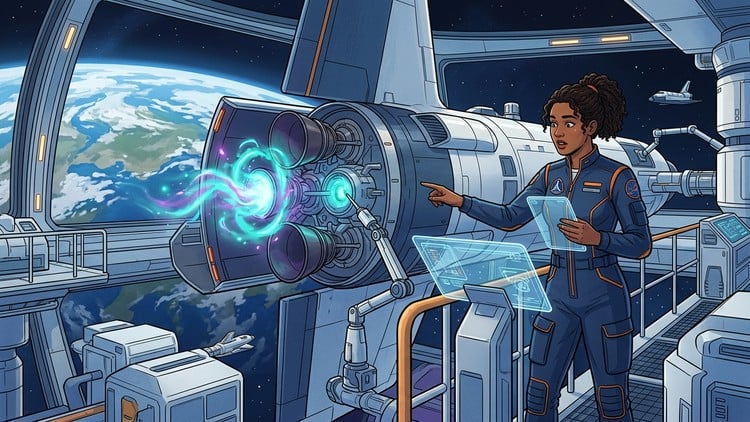
- Learn exactly how a nuclear engine works to push a heavy spaceship through deep space using heat and atoms.
- Identify every main part of the engine like the pumps, nozzles, and the white-hot core without getting confused.
- Master safety rules to protect your crew from radiation and learn how to fix major engine problems in an emergency.
- Practice steering a ship to Mars or Jupiter by learning the best times to fire the engine and how to save fuel.
- Pass the 2026 In-Space Propulsion Architect exam by practicing with realistic test questions and simple explanations.
- Show more
An Honest Look at the 2026 Nuclear Thermal Propulsion Architect Track
Let’s be real for a second: the “New Space” era has moved past the point where simple chemical rockets can get the job done for deep-space logistics. If you want to be more than just another cog in the machine, you have to look toward Nuclear Thermal Propulsion (NTP). I recently dove into the Prepare For In-Space Propulsion Architect (Nuclear Thermal) course, and honestly, it’s a breath of fresh air in a sea of generic certification prep materials. We aren’t just talking about burning fuel anymore; we are talking about harnessing the power of the atom to cut transit times to Mars by half. This course doesn’t just teach you the “what”—it forces you to understand the “how” and the “why” of multi-megawatt systems.
What struck me most was the shift in perspective. Most courses treat engines like black boxes. This curriculum treats the engine as a living, breathing thermodynamic beast. My initial take? It’s a rigorous, beginner to advanced journey that bridges the gap between theoretical physics and job-ready skills. It captures that specific 2026 exam vibe where the industry is moving toward standardized safety protocols for fission-based transit. If you’re serious about career growth in aerospace, this isn’t an elective; it’s a requirement.
Prerequisites: What You Actually Need Before Starting
Don’t expect to walk in here without some fundamental groundwork. While the course claims to be accessible, you’ll struggle if you don’t have a handle on basic thermodynamics and Newtonian physics. You don’t need to be a nuclear scientist on day one, but having a hands-on familiarity with fluid dynamics will save you hours of rewinding videos. Specifically, I’d recommend:
- A foundational understanding of orbital mechanics (knowing your Hohmann transfers from your b-planes).
- Basic literacy in industry-standard tools like MATLAB or Python for thermal modeling.
- A high-level grasp of the periodic table, specifically regarding isotopes and neutron moderators.
- An appetite for complex problem-solving—this is certification prep that actually makes you sweat.
Skills & Tools: The Architect’s Utility Belt
The course goes heavy on real-world projects. You aren’t just looking at diagrams; you are virtually “building” systems. You’ll spend a significant amount of time in high-fidelity simulators that mimic the white-hot core environment. One of the most valuable takeaways for me was the mastery of radiation shielding configurations—balancing the weight of the shield against the delta-V requirements of the mission.
You’ll gain proficiency in industry-standard tools for neutronics and thermal-hydraulic coupling. By the end of the modules, you’re expected to design a redundant cooling loop that can handle a “scram” event without melting the nozzle. These are job-ready skills that prime you for roles at major aerospace firms and defense contractors who are currently scrambling for NTP talent. It’s less about memorizing formulas and more about hands-on labs where you manage the delicate dance between hydrogen expansion and reactor criticality.
Career Benefits & Job Roles
The In-Space Propulsion Architect certification is arguably going to be the “Gold Standard” by 2026. As we look toward permanent lunar bases and crewed Mars missions, the demand for architects who can design safe, efficient nuclear engines is skyrocketing. This course is a massive catalyst for career growth. Completing this program puts you on the shortlist for roles such as:
- Propulsion Systems Integration Lead: Managing how the nuclear engine interacts with the rest of the spacecraft’s avionics.
- Nuclear Safety Officer (Space Systems): Ensuring every burn adheres to interplanetary safety rules and radiation containment standards.
- Mission Architect: Using your knowledge of fuel efficiency and high-thrust maneuvers to plan deep-space trajectories.
- Thermodynamics Consultant: Solving the extreme heat rejection challenges inherent in nuclear space travel.
The Pros: Why This Course Stands Out
- Realistic Mock Exams: The practice tests are brutal but fair. They mirror the 2026 exam’s focus on emergency “fail-safe” scenarios, which is exactly what you need to feel confident on test day.
- Simplified Complexities: The way they explain the white-hot core and neutron moderation is brilliant. They use simple explanations for high-level concepts without “dumbing down” the science.
- Focus on Safety: Most courses gloss over the “danger” part. This one puts radiation protection and emergency repairs front and center, making it feel like a true real-world project.
- Direct Career Pathing: The curriculum is clearly aligned with the actual hiring needs of the 2026-2030 window, focusing on job-ready skills rather than just academic theory.
The Cons: An Honest Critique
If I have one gripe, it’s the steep learning curve in the mid-section of the course. When you move from “how it works” to “emergency engine repair,” the complexity spikes significantly. If you aren’t disciplined with your hands-on labs, it’s easy to get overwhelmed by the math involved in calculating specific impulse (Isp) variations during core degradation. It’s not a “quick win” course; it requires a serious time commitment that might be tough for those working full-time.