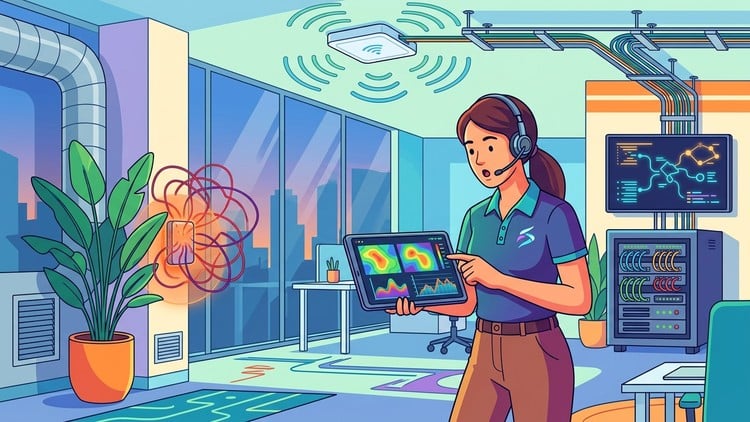
Master wireless networking with realistic practice questions and detailed explanations for the CWNT 2026 certification.
What You Will Learn:
- How to solve real-world wireless network problems and fix dropped connections quickly.
- The strict rules of 802.11 standards, including Wi-Fi 7, 6 GHz channels, and roaming.
- Ways to protect enterprise networks using WPA3 security and block rogue access points.
- Steps to design, plan, and survey a brand new wireless network before buying hardware.
- How to calculate radio power, understand antenna gain, and find hidden interference.
An Honest Deep-Dive into the CWNT 2026 Practice Environment
Look, we’ve all been there—standing in the middle of a warehouse or a high-density office space with a tablet in hand, wondering why the 5 GHz band is performing like a dial-up connection from 1998. In the world of wireless engineering, theory only gets you so far. You need that gut-level intuition that only comes from banging your head against 802.11 standards until they finally make sense. That’s exactly where ‘Practice Tests For CWNT Professional’ steps in.
Instead of just being another dry certification prep resource, this course feels like a simulated trial by fire. It doesn’t just ask you to memorize acronyms; it forces you to think like a lead engineer. The 2026 version of the CWNT is a different beast entirely because it moves past the basics and dives headfirst into the complexities of the 6 GHz spectrum. If you’re looking to move from a generalist to a specialized wireless pro, you need to know that this isn’t a “memorize and dump” situation—it’s about developing job-ready skills that actually translate to a paycheck.
Prerequisites for Success
Before you jump into these practice exams, don’t expect to be handheld through the basics of “what is an IP address.” This is a beginner to advanced bridge, but you definitely need a solid foundation in Network+ or CCNA level concepts. You should already have a firm grasp of the OSI model and basic TCP/IP. Ideally, you’ve spent at least six months logged into a controller or managing cloud-based Access Points (APs). If you don’t know the difference between a 20 MHz and an 80 MHz channel width, you might want to brush up on your fundamentals first, as these tests assume you’re ready to design for high-capacity environments.
High-Level Skills and Industry-Standard Tools
This course is designed to get you comfortable with the industry-standard tools used by the pros. While the tests are text-based, the scenarios they describe will have you mentally navigating through:
- Predictive Modeling: Understanding how to use tools like Ekahau or Hamina to simulate walls and attenuation before a single cable is pulled.
- Protocol Analysis: Learning to read Wireshark captures to identify 802.11 management frames and find out exactly why a client is failing to roam.
- Spectrum Analysis: Identifying non-Wi-Fi interference from microwave ovens, zigbee sensors, or rogue legacy devices that are killing your airtime fairness.
- Security Implementation: Moving beyond simple passwords to WPA3-Enterprise and 802.1X authentication for ironclad enterprise network protection.
Career Benefits and Job Roles
Investing your time here is a massive play for career growth. We are currently seeing a massive shift in the industry as companies migrate to Wi-Fi 7 and Wi-Fi 6E. Organizations are desperate for engineers who don’t just “install” Wi-Fi, but “architect” it.
Completing this prep and passing the CWNT 2026 can land you roles such as:
- Wireless Network Architect: Designing complex multi-floor deployments for hospitals or stadiums.
- Network Security Engineer: Focusing on rogue access point detection and WPA3 compliance.
- Mobility Engineer: Ensuring seamless roaming for VoIP and mission-critical robotics in automated warehouses.
- Field Systems Engineer: Solving real-world wireless network problems for managed service providers.
Pros of This Course
- Realistic Scenario Logic: The questions aren’t just “what is X?” They are “Given these three interference sources and this wall type, which antenna gain do you choose?” This builds real-world projects thinking.
- Focus on the 6 GHz Frontier: Most older certifications are stuck in the past. This course leans heavily into Wi-Fi 7 and 6 GHz channels, making you the most relevant person in the room.
- Detailed Explanations: When you get a question wrong, the breakdown doesn’t just give you the right answer; it explains the 802.11 logic behind why the other choices would fail in a production environment.
- Troubleshooting Mastery: It places a heavy emphasis on fixing dropped connections quickly, which is the #1 skill employers look for during a technical interview.
The Honest Con
The only real downside is the lack of hands-on labs built directly into the platform. While the practice tests are top-tier for certification prep, you’ll still need to seek out physical hardware or a virtual lab environment to truly master the industry-standard tools mentioned in the questions. It’s a bridge to expertise, but you still have to walk it yourself by applying these theories in a live controller environment.