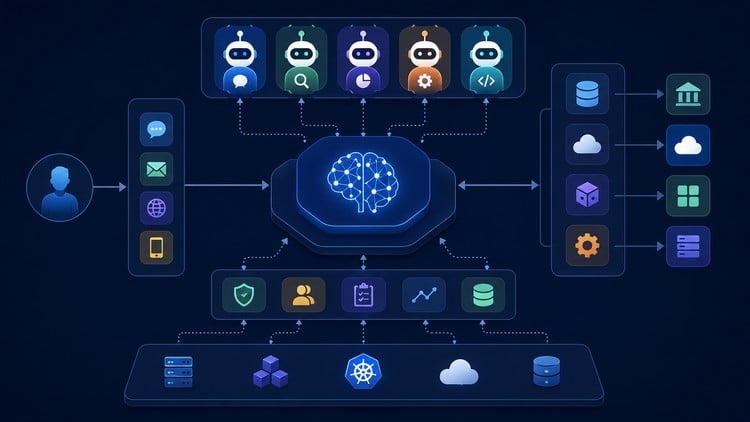
Architect production AI agents: patterns, memory, multi-agent, HITL & evals — hands-on with LangGraph
What You Will Learn:
- Choose deliberately between workflows, single agents, and multi-agent systems
- Apply ReAct, plan-and-execute, and reflection patterns — and know when each fits
- Design typed tool contracts and integrate enterprise systems via MCP
- Architect short-term session state and long-term memory with deliberate forgetting
- Decompose monolithic super-agents into orchestrator/worker topologies and weigh the tradeoffs
- Design human-in-the-loop approval gates, autonomy tiers, and audit trails
- Build the Agent Development Lifecycle: evals, tracing, versioning, CI gates
- Produce a reference architecture and ADR set for an agent platform
Moving Beyond the Hype: A Practitioner’s Take on Agentic Architecture
Let’s be honest: the AI space is currently flooded with “hello world” tutorials that show you how to build a basic chatbot in five minutes. But if you’ve tried to move those prototypes into a production environment, you know exactly where the wheels fall off. Brittle prompts, hallucinating workflows, and the “black box” nature of agentic reasoning make enterprise deployment a nightmare. This course, Agentic Architecture: Enterprise AI Agent Systems Design, is the first curriculum I’ve encountered that stops treating agents like magic tricks and starts treating them like distributed systems.
The real value here isn’t just learning a specific library; it’s the shift from a “prompt engineering” mindset to an “architectural” mindset. We are moving away from linear RAG (Retrieval-Augmented Generation) and into complex, stateful, and cyclic systems. This course addresses the elephant in the room: how do you maintain governance, observability, and predictability when your software is non-deterministic? It bridges the gap between a weekend hobbyist and a professional AI Architect by focusing on the “boring” parts of AI—the infrastructure, the memory management, and the decision logs—that actually make a system viable for a Fortune 500 company.
Prerequisites for Success
This isn’t a beginner to advanced bootcamp for someone who hasn’t written a line of code. To get the most out of the hands-on labs, you need a solid foundation. You should be comfortable with Python (specifically asynchronous programming) and have a working knowledge of how LLMs function at a high level. If you’ve never used a Vector Database or don’t know what a JSON schema is, you’ll likely struggle. This is designed for software engineers, data scientists, and solution architects who are ready to build job-ready skills in the emerging agentic layer of the tech stack.
Industry-Standard Tools & Core Skills
The course leans heavily into LangGraph, which is quickly becoming the industry-standard tool for building complex, stateful multi-agent systems. Unlike simpler frameworks, it allows for the cyclic logic required for true “reflection” and “error correction” patterns. You’ll also dive deep into:
- Model Context Protocol (MCP): Learning how to standardize tool use across different enterprise systems.
- State Management: Designing short-term session persistence and long-term memory with “deliberate forgetting” to manage token costs and privacy.
- Orchestration Patterns: Mastering the difference between a simple ReAct loop and a sophisticated orchestrator-worker topology.
- Architectural Decision Records (ADRs): Learning how to document *why* you chose a specific agent pattern over a deterministic workflow.
Career Benefits & Job Roles
The demand for AI Engineers and Enterprise Architects who actually understand agentic flows is skyrocketing. Completing this course and its real-world projects positions you for significant career growth. We are seeing a shift where companies no longer want “AI generalists”; they want specialists who can design autonomous agents that don’t go rogue. Whether you are aiming for a promotion to a Lead Architect role or looking to pivot into AI consulting, the hands-on labs and the resulting portfolio of reference architectures provide a level of certification prep that proves you can handle production-grade complexity. You’ll be ready for roles like AI Product Architect, Senior Machine Learning Engineer, or Enterprise AI Strategist.
Why This Course Stands Out (The Pros)
- Pragmatism Over Hype: The course is refreshingly honest about when *not* to use an agent. It teaches you to weigh the trade-offs between a rigid, reliable workflow and a flexible, high-latency multi-agent system.
- Focus on Traceability: The section on evals and tracing is worth the price of admission alone. Building a system is easy; proving that it’s getting better over time through CI gates and automated evaluation is what separates the pros from the amateurs.
- The ADR Framework: You don’t just build code; you produce a reference architecture. This teaches you how to communicate your technical choices to stakeholders, a vital skill for career growth in senior leadership.
The One Catch (The Cons)
The only real downside is the velocity of the ecosystem. Because it focuses on cutting-edge tools like LangGraph and MCP, some of the specific syntax in the hands-on labs might feel slightly outdated within six months as these libraries iterate. However, the underlying architectural patterns—like the orchestrator-worker model and the human-in-the-loop gates—are evergreen principles that will remain relevant regardless of which framework eventually wins the “agent wars.”