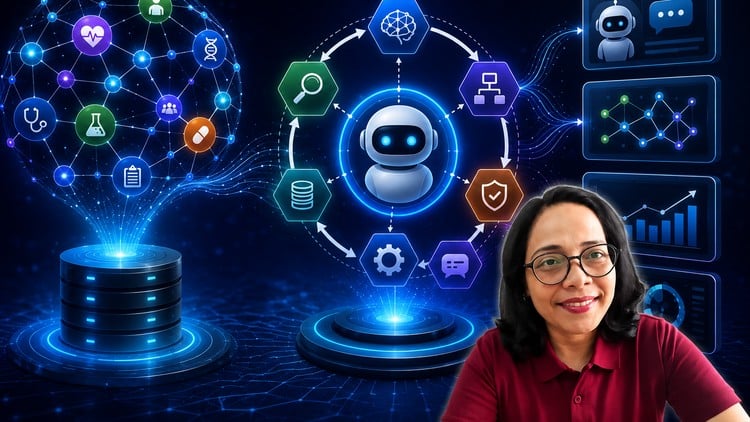
Build enterprise-grade multi-agent AI systems using LangGraph, Knowledge Graphs, RAG, Neo4j, Human-in-the-Loop, Memory,
What You Will Learn:
- Build a multi-agent AI Assistant using LangGraph with Planner, Ontology, Retrieval, Insight, and Response agents.
- Integrate Knowledge Graphs, GraphRAG, and LLMs to deliver accurate, explainable, and context-aware AI responses.
- Implement agent orchestration, memory, tool calling, and human-in-the-loop workflows for enterprise AI assistants.
- Monitor, trace, and evaluate AI agents using LangSmith to debug, optimize, and improve production-ready AI systems.
Overview
Alright, let’s talk about “From Knowledge Graph Assistant to Agentic AI with LangGraph.” My take? This isn’t just another course on stuffing data into an LLM and hoping for the best. Frankly, the AI landscape is moving beyond basic RAG, and this program nails where things are headed: truly agentic AI systems. We’re talking about building intelligent entities that can reason, plan, self-correct, and interact dynamically, not just retrieve static information. What caught my eye immediately is its focus on integrating Knowledge Graphs with LangGraph to create these sophisticated multi-agent architectures. This isn’t just about providing context; it’s about embedding structured domain knowledge and semantic understanding directly into your AI’s reasoning process. If you’re like me and you’ve seen the limitations of vanilla RAG in complex enterprise scenarios – where explainability, accuracy, and handling ambiguity are paramount – then this course offers a potent solution. It’s a deep dive into creating resilient, context-aware, and frankly, smarter AI assistants that can tackle real-world, intricate business problems.
Prerequisites
To get the most out out of this journey, you’ll want a solid foundation. This isn’t for the absolute beginner just starting their Python adventure. You’ll definitely need intermediate Python programming skills, especially familiarity with object-oriented programming concepts. A basic understanding of LLM fundamentals and how they operate is also pretty crucial – think prompt engineering basics and the general concept of embeddings. If you’ve tinkered with LangChain before, that’s a huge plus, as LangGraph builds directly on those concepts. While the course likely guides you through the specifics, having some prior exposure to database concepts, particularly graph databases like Neo4j (even if just theoretically), will flatten the initial learning curve. It’s designed to take you from a decent understanding to truly advanced implementation, so come prepared to code and think conceptually about system design.
Skills & Tools
This course arms you with a serious toolkit for building next-generation AI. You’ll get hands-on experience with:
- LangGraph: Mastering the framework for orchestrating complex, cyclical multi-agent behaviors.
- Neo4j & Knowledge Graphs: Deep integration of graph databases for structured knowledge representation, ontology development, and enhancing LLM reasoning.
- GraphRAG: Moving beyond simple RAG by leveraging the power of graph structures for more precise and contextually rich retrieval.
- LLMs: Understanding how to effectively integrate and prompt large language models within agentic workflows.
- Agent Orchestration: Designing and implementing planners, retrievers, insight generators, and response agents.
- Memory Management: Implementing various forms of memory (conversational, long-term, working) for persistent and coherent AI interactions.
- Tool Calling & Function Calling: Empowering agents to interact with external systems and APIs.
- Human-in-the-Loop (HITL): Designing workflows that allow for human oversight and intervention, crucial for enterprise-grade AI.
- LangSmith: Utilizing this industry-standard tool for robust monitoring, tracing, debugging, and evaluation of your AI agents, moving them from prototype to production.
These are all job-ready skills that directly address current pain points in AI development.
Career Benefits & Job Roles
Look, if you’re serious about your career growth in AI, this course is a strategic investment. The skills you acquire here aren’t niche; they’re becoming foundational for advanced AI development. You’ll be highly competitive for roles like:
- AI Engineer / Senior AI Engineer: Designing and implementing complex agentic systems.
- Machine Learning Engineer (MLOps focused): Specializing in deploying and managing intelligent agents in production.
- GenAI Developer: Focusing on building sophisticated generative AI applications.
- Solutions Architect (AI/Data): Crafting robust, scalable AI architectures that leverage knowledge graphs and agentic patterns.
- Data Scientist (with AI Engineering focus): Applying advanced data modeling to enhance AI reasoning.
This isn’t just about adding a line to your resume; it’s about acquiring the expertise to build solutions that truly stand out in the market, making you an invaluable asset in the evolving landscape of enterprise AI. It’s the kind of training that can propel you into leadership roles in cutting-edge AI projects.
Pros
- Bridging the Gap to True Agentic AI: This course doesn’t just scratch the surface; it dives deep into building intelligent, multi-agent systems with LangGraph. It’s a significant leap beyond basic RAG, teaching you how to engineer AI that can plan, reason, and adapt, which is crucial for complex, real-world scenarios.
- Strategic Integration of Knowledge Graphs: The emphasis on marrying LangGraph with Neo4j and Knowledge Graphs for enhanced reasoning and explainability is a game-changer. This approach provides a robust framework for delivering accurate, context-aware, and verifiable AI responses, directly addressing a major pain point in production AI.
- Production-Readiness Focus: From human-in-the-loop workflows to utilizing LangSmith for monitoring, tracing, and evaluation, the course instills best practices for building stable, debuggable, and optimizable production-grade AI systems. This focus on MLOps principles is invaluable for anyone looking to move beyond prototypes.
- Practical, Hands-On Skill Development: The promise of building a full multi-agent AI Assistant with various specialized agents means you’re not just learning theory. You’re acquiring concrete, hands-on labs experience in designing and implementing complex AI architectures, providing you with tangible real-world projects for your portfolio.
Cons
- Steep Learning Curve for Integrated Systems: While comprehensive, the integration of LangGraph, LLMs, and a graph database like Neo4j can present a significant learning curve, especially if you’re new to either agentic frameworks or graph databases. Juggling the intricacies of multiple complex systems simultaneously might be demanding for some, requiring dedication to truly master the interconnected concepts.