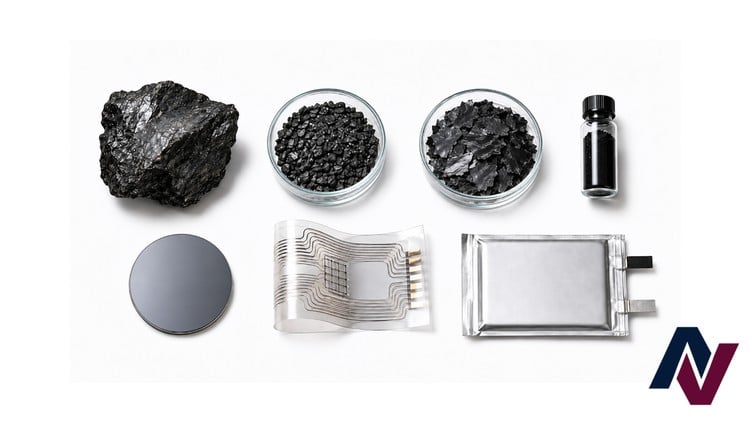
Understand nanomaterial behavior, processing, characterization, safety, quality, and industrial implementation
What You Will Learn:
- Develop a strong understanding of nanomaterials and the basic principles that explain their unique behavior, properties, and value in modern technology.
- Gain a broad understanding of the main nanomaterial categories and learn how to evaluate their suitability, advantages, limitations, and potential uses.
- Understand how nanomaterials are produced and learn how manufacturing choices influence their quality, consistency, performance, and practical feasibility.
- Learn how appropriate processing and surface treatment can improve nanomaterial stability, compatibility, usability, and performance in final products.
- Develop the ability to select suitable analytical methods and interpret results accurately to support reliable nanomaterial evaluation and decision-making.
- Understand why nanomaterials may lose stability or performance and learn how to identify causes, prevent problems, and support dependable long-term use.
- Show more
Overview: Moving Beyond the “Magic Powder” Hype
In my fifteen years working across deep-tech and materials engineering, I’ve seen “nano” used more as a marketing buzzword than a technical specification. However, the Nanomaterials Science and Technology course is a refreshing departure from that trend. Instead of just marveling at how small things can get, this course dives deep into the “why” and “how” of industrial-scale implementation. It bridges the gap between theoretical physics and the gritty reality of a manufacturing floor.
What I appreciated most was the focus on the surface-to-volume ratio and how that fundamental principle dictates everything from chemical reactivity to mechanical strength. Most courses stop at “it’s different at the nanoscale,” but this one pushes you to understand the thermodynamics behind why these materials aggregate and how to stop it. It’s essentially a certification prep powerhouse for anyone looking to enter the semiconductor, aerospace, or biotech sectors. It treats nanomaterials not as magic powders, but as volatile, high-performance components that require precision handling. If you’re looking for job-ready skills that translate to a cleanroom environment, this is where you start.
Prerequisites: What You Actually Need to Know
Don’t let the “Science” in the title scare you off, but don’t walk in blind either. While the course is marketed as a beginner to advanced journey, you’ll struggle if you don’t have a foundational grasp of general chemistry and basic Newtonian physics. You don’t need a PhD, but a comfort level with molecular structures and the periodic table is non-negotiable. If you’ve spent any time in a lab or have a background in mechanical or chemical engineering, you’ll find the learning curve manageable. The instructors do a solid job of explaining quantum confinement, but having a “tech-adjacent” mindset will definitely speed up your progress through the more math-heavy modules.
Skills & Tools: The Industrial Toolkit
The curriculum is packed with exposure to industry-standard tools that are essential for modern R&D. You aren’t just reading papers; you’re learning the logic behind complex characterization techniques. Key skills covered include:
- Microscopy & Imaging: Deep dives into SEM (Scanning Electron Microscopy) and TEM (Transmission Electron Microscopy) for structural analysis.
- Spectroscopy: Mastering EDX (Energy Dispersive X-ray) for elemental composition and DLS for particle size distribution.
- Manufacturing Logic: Distinguishing between “Top-Down” lithography and “Bottom-Up” self-assembly, and knowing when to use each based on cost-efficiency.
- Surface Functionalization: Learning how to use ligands and surfactants to ensure nanomaterial stability and prevent unwanted oxidation.
- Quality Control: Implementing real-world projects centered around batch-to-batch consistency and purity standards.
Career Benefits & Job Roles
Investing time in this course is a massive catalyst for career growth. We are currently seeing a “materials gold rush” in industries like green energy (solid-state batteries) and personalized medicine. By gaining a nanotechnology certification, you position yourself as a specialized asset in a crowded market. The focus on career-ready skills makes you a prime candidate for roles such as:
- Materials Scientist: Developing next-gen composites for aerospace.
- Process Engineer: Scaling up the production of carbon nanotubes or graphene.
- Quality Assurance (QA) Specialist: Ensuring nanomaterial safety and compliance with international environmental standards.
- Product Developer: Incorporating quantum dots or silver nanoparticles into consumer electronics and healthcare products.
Pros: Why This Course Stands Out
- Industrial Realism: It doesn’t ignore the “ugly” side of nano—like the high cost of production and the difficulty of keeping materials from degrading. This honesty is rare and valuable.
- Comprehensive Characterization: The module on analytical methods is gold. Knowing how to interpret a Zeta potential report is a high-demand skill that most general engineering degrees overlook.
- Safety First: The emphasis on nanotoxicity and environmental impact is essential. In today’s regulatory climate, understanding the safety profile of what you’re building is just as important as the building itself.
Cons: The Honest Take
The only real drawback is the lack of physical hands-on labs. While the virtual simulations are top-tier and do a great job of mimicking the interface of industry-standard tools, there is a specific tactile “stress” to working with real nanomaterials—like dealing with static electricity or accidental contamination—that a screen simply cannot replicate. You’ll understand the theory perfectly, but you’ll still need a bit of “bench time” in a real facility to feel 100% confident.