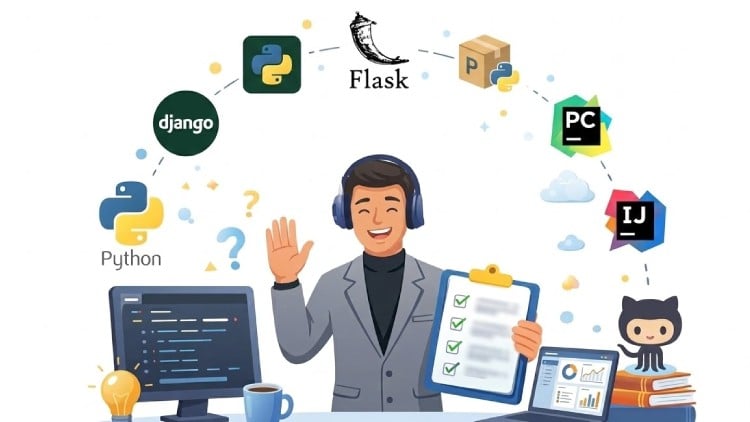
Python Developer Interview Questions and Answers | Practice Test Exam | Freshers to Experienced | Detailed Explanation
What You Will Learn:
- Master core Python concepts for technical interviews
- Solve 1400+ MCQs with detailed explanations
- Strengthen skills in OOP, data structures, and functions
- Gain confidence to clear coding rounds and system design interviews
An Honest Deep Dive into the 1400+ Python Interview Practice Test
I’ve sat on both sides of the interview desk for over a decade, and if there’s one thing I’ve learned, it’s that being a great coder doesn’t always make you a great interviewee. Technical interviews are a different beast entirely—they test your ability to recall Pythonic nuances under pressure and explain the “why” behind the “how.” When I first saw the 1400+ Python Developer Interview Questions Practice Test, my first thought was: “Is this overkill?” But after digging through the modules, I realized that in a market saturated with “junior” developers, this kind of exhaustive certification prep is exactly what separates the serious candidates from the rest.
This isn’t your typical “what is a variable” quiz. It feels more like a mental marathon designed to find the gaps in your knowledge that you didn’t even know existed. The sheer volume of questions acts as a stress test for your brain. It covers the weird edge cases—the stuff that usually trips you up during a live coding round or a system design interview. Instead of just memorizing syntax, you’re forced to look at snippets and predict outcomes, which is the fastest way to build job-ready skills that actually stick.
What You Need Before Jumping In
Let’s be clear: this isn’t a “learn Python from scratch” course. If you don’t know the difference between a list and a tuple, you’re going to have a bad time. To get the most out of this, you should have a solid grasp of basic syntax and have spent some time working with industry-standard tools like VS Code or PyCharm. I recommend having a local environment set up so you can take the tricky questions and run them through hands-on labs of your own making. This course is for the person who has finished a few real-world projects and is now looking to turn that raw experience into a professional-grade career growth trajectory.
The Skills and Tools You’ll Actually Master
While the course is structured as a practice test, the educational value is hidden in the explanations. You aren’t just clicking buttons; you’re dissecting the core of the language. You’ll sharpen your understanding of:
- Memory Management: Understanding how Python handles garbage collection and memory allocation—vital for beginner to advanced transitions.
- Advanced OOP: Going beyond classes to understand dunder methods, inheritance patterns, and mixins.
- Concurrency and Parallelism: Learning the pitfalls of the GIL (Global Interpreter Lock) and when to use threading vs. multiprocessing.
- Standard Library Deep Dives: Mastering modules like itertools, collections, and functools to write more efficient, Pythonic code.
- Debugging Logic: Developing the eye of a senior dev who can spot a logic error in a 10-line snippet in seconds.
Career Benefits and the Path to Employment
The tech landscape is shifting. Companies aren’t just looking for someone who can write a script; they want someone who understands system design and can optimize code for performance. Passing these practice tests gives you more than just certification prep; it gives you the vocabulary to speak confidently during a technical screening. When a recruiter asks about decorators or generators, you won’t give a rehearsed, shallow answer. You’ll have the depth of knowledge that comes from seeing those concepts framed in a hundred different ways.
This course is a direct pipeline to roles like Senior Python Developer, Backend Engineer, or Data Engineer. In a high-stakes environment where one wrong answer can end a six-figure job opportunity, this level of preparation is essentially an insurance policy for your career.
The Pros: Why This Works
- The Explanation Quality: Most MCQ tests just tell you if you’re wrong. This one explains the logic, which turns a simple test into a hands-on labs experience for your brain.
- Volume and Variety: With 1400+ questions, you aren’t going to see the same thing twice. It covers everything from data structures to OOP and obscure library functions.
- Realistic Pressure: The format mimics the timed environments of platforms like HackerRank or LeetCode, which is crucial for building job-ready skills.
- Accessibility: It caters to a wide range, from those looking for entry-level roles to seasoned pros who need to brush up on the latest industry-standard tools and PEP standards.
The Cons: An Honest Critique
The only real downside is the format’s inherent limitation: it’s all multiple-choice. While 1400+ MCQs are incredible for theory and logic, they can’t replace the act of actually typing code into an IDE. If you use this as your only study tool without actually building real-world projects on the side, you might find yourself knowing the “theory” of a solution without having the muscle memory to implement it from scratch in a blank text editor. It’s a supplement to coding, not a replacement for it.