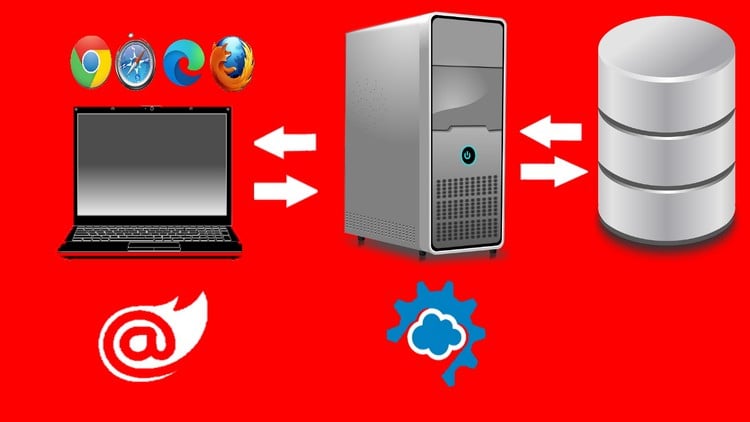
Crea aplicaciones web con Blazor WebAssembly ,construye tu propia Web API y crea tu estructura de base de datos SQL
What You Will Learn:
- Desarrollar aplicaciones web con Blazor Web Assembly, C# y SQL Server
- Crear Web API con autenticación JWT
- Crear bases de datos con SQL Server
- Tendrán las bases para crear sus propias aplicaciones de gestión
Alright, let’s talk about “Aprende Blazor WebAssembly + .Net + SQL Server.” If you’re a C# developer looking to expand your horizons beyond traditional ASP.NET MVC or just dive headfirst into modern full-stack web development within the Microsoft ecosystem, this course might just be your ticket. From what I can gather, this isn’t just a basic intro to Blazor; it’s designed to give you the blueprint for building a fully functional web application, complete with a robust backend and a solid database foundation. My take? It’s exactly the kind of comprehensive training developers need to move from knowing individual components to truly understanding how they fit into a cohesive, production-ready solution.
Overview
Here’s the deal: many courses teach you Blazor, many teach you C# Web APIs, and many more cover SQL Server. What’s often missing is a coherent narrative that stitches them all together into a tangible, deployable application. This course seems to address that gap head-on. It promises to guide you through the process of creating web applications using Blazor WebAssembly for the front-end, building your own secure Web API with JWT authentication for the backend, and designing your database schema using SQL Server. It’s not just about syntax; it’s about architecture and integration, giving you a holistic view of modern .NET full-stack development. You’ll move beyond fragmented knowledge and gain the ability to deploy full-stack solutions, which is invaluable for any developer aspiring to be more than just a component builder.
Prerequisites
Let’s be real for a moment. While the course title includes “Aprende” (Learn), meaning it aims to teach, I wouldn’t recommend this as your very first programming course ever. To truly get the most out of it, you’ll want at least a foundational understanding of C#. We’re talking basic syntax, object-oriented programming concepts (classes, interfaces, inheritance), and perhaps a little experience with Visual Studio. Having a general grasp of web concepts like HTTP requests, client-server architecture, and maybe a smidgen of HTML/CSS will also significantly smooth your learning curve. If you’ve dabbled with ASP.NET Core MVC or even WinForms, you’ll find yourself much more comfortable transitioning into Blazor WebAssembly and Web API development. Don’t expect it to hold your hand through C# 101; it’s geared towards accelerating your path as an already-budding developer.
Skills & Tools
Upon completion of this course, you’ll be equipped with a powerful set of job-ready skills and proficiency in industry-standard tools. Specifically, you’ll master:
- Developing reactive and client-side web applications using Blazor WebAssembly.
- Crafting robust and scalable backend services with C# and .NET Web API.
- Implementing secure authentication mechanisms using JWT (JSON Web Tokens).
- Designing, creating, and managing relational databases with SQL Server.
- Understanding the full lifecycle of a web application, from front-end UI to backend logic and database persistence.
- Utilizing development environments like Visual Studio and database management tools such as SQL Server Management Studio (SSMS).
These are not just buzzwords; these are the core competencies hiring managers are actively seeking for modern .NET full-stack roles.
Career Benefits & Job Roles
For any developer focused on career growth within the Microsoft technology stack, this course is a strategic investment. The skills you acquire are highly marketable and directly applicable to numerous roles. You’ll be well-positioned for positions such as:
- Full-stack .NET Developer: Capable of building and maintaining both client-side and server-side components.
- Blazor Developer: Specializing in modern, interactive web UIs within the .NET ecosystem.
- Backend .NET Developer: With a strong focus on API design, implementation, and security.
- Database Developer/Administrator (Junior): With the fundamentals of SQL Server database creation and management.
The ability to build a complete application from scratch, manage authentication, and interact with a database using industry-standard tools demonstrates a comprehensive understanding that’s crucial for senior roles. While not explicitly certification prep, the foundational knowledge you gain here will certainly put you in good stead for Microsoft Certified: Azure Developer Associate or .NET-specific exams.
Pros
- True Full-Stack Integration: This isn’t a course where you learn technologies in isolation. The emphasis on connecting Blazor WebAssembly, Web API, and SQL Server into a single application is its strongest selling point. This approach yields invaluable understanding of how modern web systems interact, which is crucial for real-world projects.
- Modern and Relevant Technology: Blazor WebAssembly is quickly gaining traction as a compelling alternative for client-side web development within the .NET space. Learning it now, alongside .NET and SQL Server, positions you at the forefront of contemporary C# web development, ensuring your skills remain relevant for years to come.
- Practical, Hands-On Application: The promise of creating your own application framework implies extensive hands-on labs and practical exercises. This project-based learning is far more effective than passive consumption of lectures, cementing concepts through direct application.
- Crucial Security Implementation: Covering JWT authentication is a significant plus. Secure API design is non-negotiable in today’s development landscape, and understanding how to implement it correctly is a key differentiator for any developer.
Cons
- Pace and Depth for Absolute Beginners: While it covers fundamentals, the breadth of topics—Blazor, Web API, JWT, and SQL Server—means the pace might be quite challenging for someone with absolutely no prior programming experience or even just a very limited understanding of C#. The “aprende” (learn) in the title might set an expectation for a slower, more introductory pace than the actual content might deliver, potentially leaving true novices feeling overwhelmed. It’s more suited for those who are ready to hit the ground running with core C# concepts already in their toolkit.