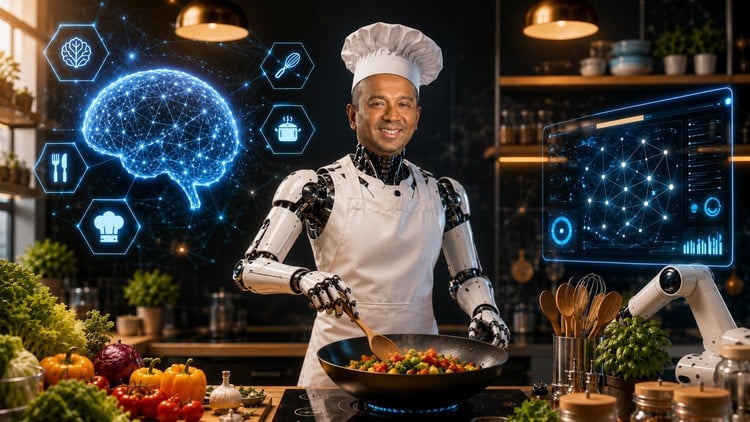
Learn AI, Agents, RAG, and Architectures Using Simple Food and Kitchen Analogies Anyone Can Understand
What You Will Learn:
- Understand the fundamentals of AI using simple kitchen and food analogies anyone can follow.
- Explain the difference between AI, software, automation, narrow AI, general AI, training, and inference.
- Understand how data, models, compute, and prompts work together to produce AI outputs.
- Learn how Large Language Models work, including tokens, context windows, prompting, and hallucinations.
- Apply prompt engineering techniques such as zero-shot prompting, few-shot prompting, system prompts, structured prompts, and step-by-step reasoning.
- Understand how AI tools, APIs, plugins, and function calling allow AI systems to take action beyond simple text generation.
- Show more
Alright, let’s talk about “Cooking Up AI: From Basics to Agentic Systems.” As someone who’s navigated the ever-shifting sands of the tech landscape for a while now, I’m always on the lookout for courses that promise to demystify the AI hype without resorting to overly technical jargon. This one, with its promise of food and kitchen analogies, immediately piqued my interest. Could they actually make concepts like RAG and agentic systems digestible for more than just seasoned AI researchers? I dove in to find out.
Overview
The core premise of “Cooking Up AI” is brilliant in its simplicity. Instead of throwing complex mathematical formulas or code at you from the get-go, it frames foundational AI concepts through relatable kitchen scenarios. Think of training an AI like teaching a chef a new recipe – you provide ingredients (data), show them how to combine them (model architecture), and they practice until they get it right. Inference is then the chef actually cooking that dish for you. This analogy-driven approach is a breath of fresh air, making abstract ideas like the difference between AI and mere automation, or the distinction between narrow and general AI, feel surprisingly intuitive. They do a solid job of breaking down how the core components – data, models, compute, and prompts – interact to generate meaningful outputs. For anyone struggling to grasp how Large Language Models (LLMs) actually function, their explanations of tokens, context windows, and the ever-present specter of hallucinations are particularly well-articulated. The course doesn’t just stop at understanding; it guides you through practical prompt engineering techniques, including zero-shot, few-shot, and the crucial system prompts that guide AI behavior. The progression to understanding how AI tools, APIs, and function calling enable AI to move beyond generating text and actually take action is a critical step for building practical, real-world applications.
Prerequisites
This is where the course truly shines in its inclusivity. Honestly? If you can follow a recipe, you can likely get through this. No prior coding experience is strictly necessary, although a basic understanding of how computers work will certainly help. If you’re aiming for a more hands-on role, a willingness to experiment with prompt interfaces and potentially dabble in some basic API interactions later on will be beneficial, but the foundational concepts are accessible to anyone with a curious mind.
Skills & Tools
By the end of “Cooking Up AI,” you’ll walk away with a solid understanding of:
- Fundamental AI and LLM concepts.
- The mechanics of training and inference.
- Effective prompt engineering strategies.
- How AI systems interact with external tools and APIs.
- The building blocks of agentic AI systems.
While the course focuses heavily on conceptual understanding and prompt engineering, it lays the groundwork for you to explore industry-standard tools and platforms as you progress. The emphasis on building job-ready skills in understanding AI architecture is paramount.
Career Benefits & Job Roles
This course is an excellent stepping stone for anyone looking to pivot into or deepen their knowledge within the AI space. It provides the foundational understanding necessary for roles such as:
- AI Prompt Engineer
- AI Product Manager
- AI Solutions Architect (entry-level understanding)
- Technical Writer specializing in AI
- Data Analyst looking to understand AI outputs
The ability to clearly articulate AI concepts and understand its practical applications is a valuable asset for career growth in nearly any tech-adjacent field.
Pros
- Exceptional Analogies: The kitchen and food analogies are genuinely brilliant. They break down complex topics into easily digestible chunks, making AI accessible to a much wider audience than typical technical courses.
- Clear Progression: The course moves logically from the absolute basics of AI to more advanced topics like agentic systems and function calling, providing a coherent learning path.
- Practical Prompting Focus: The emphasis on prompt engineering techniques is highly relevant and immediately applicable, giving learners concrete skills they can use right away.
- Demystifies Hype: It effectively cuts through the buzzwords, providing a grounded understanding of what AI can and cannot do, and how it actually works under the hood.
Cons
My one honest critique is that while the conceptual understanding is phenomenal, the direct hands-on labs are somewhat limited. For learners who thrive on immediate coding practice to solidify their understanding, they might find themselves wanting more opportunities to implement the learned concepts in a more code-centric environment. While the prompt engineering section offers practical application, the leap to building full-fledged agentic systems would benefit from more guided, code-based exercises to bridge the gap between theory and full-scale implementation.