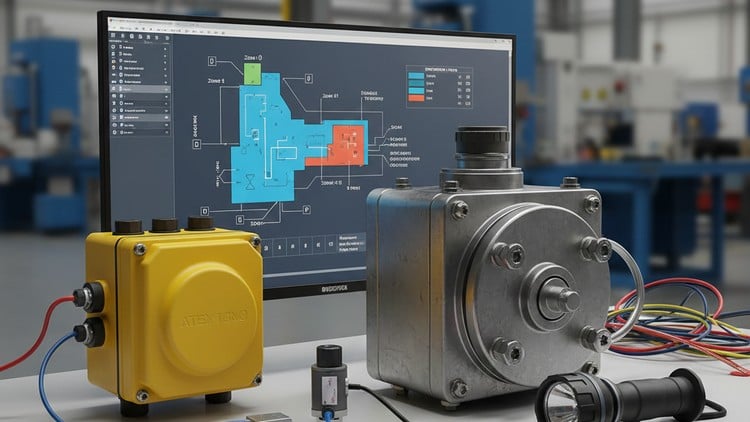
Detailed Practice Tests to Build Confidence for Explosive Atmosphere Exams
What You Will Learn:
- Understand hazardous concepts
- Interpret exam scenarios
- Analyze MCQ distractors
- Apply safety logic
Overview: Beyond the “Ex” Label
If you have spent any time in the oil and gas, pharmaceutical, or chemical processing industries, you know that the CompEx certificate isn’t just a piece of paper—it’s a license to work in environments where a single mistake can be catastrophic. I’ve seen plenty of brilliant electricians and engineers fail the certification prep phase simply because they underestimated the trickery of the Multiple Choice Questions (MCQ). This course, “CompEx Hazardous Atmosphere Practice Tests – MCQ Focus,” addresses the specific “exam-room anxiety” that plagues even seasoned veterans.
My first impression? This isn’t just a memory dump of ATEX directives. Instead, it’s a deep dive into the psychology of the exam itself. While most certification prep materials focus solely on the 60079 standards, this course teaches you how to navigate the linguistic traps set by examiners. It moves you from a beginner to advanced understanding of how to differentiate between “Ex d” flameproof protection and “Ex e” increased safety when the question is phrased in a deliberately ambiguous way. It’s about building the “exam muscle” so that when you’re sitting in that booth, the logic of hazardous area classification feels like second nature.
What I appreciated most was the focus on “Safety Logic.” In the real world, you don’t just memorize a table; you apply a mindset. This course treats the MCQ format as a diagnostic tool for your own knowledge gaps. It forces you to justify why three answers are wrong rather than just guessing why one is right. That’s the kind of career growth investment that pays off long after you’ve received your certificate.
Prerequisites
While this course is labeled as a tool to help you through the certification prep cycle, you shouldn’t jump in completely blind. To get the most out of these practice tests, you really need a baseline understanding of basic electrical theory and some familiarity with industry-standard tools like multimeters and insulation testers. Ideally, you should have already looked at the DSEAR (Dangerous Substances and Explosive Atmospheres Regulations) or the IEC 60079 series. This isn’t a “ground zero” course; it is a high-octane refinery for your existing knowledge. If you don’t know the difference between a Zone 0 and a Zone 2 area, you might want to do some preliminary reading before tackling these simulations.
Skills & Tools
The primary “tool” you’ll be wielding here is the CompEx methodology for inspection and installation. Through these practice tests, you develop a sharp eye for job-ready skills such as:
- Interpreting Certification Labels: You’ll learn to decode those long strings of alphanumeric characters on equipment nameplates without breaking a sweat.
- Distractor Analysis: A critical skill for career growth is identifying the “almost right” answer. This course trains you to spot the subtle technical errors in MCQ distractors.
- Standards Navigation: You’ll get better at mentally indexing the IECEx and ATEX frameworks, allowing for faster recall during high-pressure real-world projects.
- Glanding and Termination Logic: Even though this is an MCQ-focused course, the questions are designed to simulate the decision-making process required during hands-on labs and physical assessments.
Career Benefits & Job Roles
Holding a CompEx credential is a massive catalyst for your salary trajectory. In the current market, companies are desperate for “Ex” competent personnel who can prove they have job-ready skills. Successfully passing your exams using these practice tests positions you for several high-stakes roles:
- E&I Technician (Hazardous Areas): The bread and butter of the industry, where you’ll be maintaining industry-standard tools in volatile environments.
- Hazardous Area Inspector: A role focused on compliance and safety audits, ensuring that every piece of kit meets IECEx requirements.
- Offshore Maintenance Lead: A high-paying leadership role that requires an advanced understanding of explosive atmospheres and real-world projects.
- Technical Safety Consultant: Moving into the office-based side of things, helping firms design intrinsically safe systems from the ground up.
Pros
- Realistic Question Weighting: The tests don’t just throw random questions at you; they mimic the actual distribution of topics you’ll see on the CompEx exam, from gas groups to temperature classes.
- Focus on the “Why”: The explanations provided for the answers are excellent. They don’t just tell you that (C) is the answer; they explain why (A) and (B) would lead to a safety violation in a real-world project.
- High ROI for Certification Prep: The time saved by focusing on MCQ distractors rather than re-reading dry manuals is significant. It’s an efficient way to achieve career growth.
Cons
- Lacks Physical Simulation: While the course is excellent for the theoretical and MCQ portions of the CompEx exam, it cannot replace the hands-on labs required for the practical units (like J-units). You will still need to find a way to practice your actual glanding and wiring to be fully job-ready.