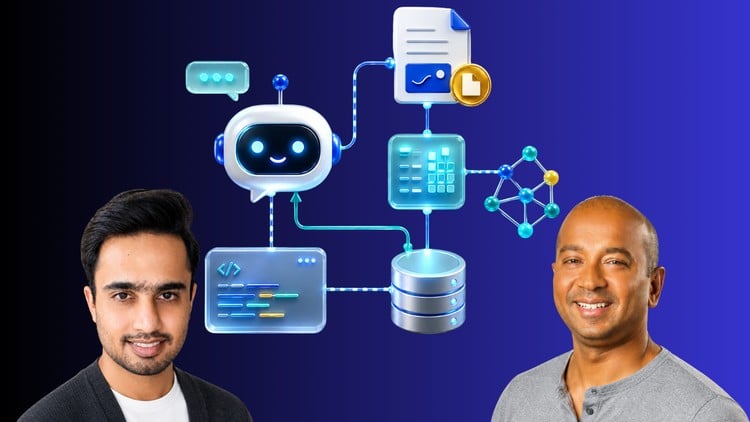
Build PDF Chatbots, Semantic Search Engines, Vector Databases, and Enterprise AI Assistants with Python
What You Will Learn:
- Understand how Retrieval-Augmented Generation, or RAG, works and when to use it instead of relying only on a large language model.
- Build Python applications that allow users to ask questions about their own documents and data.
- Extract, clean, and process content from PDF, text, Markdown, and CSV files.
- Split documents into effective chunks while preserving useful metadata such as filenames, headings, and page numbers.
- Generate text embeddings and store them in vector databases such as ChromaDB or FAISS.
- Build semantic search systems that retrieve information based on meaning instead of exact keyword matches.
- Show more
Overview
If you have spent any time in the tech space over the last year, you know that Large Language Models (LLMs) are the shiny new toy everyone wants to play with. But here is the cold, hard truth from someone who has been in the trenches: a vanilla chatbot that just “knows things” from its training data is almost useless for a serious business. Companies don’t want a bot that can write a poem about pizza; they want a bot that knows their specific 2024 quarterly earnings, their proprietary HR manuals, and their technical documentation. This is where Retrieval-Augmented Generation (RAG) comes in, and this course, ‘RAG with Python,’ is one of the most practical deep-dives I have seen for turning that concept into a real-world project.
Most tutorials online stop at a basic “Hello World” implementation. This course goes much deeper. It treats RAG not just as a buzzword, but as a data engineering challenge. The “secret sauce” of a successful AI application isn’t just the model—it’s how you clean, chunk, and retrieve your data. I appreciated that the curriculum doesn’t shy away from the “unsexy” parts of AI development, like handling messy CSV files or dealing with the limitations of semantic search. It moves you from a beginner to advanced mindset by teaching you how to build systems that actually provide reliable, hallucination-free answers.
Prerequisites
While the course advertises itself as accessible, let’s be honest: you need to have your Python fundamentals down. If you don’t know the difference between a list and a dictionary, or if you’ve never touched an API, you’re going to struggle. To get the most out of these hands-on labs, you should be comfortable with:
- Intermediate Python: You should understand functions, basic classes, and environment management (venv or Conda).
- Basic Data Handling: Familiarity with how data is structured in JSON, CSV, and Markdown.
- API Basics: You don’t need to be a pro, but knowing how to call an OpenAI or Anthropic API is a baseline requirement.
- Command Line Literacy: You’ll be installing plenty of industry-standard tools, so being comfortable with the terminal is a must.
Skills & Tools
The tech stack here is exactly what you see in modern Enterprise AI environments. You aren’t just learning theory; you are getting job-ready skills by working with:
- Vector Databases: Deep dives into ChromaDB and FAISS for high-speed similarity searches.
- Embeddings: Understanding how to turn raw text into mathematical vectors that a machine can actually “understand.”
- Document Loaders: Using Python libraries to strip useful content out of stubborn PDFs and messy text files.
- Metadata Management: This is huge. Learning how to keep track of page numbers and headings so your bot can actually cite its sources.
- Orchestration: Using Python to glue the retrieval logic and the LLM generation into one cohesive pipeline.
Career Benefits & Job Roles
We are currently seeing a massive shift in the job market. General software engineers are a dime a dozen, but AI Engineers who understand the nuances of data retrieval are seeing massive career growth. Completing a course like this is excellent certification prep for internal company roles or freelance pivots. By building a portfolio of PDF Chatbots and Semantic Search Engines, you position yourself for roles such as:
- AI Solutions Architect: Designing how a company’s data interacts with LLMs safely.
- Machine Learning Engineer: Specifically focusing on the Natural Language Processing (NLP) side of the house.
- Data Engineer: Transitioning from traditional SQL databases to modern Vector Databases.
- Enterprise AI Consultant: Helping firms bridge the gap between their private data and public AI models.
Pros
- Focus on Data Quality: Unlike other courses that ignore data cleaning, this one spends significant time on how to split documents into effective chunks. If your chunks are bad, your RAG is bad—and this course gets that.
- Real-World Projects: You aren’t just watching videos; you are building tools that you can actually deploy. The hands-on labs ensure that the code sticks in your memory.
- Tool Agnostic Logic: While it uses specific industry-standard tools, it teaches the underlying logic of RAG, so you can easily switch from ChromaDB to Pinecone or Weaviate later if needed.
Cons
- The “Bleeding Edge” Problem: The AI world moves at light speed. Some of the specific library versions used in the tutorials might feel a bit dated within six months. You will need to be comfortable checking documentation or GitHub issues to troubleshoot minor versioning conflicts as libraries like LangChain or OpenAI’s SDK update.