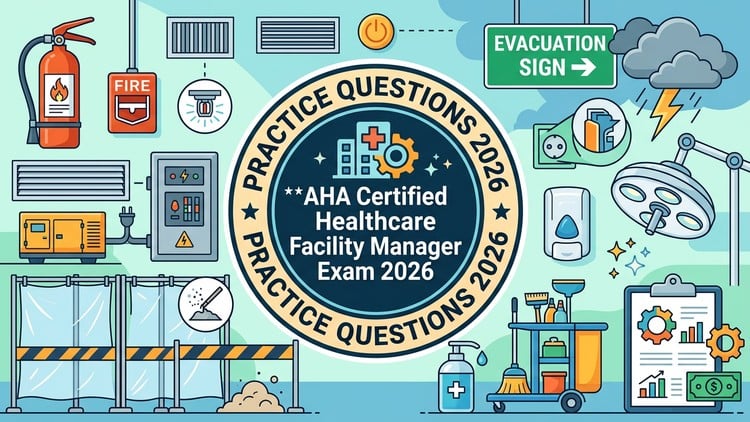
Pass your 2026 hospital facility manager test easily with realistic practice questions and simple explanations.
What You Will Learn:
- Learn how to follow strict fire safety codes to keep the hospital perfectly safe.
- Understand how to check large hospital machines like boilers and generators.
- Know how to plan a budget and control the money used for big building repairs.
- Protect sick patients from bad dust and germs during indoor construction work.
- Practice for your real 2026 exam with realistic questions and clear explanations.
Alright, let’s talk shop about the ‘AHA Certified Healthcare Facility Manager: Practice Test 2026.’ If you’re eyeing that HFM certification, you know it’s not just another badge; it’s a serious validation of expertise in one of the most critical and complex environments out there: a hospital. This isn’t a sit-back-and-learn kind of course; it’s your final gauntlet run, your proving ground before you step into the real exam arena. And frankly, it’s a pretty solid one.
Overview
Forget the fluffy intros; this practice test is all about getting you battle-ready for the AHA Certified Healthcare Facility Manager exam in 2026. What I appreciated most is that it doesn’t just rehash basic concepts. Instead, it dives deep into the kind of nuanced, scenario-based questions that truly test your mettle. This isn’t about memorizing definitions; it’s about applying your knowledge to real-world operational challenges unique to a healthcare setting. Think of it as a comprehensive diagnostic tool, helping you pinpoint exactly where your understanding is rock-solid and where you might have some lingering blind spots. It’s the quintessential certification prep material, designed to give you a genuine feel for the exam’s rigor and scope, ensuring you’re not caught off guard by unexpected phrasing or intricate compliance questions. It really helps solidify your grasp on applying `industry-standard tools` and protocols for managing complex hospital infrastructure and safety.
Prerequisites
Let’s be clear: this isn’t for the faint of heart, nor for someone just dipping their toes into facility management. The course description, while indicating a path to “pass easily,” presupposes a significant foundation. You should already possess a solid understanding of facility operations, ideally with several years of experience in a healthcare environment. Familiarity with critical building systems, basic budgeting principles, and, crucially, a general awareness of healthcare-specific regulations like NFPA codes, JCAHO standards, and OSHA guidelines is pretty much non-negotiable. This is an advanced review and practice, not a beginner to advanced teaching module. If you’re starting from scratch, you’ll want to hit the textbooks and foundational courses first.
Skills & Tools
This practice test hones a range of indispensable job-ready skills. You’ll sharpen your ability to interpret and apply stringent regulatory frameworks, particularly around fire safety and infection control during construction—an absolute must in a hospital. Expect to flex your critical thinking muscles on questions related to the diagnostics and maintenance schedules for vital hospital machinery like complex HVAC systems, emergency generators, and boilers. You’ll refine your understanding of capital planning and operational budgeting for facility upgrades and repairs, demonstrating competence in financial stewardship. Perhaps most critically, you’ll bolster your expertise in patient protection protocols during any facility work, learning how to mitigate risks from dust, noise, and pathogens. While not `hands-on labs` in the traditional sense, the simulated scenarios act as crucial real-world projects, forcing you to think like a facility manager on the front lines, utilizing conceptual `industry-standard tools` for safety and operational excellence.
Career Benefits & Job Roles
Passing the AHA HFM certification is a significant boost to your professional trajectory. It’s not just about a title; it’s about showcasing a verified, high level of competency that directly translates into tangible career growth. For hospitals, hiring an AHA-certified manager means bringing in someone who understands the unique, high-stakes environment of healthcare infrastructure. You’ll be positioned for roles such as Hospital Facility Manager, Director of Facilities, Operations Manager in a healthcare system, or even as a consultant specializing in healthcare facility compliance and safety. This certification signals to employers that you possess the advanced knowledge and strategic foresight required to manage complex building systems, ensure patient safety, and navigate the intricate regulatory landscape, ultimately contributing to a safer and more efficient healing environment.
Pros
- Authentic Exam Simulation: The questions genuinely mirror the format, difficulty, and scope of the actual 2026 AHA HFM exam. This isn’t some watered-down version; it’s designed to give you a true taste of the challenge, which is invaluable for effective certification prep.
- Clear and Concise Explanations: Each question comes with a straightforward, easy-to-understand explanation for both correct and incorrect answers. This isn’t just about getting a score; it’s a learning opportunity to truly grasp *why* an answer is right or wrong, reinforcing key concepts.
- Comprehensive Topic Coverage: It touches on all critical domains, from fire safety codes and complex machine maintenance to budgeting and infection control during construction. This holistic approach ensures you’re not overlooking any major exam section.
- Confidence Booster: Successfully navigating these realistic practice questions builds crucial confidence. Repeated exposure to exam-like scenarios significantly reduces test anxiety, allowing you to focus on demonstrating your knowledge on the big day.
Cons
- Not a Foundational Learning Resource: This is purely a practice test. It assumes you already possess a strong working knowledge of healthcare facility management. If you’re looking for introductory lessons or in-depth instructional material, you’ll need to seek out other resources first. There are no `hands-on labs` or lectures to teach new concepts here; it’s purely for validation and refinement.