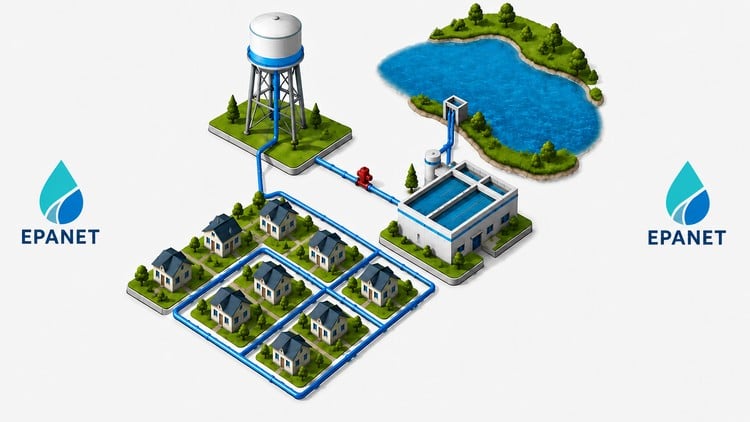
A Practical Approach to Designing and Optimizing Water Distribution Systems with EPANET
What You Will Learn:
- Introduction to Water Distribution Systems
- EPANET Interface and Functionality
- Model Building and Input Data
- Hydraulic Calculations & System Analysis
- Reporting and Results Interpretation
- Practical Project Application
- Real AutoCAD design project file included
Overview
Alright, let’s talk about ‘Water Supply System Design by EPANET.’ As someone who’s been elbow-deep in various design and analysis software over the years, I’ve seen a lot of training material come and go. This course, however, genuinely stands out as a solid resource for anyone looking to get serious about water distribution system design. It’s not just another theoretical deep dive; it’s a focused, practical journey into leveraging EPANET – an undeniable industry-standard tool – for real-world applications. Forget the robotic, dry lectures you might have encountered elsewhere. This course feels like having a seasoned engineer walk you through the process, breaking down complex hydraulic calculations into manageable, actionable steps within the software. You’re not just learning button clicks; you’re learning the ‘why’ behind the ‘what,’ which is critical for developing true job-ready skills. The emphasis on hands-on application, particularly with the inclusion of a real AutoCAD design project file, is a game-changer. It bridges the often-missing gap between software proficiency and actual project execution, making it a valuable asset for significant career growth in the water engineering domain.
Prerequisites
So, who’s this course for? While the “beginner to advanced” label is often thrown around, here’s my honest take: if you’re an absolute novice to engineering principles, particularly hydraulics, you might find the initial pace a bit quick. A basic understanding of fluid mechanics, pipe flow, and general civil engineering concepts would definitely put you in a stronger starting position. You don’t need to be an EPANET guru, obviously – that’s what the course is for – but a general comfort with technical software interfaces will help. If you’re coming from a civil engineering background, or are a student looking to bolster your practical design skills beyond textbook theory, you’re perfectly primed. No advanced coding or complex mathematical prowess is required beyond what a typical engineering degree would provide. Having AutoCAD installed and some basic familiarity with it would also be beneficial, especially to fully engage with the included design project file.
Skills & Tools
By the time you wrap this up, you’ll be pretty comfortable navigating EPANET’s interface and functionality, which is a massive win in itself. Beyond just knowing where the buttons are, you’ll gain the critical skill of model building and input data management, understanding how to translate a physical system into a digital model. More importantly, you’ll master hydraulic calculations & system analysis within EPANET, learning to interpret flow rates, pressures, and water quality parameters with confidence. This isn’t just about design; it’s about optimization and troubleshooting existing systems too. The course’s strong focus on reporting and results interpretation means you won’t just generate data, you’ll understand how to communicate it effectively. And, of course, the inclusion of a real AutoCAD design project file ensures you gain experience integrating EPANET outputs with actual engineering drawings, a crucial skill for any practicing engineer. This directly contributes to building a robust portfolio of hands-on labs and real-world projects.
Career Benefits & Job Roles
This course is a direct investment in your career growth. Proficiency in EPANET isn’t just a nice-to-have; it’s increasingly a must-have for a range of roles in the civil and environmental engineering sectors. Successfully completing this program significantly bolsters your job-ready skills for positions such as Water Resources Engineer, Hydraulic Modeler, Design Engineer, Consulting Engineer, or even Urban Planner focusing on infrastructure. For those eyeing professional engineering licensure, the practical application and understanding of water distribution systems gained here can serve as excellent certification prep, reinforcing concepts that often appear on exams. Being able to confidently design, analyze, and optimize water supply networks using an industry-standard tool like EPANET makes you a highly valuable asset to municipal agencies, private consulting firms, and utility companies alike. It’s about more than just a certificate; it’s about tangible skills that open doors to exciting and impactful projects.
Pros
- Deep Dive into EPANET: The course provides truly comprehensive coverage of EPANET, moving beyond basic tutorials to advanced modeling techniques, making you proficient in an essential industry-standard tool.
- Real-World Project Integration: The inclusion of a real AutoCAD design project file is invaluable. It forces you to apply theoretical knowledge and software skills to a practical scenario, offering genuine hands-on labs and experience with real-world projects.
- Practical, Actionable Insights: The focus is consistently on practical application and problem-solving, ensuring you develop truly job-ready skills rather than just abstract knowledge.
- Structured Learning Path: It effectively guides users from understanding fundamental concepts of water distribution to advanced hydraulic analysis, making it suitable for those looking to progress from beginner to advanced.
Cons
- While the course is excellent at teaching EPANET application, absolute beginners with no prior exposure to hydraulics or fluid mechanics might need to supplement the initial theoretical sections with external foundational material to fully grasp the underlying engineering principles before diving deep into the software’s intricacies.