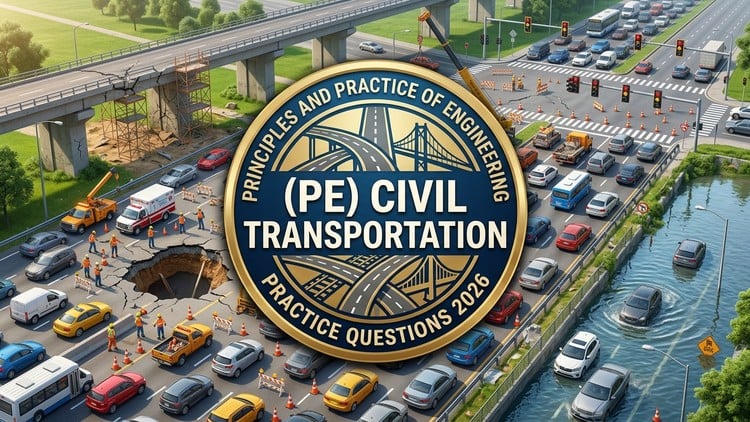
Improve Exam Readiness, Build Confidence, and Prepare for the 2026 PE Civil Transportation Exam
What You Will Learn:
- Assess your readiness for the PE Civil Transportation Exam through realistic practice tests and exam-style questions.
- Identify strengths and weak areas across transportation engineering topics and focus study efforts effectively.
- Improve time management and test-taking skills by practicing under simulated exam conditions.
- Learn key transportation engineering concepts through detailed explanations for every question.
- Build confidence before exam day by completing practice tests aligned with 2026 exam preparation needs.
Alright folks, let’s talk about the PE Civil Transportation Practice Test 2026. If you’re wading through the certification prep world, especially for the PE Civil Transportation exam, you know it’s a beast. I’ve been in the tech trenches for a while, seen my share of certification programs, and frankly, a lot of them are glorified flashcard sets. But this one? I think it’s got some real meat on its bones.
Overview
My initial impression of this practice test was that it’s not just a collection of random problems thrown together. It feels thoughtfully designed to mirror the actual 2026 PE Civil Transportation Exam in terms of difficulty, question style, and the breadth of topics covered. It’s like they’ve cracked the code on what the NCEES (National Council of Examiners for Engineering and Surveying) is actually looking for, rather than just rehashing old exam formats. The aim here is clear: get you exam-ready, and do it with a level of realism that builds genuine confidence, not just a false sense of security. It’s about dissecting your current understanding, pinpointing exactly where you need to shore up your knowledge, and then giving you the tools to do that effectively. This isn’t about skimming; it’s about deep dives into concepts, ensuring you don’t just *recognize* an answer but truly *understand* why it’s correct.
Prerequisites
Before you even think about diving into this practice test, you should have a solid foundation in the core undergraduate-level civil engineering principles. We’re talking about your standard civil engineering curriculum, with a particular emphasis on transportation engineering fundamentals. If you’re coming straight out of school or have been out of the game for a bit, revisiting your textbooks on traffic engineering, highway design, transportation planning, and related fields is a must. Think of this as a diagnostic tool; it’s designed to highlight gaps, not teach you from scratch. So, while it’s great for advanced prep, it’s not a substitute for a formal education or a comprehensive study guide that covers the basics.
Skills & Tools
This isn’t about learning new software or fancy programming languages. The skills you’ll hone here are purely intellectual and test-taking oriented. You’ll be sharpening your analytical skills to break down complex problems, improving your problem-solving abilities under pressure, and most importantly, mastering time management – a critical factor on any high-stakes exam. The “tools” are the provided practice tests themselves, acting as simulators. The real value is in the detailed explanations that accompany each question. These aren’t just answers; they’re mini-lessons that clarify the underlying concepts, reinforcing industry-standard knowledge. It’s about building the mental toolkit you need to tackle any question that comes your way.
Career Benefits & Job Roles
Let’s be blunt: passing the PE Civil exam, especially the Transportation discipline, is a significant career accelerator. It moves you from an engineer-in-training to a licensed professional engineer, opening doors to senior roles, project management positions, and the ability to stamp and approve engineering designs. This certification is often a hard requirement for many senior transportation engineer, traffic engineer, and civil project manager roles. It signals to employers that you possess a high level of competency and are ready for greater responsibility. Beyond just the title, it can lead to career growth, higher earning potential, and the opportunity to work on more impactful real-world projects. It’s a badge of competence that speaks volumes in the professional engineering world.
Pros
- Realistic Simulation: The questions and test format closely mimic the actual PE Civil Transportation exam, providing an invaluable sense of what to expect on exam day and allowing for effective exam readiness improvement.
- Targeted Study: By identifying specific weak areas, you can focus your study efforts precisely where they’re needed most, making your preparation more efficient and less overwhelming. This is crucial for maximizing your study time.
- Concept Reinforcement: The detailed explanations for every question are gold. They don’t just give you the answer; they teach you the underlying principles, solidifying your understanding of key transportation engineering concepts.
- Confidence Booster: Successfully navigating these practice tests under simulated conditions is a significant confidence builder. Knowing you can perform under pressure is half the battle won.
Cons
My one honest gripe is that while these practice tests are excellent for simulating the exam experience and reinforcing concepts, they are precisely that: practice tests. They won’t teach you the foundational knowledge from scratch. If you’re completely new to certain transportation engineering topics, you’ll need to supplement this with a more comprehensive study guide or textbook that covers the material in greater depth. Think of this as the final polish, not the initial building blocks.