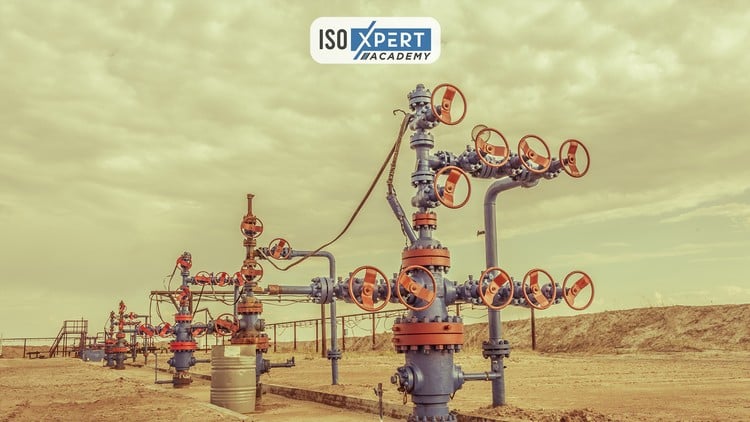
Master API 6A Standards, CRA Selection, NACE MR0175/ISO 15156 Compliance, PSL Levels & Age-Hardened Nickel Alloys.
What You Will Learn:
- Understand the complete API 6A 21st Edition specification for wellhead and Christmas tree equipment
- Master the selection and application of Corrosion Resistant Alloys (CRA) in oil and gas environments
- Apply NACE MR0175/ISO 15156 standards for sour service material qualification
- Differentiate between API 6A Material Classes (AA, BB, CC, DD, EE, FF, HH, ZZ) and their applications
- Evaluate Product Specification Levels (PSL 1–4) requirements for different service conditions
- Specify age-hardened nickel-based alloys (Alloy 718, 725, 925) for HPHT applications
- Implement proper quality control, testing, and inspection procedures for CRA components
- Analyze real-world failure cases and apply lessons learned to prevent similar incidents
- Design material solutions for high-pressure, high-temperature (HPHT) well conditions
- Ensure regulatory compliance and safety in critical oilfield equipment design
Overview: Cutting Through the HPHT Hype
If you’ve spent any time in the upstream sector, you know that wellhead integrity isn’t just about bolting things together and hoping for the best. I’ve seen my fair share of “introductory” courses that gloss over the nuances of metallurgy, but ‘API 6A CRA Mastery’ isn’t one of them. This is a deep-dive into the guts of the API 6A 21st Edition, specifically focusing on the high-stakes world of Corrosion Resistant Alloys (CRA) and sour service environments.
What I appreciated most was the refusal to treat the NACE MR0175/ISO 15156 standard as a mere suggestion. In the field, failing to meet these compliance benchmarks means catastrophic failure, and this course treats it with the gravity it deserves. We aren’t just looking at charts; we’re looking at the logic behind material qualification. Whether you are dealing with a standard PSL 1 application or a high-criticality PSL 4 offshore manifold, the course bridges the gap between theoretical metallurgy and job-ready skills that you can actually use during a design review or a vendor audit. It’s an honest, technical breakdown for those who are tired of superficial “overview” slides and want to understand why Alloy 718 is the gold standard for HPHT (High Pressure, High Temperature) completions.
Prerequisites: Who Should Buckle Up?
This isn’t a “Metallurgy 101” for someone who doesn’t know the difference between a bolt and a flange. To get the most out of this, you need a foundational understanding of mechanical engineering or at least a year or two of experience in oilfield equipment design or manufacturing. You should be familiar with basic stress-strain concepts and have a general idea of what a Christmas tree looks like in the field. If you’re looking for certification prep, having some exposure to the older API editions will actually help you appreciate the updates in the 21st Edition much more.
Skills & Tools: Your Professional Toolkit
The course equips you with a specific set of industry-standard tools and analytical frameworks. You’ll walk away being able to navigate the complex matrix of API 6A Material Classes (from AA for general service to ZZ for those “everything-is-on-fire” bespoke environments).
- Material Selection Logic: Determining when to jump from low-alloy steel to expensive nickel-based CRAs.
- Compliance Auditing: Verifying NACE MR0175 hardness and heat-treatment records.
- Technical Specification: Writing data sheets for age-hardened nickel alloys like 725 and 925.
- Quality Control: Implementing rigorous PSL-level testing protocols, including volumetric NDE and pressure testing nuances.
Career Benefits & Job Roles: The ROI of Expertise
In the current market, “Material Specialist” or “Corrosion Engineer” roles are seeing massive career growth because the easy oil is gone; everything we find now is deeper, hotter, and more sour. Mastering CRA Selection and API 6A compliance moves you from being a generalist to a specialist that major operators (the Shells and Exxons of the world) desperately need.
This course is a direct path into roles like:
- Wellhead Design Engineer: Ensuring equipment survives 20 years on the seafloor.
- QA/QC Lead: Overseeing real-world projects at manufacturing plants to prevent non-conformance.
- Materials & Corrosion Consultant: Providing high-level advice on HPHT well conditions.
- Procurement Specialist: Understanding why a quote for Alloy 925 is five times higher than 4130 steel.
The Pros: What They Got Right
- Real-World Failure Analysis: The course doesn’t just show you how to do it right; it shows you what happens when you do it wrong. Analyzing actual failures provides beginner to advanced learners with a visceral understanding of hydrogen-induced stress cracking (HISC).
- 21st Edition Updates: Many “veterans” in the industry are still working off 10-year-old knowledge. This course forces you to update your industry-standard tools to the latest regulatory requirements.
- Depth on Nickel Alloys: They don’t just mention Alloy 718; they explain the precipitation hardening process and why cooling rates during manufacturing matter. This is the “secret sauce” for HPHT success.
The Cons: The Honest Truth
If I have one gripe, it’s the sheer density of the technical data. It can feel like drinking from a firehose, especially when you get into the PSL 3G and 4 requirements. There aren’t enough “breaks” in the technical delivery, so you’ll likely need to re-watch the sections on NACE qualification twice to fully grasp the nuances of pH and H2S partial pressure calculations. It’s definitely not a “passive” watch.