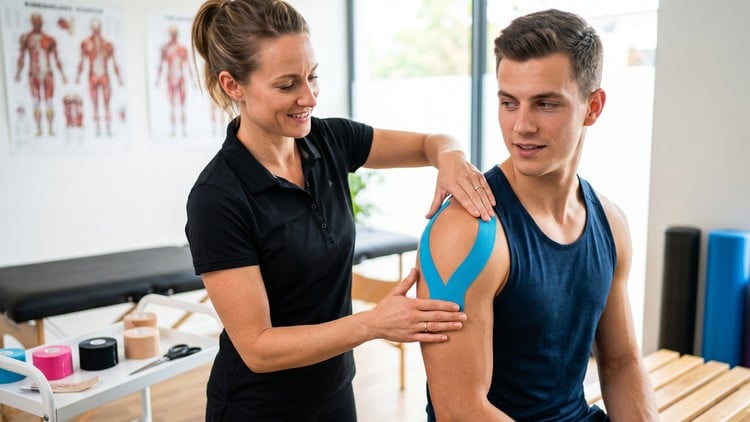
Kinesiology Taping for Pain Relief, Physiotherapy, Rehabilitation, Performance, Injury Recovery and Functional Support.
What You Will Learn:
- Understand the history, philosophy, and scientific foundations of kinesiology taping.
- Explain the material properties and mechanical characteristics of elastic therapeutic tape.
- Differentiate kinesiology tape from traditional rigid athletic tape.
- Describe how taping interacts with the skin, fascia, muscles, joints, and nervous system.
- Understand the theories of pain modulation, proprioception, and neurosensory feedback.
- Explain the proposed effects of taping on circulation, lymphatic flow, and tissue decompression.
- Show more
Overview: More Than Just “Fancy Band-Aids”
As someone who spends way too many hours hunched over a mechanical keyboard and diving into complex codebase, I’ve developed a bit of a cynical eye for “wellness” trends. When I first saw professional athletes decked out in neon tape, I assumed it was 10% placebo and 90% branding. However, a persistent rotator cuff issue forced me to look for solutions beyond standard ergonomics, leading me to the Kinesiology Taping Mastery: Science, & Clinical Application course. I didn’t want a “how-to” guide for sticking tape on my arm; I wanted to understand the underlying architecture—the physics of the skin and the engineering of the fascia.
This course blew my expectations out of the water because it treats the human body like a complex, interconnected system rather than a series of isolated parts. Instead of just showing you where the tape goes, the curriculum dives deep into the neurosensory feedback loops that make this modality actually work. It’s about more than just support; it’s about decompression and signaling. The course does a fantastic job of explaining how lifting the skin slightly can facilitate lymphatic flow and modulate pain signals sent to the brain. For a tech professional who values data and logic, seeing the mechanical breakdown of tape tension and its effect on tissue pressure was exactly what I needed to buy into the methodology. This isn’t just a surface-level tutorial; it’s a deep dive into the science-based application of therapeutic tools.
Prerequisites
While you don’t need a medical degree to get started, having a foundational grasp of human anatomy is a massive leg up. You should at least know your way around major muscle groups and joints. If you’ve ever looked at an anatomical chart or spent time in a gym, you’ll be fine. For the hands-on labs components, you’ll obviously need some industry-standard tools—specifically, high-quality kinesiology tape (don’t go for the cheap, non-elastic stuff) and a sharp pair of trauma shears or specialized fabric scissors. It’s a beginner to advanced journey, so as long as you have the patience to learn the terminology, you’re good to go.
Skills & Tools
By the end of this program, you aren’t just “taping”; you are performing clinical assessments. You’ll walk away with several job-ready skills, including:
- Clinical Assessment: Learning how to test joint range of motion before and after application to measure efficacy.
- Tension Calibration: Mastering the difference between 0%, 25%, and 75% stretch—this is the “code” that determines the physical outcome.
- Tool Proficiency: Proper handling of industry-standard tools like RockTape, KT Tape, and various skin adhesives to ensure longevity in high-performance environments.
- Real-World Projects: The course encourages you to apply these techniques to actual injury scenarios, moving from theory to hands-on labs.
Career Benefits & Job Roles
If you’re looking for career growth in the health and wellness sector, this is a major resume booster. It serves as excellent certification prep for those aiming for specialized physical therapy or athletic training credentials. For personal trainers, it adds a layer of job-ready skills that sets you apart from the “standard” coach. You’re no longer just suggesting exercises; you’re offering immediate pain relief and functional support. Common job roles that benefit from this mastery include:
- Physical Therapy Assistant: Enhancing patient recovery plans with supplemental taping techniques.
- Sports Massage Therapist: Providing structural support that lasts long after the session ends.
- Fitness Coach / Strength & Conditioning Specialist: Helping clients navigate minor injuries without sacrificing performance.
- Ergonomic Consultant: Using taping as a corrective feedback tool for office-related RSI (Repetitive Strain Injury).
Pros
- The “Why” Before the “How”: I loved the focus on the scientific foundations. Understanding the “gate control theory” of pain modulation makes you a better practitioner because you aren’t just memorizing patterns; you’re solving problems.
- Scalable Difficulty: The course moves seamlessly from beginner to advanced concepts. It starts with simple muscle support and ends with complex lymphatic drainage and ligament corrections.
- Hands-On Focus: Despite being a digital course, the emphasis on hands-on labs ensures you aren’t just watching videos. You’re expected to cut, stretch, and apply, which is vital for building muscle memory.
- Practicality: The focus on real-world projects means you can apply what you learned in Module 2 to your own workout or a client’s injury that very same afternoon.
Cons
- The Learning Curve for Anatomy: For total novices, some of the terminology around fascia and proprioception can feel a bit dense. If you aren’t prepared to do some supplemental Googling of muscle origins and insertions, you might feel a bit lost in the more clinical modules. It’s definitely more “science” than “craft,” which might be a turn-off for those wanting a quick-and-dirty guide.