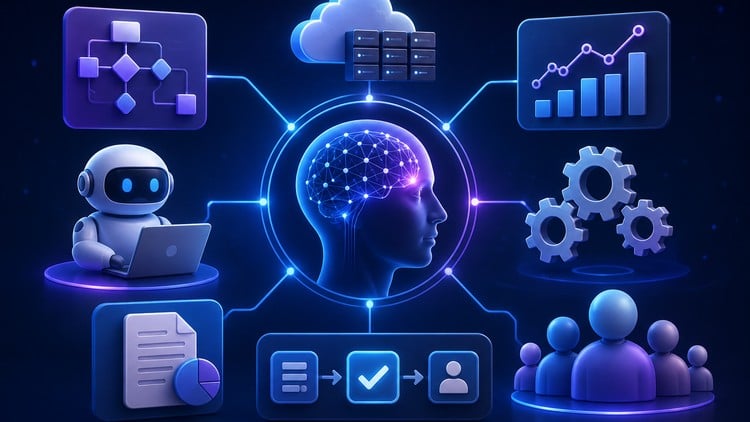
Learn to automate business processes, create AI agents, build Claude-powered workflows, and design scalable AI systems
What You Will Learn:
- Build Claude AI workflows that automate repetitive business tasks and improve productivity.
- Design and deploy AI agents for research, marketing, sales, operations, and customer support functions.
- Create reusable prompt systems, templates, and structured outputs using advanced prompt architecture techniques.
- Develop content production systems for blogs, newsletters, email campaigns, social media, and marketing assets.
- Automate research, competitor analysis, market intelligence, and business reporting using Claude AI.
- Analyze spreadsheets, KPIs, and business data to generate actionable insights and executive summaries.
- Connect Claude to external tools, data sources, and applications using MCP (Model Context Protocol) concepts.
- Build multi-step automation workflows with review loops, quality control, and human approval processes.
- Design and manage multi-agent AI teams that collaborate to complete complex business tasks.
- Apply AI automation frameworks to real-world business scenarios to increase efficiency, consistency, and scalability.
The Shift from Chatting to Building: Why Claude is Winning the Business Game
Let’s be honest: most of us started our AI journey by treating LLMs like a glorified Google search. We’d ask a question, get a response, and call it a day. But if you’re looking to move beyond the “chat” and actually build something that moves the needle for a company, you need to stop thinking about prompts and start thinking about automated workflows. I recently dove into the ‘Claude AI for Business Automation: Build AI Workflow & Agent’ course, and it’s a refreshing departure from the generic “how to write a prompt” tutorials cluttering the internet.
What sets this apart is the focus on Claude’s unique architecture. While everyone else is obsessed with GPT-4, the pros are shifting toward Claude for its 200k context window and its uncanny ability to follow complex, multi-step instructions without “hallucinating” halfway through. This course treats AI not as a toy, but as a scalable business system. We’re talking about moving from a beginner to advanced understanding of how to orchestrate multi-agent AI teams that actually talk to each other to solve problems. It’s about building job-ready skills that allow you to walk into a boardroom and explain not just what AI can say, but what it can do.
Who Should Actually Take This? (Prerequisites)
You don’t need a PhD in Computer Science or a deep background in Python to get value here, but you do need a “builder” mindset. This isn’t a passive watch; it’s a hands-on labs experience.
- Basic AI Literacy: You should know your way around a prompt, but you don’t need to be an engineer.
- Logic & Flow: If you’ve ever used “If-This-Then-That” logic or worked with a basic spreadsheet, you’re ready.
- Business Context: Having a specific problem to solve—like a messy marketing calendar or a bloated customer support queue—will make the real-world projects much more impactful.
The Toolkit: Industry-Standard Tools & Skills
The course curriculum is packed with industry-standard tools and techniques that are becoming the backbone of modern AI Operations (AIOps). You aren’t just typing into a box; you’re learning:
- Model Context Protocol (MCP): This is a game-changer. Learning how to connect Claude to external data sources and local tools is what separates the hobbyists from the professionals.
- XML Tagging for Precision: Claude loves structure. You’ll master how to use XML tags to wrap your data, ensuring the AI outputs structured data (like JSON) that other software can actually use.
- Agentic Design Patterns: You’ll learn how to build AI agents that can research, reflect, and revise their own work before you even see it.
- Automation Platforms: Integration with tools like Make.com or Zapier to create Claude-powered workflows that run on autopilot.
Career Benefits & Job Roles: The ROI of AI Automation
We are currently in a “gold rush” for AI implementation. Companies are desperate for people who can bridge the gap between “we have AI” and “AI is saving us 20 hours a week.” Completing this type of certification prep places you in a high-demand niche.
- AI Operations Manager: Overseeing the deployment of scalable AI systems across departments.
- Marketing Automation Specialist: Building content production systems that generate high-quality newsletters and social assets at scale.
- Sales Enablement Lead: Automating competitor analysis and market intelligence to give sales teams a data-driven edge.
- Solutions Architect: Designing the prompt architecture and multi-step workflows that integrate AI into existing SaaS products.
This isn’t just about career growth; it’s about future-proofing your role. As companies look to trim the fat, the person who knows how to automate repetitive business tasks becomes the most valuable person in the room.
The Pros: What Makes This Course Stand Out
- Deep Dive into MCP: Most courses ignore the Model Context Protocol, but here it’s a centerpiece. Being able to connect an LLM to your own database or local files is the “holy grail” of business AI.
- Focus on “Human-in-the-loop”: It doesn’t naively suggest you should automate everything and walk away. It teaches you how to build quality control and human approval processes into the AI workflow.
- Structured Output Mastery: Learning to force Claude to output consistent, predictable data is worth the price of admission alone. It’s the difference between a pretty poem and a business reporting tool you can actually trust.
The Cons: An Honest Reality Check
If there’s one downside, it’s the sheer speed of the industry. Because Claude and the Model Context Protocol are evolving so fast, some of the specific UI clicks in the hands-on labs might look slightly different by the time you log in. You have to be comfortable with a bit of “figure-it-out-ness” as the software updates. This isn’t a “set it and forget it” curriculum; it requires you to stay active in the community to keep your job-ready skills sharp.
Final Verdict: If you want to stop playing with chatbots and start building scalable AI systems, this course is a massive shortcut. It’s dense, opinionated, and highly practical—exactly what you need for real career growth in the age of automation.