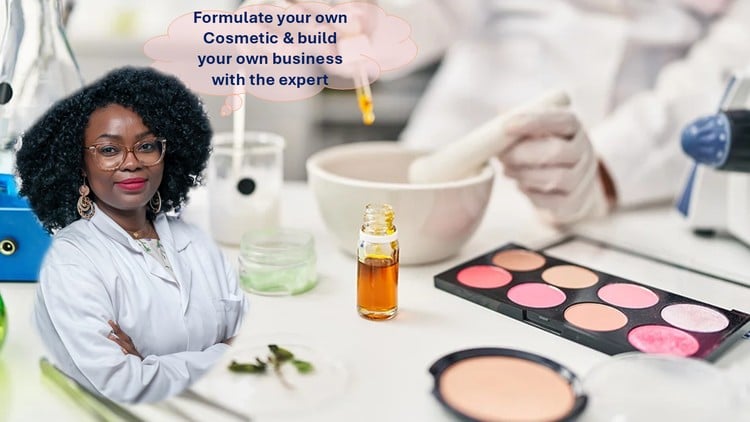
Navigate the industry from A to Z. Covering 5 technical departments, 5 industrial cosmetic formulations & case studies
What You Will Learn:
- understanding the mechanism of working of cosmetic industry from the product idea to end user
- gain deeper knowledge and understanding of the 5 technical departments and their function, R&D, QA, QC, production and supplychain
- understand the product development, the formulation Pyramid, some examples of real formulation, and stability testing
- learn about the quality and the regulation behind the product funnel, which include, raw material, production, packaging and filling
- by the end of the course you will be about to identify your strength and plan your journey into cosmetic industry with a confident
- Show more
Learning Tracks: English
Note➛ Make sure your 𝐔𝐝𝐞𝐦𝐲 cart has only this course you're going to enroll it now, Remove all other courses from the 𝐔𝐝𝐞𝐦𝐲 cart before Enrolling!
Add-On Information:
- Course Overview
- The Macro-Perspective of Personal Care: This curriculum provides a holistic lens through which to view the beauty trade, bridging the gap between theoretical chemistry and the tangible realities of the global retail marketplace.
- Synchronized Industrial Workflow: Gain a comprehensive understanding of how disjointed corporate functions harmonize to transform a raw chemical concept into a packaged solution that meets specific dermatological needs.
- Economic Drivers of Formulation: Explore the financial logic behind ingredient selection, where cost-efficiency must be balanced against high-performance efficacy to ensure a viable return on investment for stakeholders.
- Innovation Lifecycles: Trace the trajectory of trend-driven product launches, examining how seasonal shifts and viral consumer demands dictate the speed and agility of modern manufacturing cycles.
- The Intersection of Art and Science: Delve into the creative nuances of sensory profile development, where the tactile experience of a cream or serum is as vital to success as its underlying bioactive performance.
- Navigating Market Saturation: Understand the strategies used by emerging brands to carve out niches in a crowded environment through unique delivery systems and differentiated product narratives.
- Global Distribution Logic: Examine the complexities of moving temperature-sensitive and chemically active goods across international borders, accounting for differing climate zones and logistical hurdles.
- Consumer-Centric Design Thinking: Learn how to reverse-engineer products by identifying unresolved pain points in the current market and applying technical solutions to meet those specific voids.
- Requirements / Prerequisites
- Foundational Scientific Curiosity: While a formal degree in organic chemistry is not mandatory, a keen interest in how various substances interact at a molecular level will significantly enhance the learning experience.
- Business Mindset: An openness to learning about the commercial side of science, including budgeting, timeline management, and the pressures of market-entry deadlines.
- Standard Digital Literacy: Proficiency in navigating online learning platforms and a basic grasp of spreadsheet software for tracking formulation percentages and project milestones.
- Attention to Detail: A disciplined approach to following complex protocols, as the cosmetic industry relies heavily on precision to ensure both user safety and batch consistency.
- Ethical Awareness: A desire to understand the moral implications of sourcing and testing, which is becoming a cornerstone of modern consumer expectations in the beauty space.
- Skills Covered / Tools Used
- Batch Record Documentation: Master the art of meticulous record-keeping, ensuring every measurement and environmental condition is logged to facilitate future audits and troubleshooting.
- INCI Nomenclature Interpretation: Develop the ability to decode the International Nomenclature of Cosmetic Ingredients, allowing for a professional assessment of competitor products and raw material sheets.
- Scale-Up Methodology: Learn the specific techniques required to transition a successful 100g laboratory sample into a multi-ton industrial batch without losing structural integrity or consistency.
- Vendor Management and Sourcing: Tools for evaluating raw material suppliers based on purity standards, lead times, and documentation transparency (such as COAs and MSDS).
- Compliance Frameworks: Gain familiarity with the differing standards set by international bodies, ensuring that formulations are “clean” and “compliant” across diverse geographical territories.
- Microbiological Integrity Protocols: Understand the utilization of preservative systems and challenge testing to prevent contamination throughout the product’s intended shelf life.
- Visual and Olfactory Standardization: Techniques for maintaining brand uniformity through the use of colorimeters and standardized scent profiles across different production facilities.
- Risk Mitigation Strategies: Identifying potential points of failure in the manufacturing process, from raw material impurities to equipment malfunctions, and developing contingency plans.
- Benefits / Outcomes
- Enhanced Professional Credibility: Position yourself as a versatile asset who understands the “language” of multiple departments, making you an ideal candidate for cross-functional leadership roles.
- Strategic Career Mapping: Eliminate the guesswork regarding your professional future by seeing exactly how your personal talents align with the specific demands of various technical roles.
- Operational Efficiency: Ability to identify bottlenecks in the product development funnel, allowing you to streamline workflows and reduce the time-to-market for new innovations.
- Confidence in Stakeholder Communication: Empower yourself to speak authoritatively with chemists, marketers, and executives alike, ensuring that technical limitations and commercial goals are always aligned.
- Sustainability Advocacy: Gain the knowledge necessary to champion eco-friendly initiatives, from biodegradable ingredients to “green” packaging solutions, within an industrial framework.
- Intellectual Independence: Develop the critical thinking skills required to evaluate marketing “hype” versus scientific reality, protecting your brand from making unsubstantiated claims.
- Industry-Ready Portfolio: Build a mental framework of real-world case studies that can be discussed during high-level interviews to demonstrate your practical problem-solving capabilities.
- Comprehensive Product Literacy: Achieve a level of expertise where you can walk into any retail environment and immediately understand the lifecycle and technical hurdles of any product on the shelf.
- PROS
- Holistic Industry Immersion: Unlike narrow technical courses, this masterclass provides a 360-degree view that connects the laboratory bench directly to the consumer’s vanity.
- Real-World Practicality: The focus on industrial-scale formulation ensures that the knowledge gained is immediately applicable to existing manufacturing environments.
- Cross-Disciplinary Language: It equips students with the vocabulary to bridge communication gaps between disparate departments, a highly valued trait in corporate leadership.
- Safety and Ethics Focused: Prioritizes the often-overlooked aspects of regulation and quality, ensuring that your future creations are as safe as they are effective.
- CONS
- High Density of Information: The sheer breadth of the “A to Z” approach may require significant self-study and review for those who are completely new to the scientific or industrial sectors.