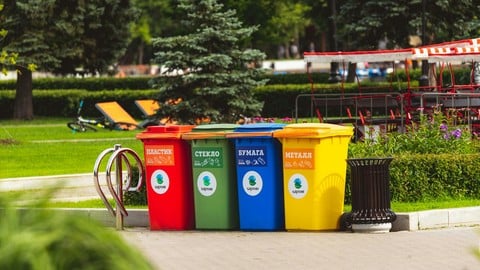
A Concise Introduction to What You Need to Know about Urban Waste Management
What You Will Learn:
- Define Types of Urban Waste
- Discover the differences between Developped and Developping counbtries in Waste Management
- Learn Waste Collection and Transportation
- Learn Waste Management Techniques
- Discover Waste-to-Energy: Potential and Challenges
Learning Tracks: English
Note➛ Make sure your 𝐔𝐝𝐞𝐦𝐲 cart has only this course you're going to enroll it now, Remove all other courses from the 𝐔𝐝𝐞𝐦𝐲 cart before Enrolling!
Add-On Information:
- Course Overview: The Global Waste Crisis
This course provides an extensive examination of the socio-economic drivers behind the escalating global waste crisis, moving beyond simple disposal to explore the systemic roots of urban consumption. We investigate the paradigm shift from a traditional linear economy—characterized by the “take-make-dispose” model—toward a more sustainable circular economy that prioritizes resource recovery at every stage of a product’s life. Students will explore the critical intersections between waste management and public health, analyzing how improper sanitation systems contribute to the spread of infectious diseases and the contamination of urban groundwater supplies. The curriculum delves into the complex legislative landscapes that govern municipal actions, including the influence of international treaties such as the Basel Convention on the transboundary movement of hazardous substances. Additionally, the course highlights the role of environmental justice, examining how waste infrastructure often disproportionately affects marginalized communities and what planners can do to ensure equitable service distribution. By looking at the political economy of trash, participants will understand the power dynamics between local governments, private contractors, and the citizens they serve. - Requirements / Prerequisites for Enrollment
To successfully engage with the course material, participants should possess a foundational understanding of basic environmental science concepts, particularly regarding ecosystems and human-environment interactions. While no advanced engineering or chemistry degree is required, a high level of digital literacy is essential for navigating the various data visualization modules and online case study repositories used throughout the program. Students should have a functional grasp of urban geography and be familiar with the basic administrative structures of municipal governments. A personal computer with a stable internet connection is necessary for accessing interactive mapping tools and simulation software. Most importantly, learners must bring a critical thinking mindset and a willingness to analyze their own local waste ecosystems, as the course encourages applying global theories to immediate, real-world surroundings. There are no specific hardware requirements beyond standard office-level computing power, making this accessible to a broad demographic of learners. - Skills Covered and Modern Tools Used
Participants will develop proficiency in Waste Stream Auditing, learning the quantitative methodologies required to categorize and measure municipal solid waste outputs accurately. The course introduces students to Geographic Information Systems (GIS) for logistical mapping, enabling them to visualize and optimize service routes for maximum fuel efficiency and coverage. We cover the application of Life Cycle Assessment (LCA) frameworks, allowing learners to evaluate the total environmental footprint of a product from raw material extraction to final disposal. Students will also practice Stakeholder Mapping, a vital soft skill used to identify and balance the competing interests of government bodies, private sector recyclers, and informal waste-picking communities. On the financial side, the course teaches Cost-Benefit Analysis specifically tailored for environmental infrastructure, helping participants understand the long-term economic viability of different management strategies. Finally, we explore the use of Internet of Things (IoT) sensors in smart bins and automated sorting technologies that are currently redefining the industry standard. - Professional Benefits and Learning Outcomes
Upon completion, students will be uniquely positioned to pursue careers in municipal planning, environmental consultancy, or corporate sustainability departments. You will gain the ability to draft comprehensive Integrated Solid Waste Management (ISWM) plans that align with international benchmarks, such as the United Nations Sustainable Development Goals (SDGs) 11 and 12. Learners will emerge with a sophisticated “green vocabulary,” enabling them to communicate effectively with engineers, policy-makers, and environmental activists alike. The course empowers you to identify hidden revenue streams within the waste sector, turning perceived liabilities into assets through innovative resource recovery strategies. You will also develop the capacity to lead public awareness campaigns, using behavioral science techniques to encourage community-wide participation in source segregation programs. Ultimately, this course bridges the gap between theoretical environmentalism and the practical, gritty reality of urban operations, making you a versatile asset in any city-focused professional role. - PROS of Taking This Course
- Interdisciplinary Approach: The curriculum masterfully blends elements of sociology, economics, and environmental science for a holistic view of the subject.
- Actionable Data: Every module is backed by the most recent data from the World Bank and the UN-Habitat, ensuring your knowledge is current.
- Global Relevance: While focused on urban centers, the principles taught are applicable to various scales, from small townships to massive megacities.
- Career Versatility: The skills learned are transferable to roles in urban planning, supply chain management, and public policy.
- Future-Proofing: As cities grow and resources become scarcer, expertise in waste management will become increasingly vital for the global economy.
- CONS of This Course
- Local Variability Challenges: Because waste management is heavily dependent on specific municipal budgets and local political climates, some high-level strategies discussed may require significant adaptation to be viable in every specific geographic context.