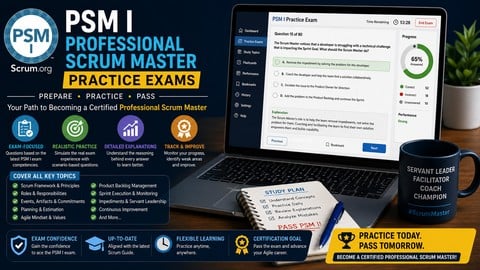
Assess your Agile knowledge and pass the official Scrum. org PSM I certification with high-quality mock tests.
What You Will Learn:
- Test your readiness for the official Scrum. org Professional Scrum Master I (PSM I) exam.
- Identify specific knowledge gaps in Scrum roles, events, artifacts, and Agile principles.
- Practice time management by taking full-length, scenario-based mock exams under pressure.
- Learn from your mistakes through in-depth explanations rooted in the official Scrum Guide.
Learning Tracks: English
Note➛ Make sure your 𝐔𝐝𝐞𝐦𝐲 cart has only this course you're going to enroll it now, Remove all other courses from the 𝐔𝐝𝐞𝐦𝐲 cart before Enrolling!
Add-On Information:
- Course Overview
- This preparatory suite offers a comprehensive deep dive into the Professional Scrum Master I mindset, transitioning away from theoretical knowledge toward practical, situational application in high-pressure environments.
- The assessment bank is meticulously designed to mirror the Scrum.org rigorous testing standards, ensuring that learners are not just memorizing facts but are internalizing the underlying philosophy of the Scrum framework.
- Each module focuses on the Empirical Process Control pillars of transparency, inspection, and adaptation, forcing students to apply these values to solve complex organizational and team-level impediments.
- The course emphasizes the 2020 Scrum Guide revisions, highlighting the shift toward a single, unified Scrum Team focused on one Product Goal, and the subtle but critical transition from “Self-Organization” to “Self-Management.”
- Questions are structured to challenge traditional project management biases, helping candidates shed “command and control” habits in favor of servant-leadership and team empowerment.
- Requirements / Prerequisites
- Candidates should possess a foundational understanding of the Software Development Life Cycle (SDLC) or have experience working within a collaborative team environment to grasp the context of the scenarios.
- A thorough, pre-existing reading of the official 2020 Scrum Guide is essential, as these practice exams are designed to validate and refine existing knowledge rather than introduce basic concepts from scratch.
- A growth mindset and the willingness to unlearn legacy Waterfall methodologies are required to successfully navigate the logic used in the Professional Scrum Master assessment.
- Access to a stable internet connection and a quiet environment is recommended to simulate the actual 60-minute examination window provided by Scrum.org for the official certification.
- Basic proficiency in the English language is necessary to distinguish between subtle nuances in phrasing, such as the difference between “must,” “should,” and “could,” which are pivotal in Scrum.org evaluations.
- Skills Covered / Tools Used
- Mastery of Servant-Leadership techniques, focusing on how a Scrum Master serves the Product Owner, the Scrum Team, and the organization at large without holding formal authority.
- Deep understanding of Facilitation and Coaching, learning how to guide events like the Sprint Retrospective and Daily Scrum to ensure they remain within the timebox and achieve their purpose.
- Application of Evidence-Based Management (EBM) principles to help teams and stakeholders measure value, innovation rate, and time-to-market through objective metrics.
- Strategic Product Backlog Management, covering the techniques for refining items, ensuring transparency of the Product Goal, and supporting the Product Owner in maximizing value.
- Advanced Conflict Resolution skills, learning how to handle internal team friction and external stakeholder interference that threatens the Sprint Goal or the team’s autonomy.
- Utilizing Burndown Charts and Kanban Boards as transparency tools to monitor progress toward the Sprint Goal and identify bottlenecks in the flow of work.
- Benefits / Outcomes
- Attain the professional confidence required to lead high-performing teams by validating your expertise against a globally recognized industry standard.
- Develop a refined vocabulary and standardized set of Scrum terms, enabling clear and effective communication with Agile practitioners and stakeholders worldwide.
- Increase your marketability and career mobility, as the PSM I certification is highly regarded by recruiters and organizations looking for verified Scrum expertise over general knowledge.
- Gain the ability to optimize team productivity by identifying and removing systemic blockers that hinder the delivery of a “Done” and potentially releasable Increment.
- Unlock access to a global community of Agile professionals, providing opportunities for continuous learning and networking beyond the scope of the initial certification.
- Improve organizational agility by learning how to champion Scrum values across different departments, fostering an environment where empirical logic drives business decisions.
- PROS
- High-Fidelity Question Bank: The mock exams provide a level of difficulty that is equal to or slightly higher than the actual PSM I, ensuring you are over-prepared for the real test.
- Instant Feedback Loops: Immediate access to results and rationale allows for rapid learning and the correction of misconceptions before they become habitual.
- Lifetime Access and Updates: The question pool is regularly updated to reflect the latest changes in the Scrum Guide and community best practices at no extra cost.
- CONS
- Assessment-Only Focus: This course is strictly a practice exam suite and does not include video-based instructional lectures or foundational theory lessons, requiring students to be self-directed in their study.