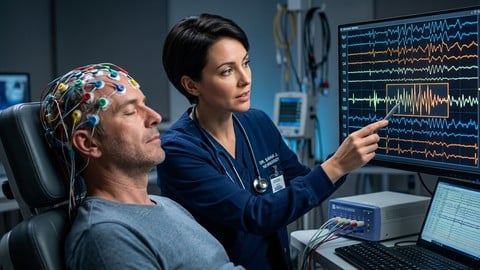
Read, Interpret & Report Adult EEG with Confidence | Seizures, Epilepsy, Encephalopathy, ICU Patterns & Neurophysiology
What You Will Learn:
- Interpret normal & abnormal adult EEG patterns with clinical confidence — from basic rhythms to complex epileptiform activity
- Identify all major seizure types on EEG — including focal, generalised, absence, and subclinical seizures — and understand their clinical significance
- Recognise EEG patterns in encephalopathy, coma, sleep disorders, and ICU settings — skills most clinicians never develop without years of hands-on exposure
- Master EEG electrode placement, montage selection, and technical troubleshooting — so you can read any EEG report or recording like an expert neurophysiologist
- Distinguish benign EEG variants from true pathology — eliminating costly misdiagnoses and unnecessary antiepileptic drug treatment
- Apply EEG findings directly to real clinical scenarios — epilepsy monitoring, neurology ward reviews, and pre-surgical workup — with structured reporting skills
- Understand the neurophysiology behind EEG waveforms — giving you the ‘why’ behind every pattern so your knowledge sticks and transfers to new cases instantly
- Build exam-ready EEG expertise for neurology boards, neurophysiology diplomas, and CLTM certification — with practice cases, quizzes, and systematic review fram
Learning Tracks: English
Add-On Information:
Note➛ Make sure your 𝐔𝐝𝐞𝐦𝐲 cart has only this course you're going to enroll it now, Remove all other courses from the 𝐔𝐝𝐞𝐦𝐲 cart before Enrolling!
“`html
-
Course Overview
- Unlock the intricate world of adult electroencephalography (EEG) through a comprehensive, practical, and clinically-oriented learning journey. This course transcends rote memorization, fostering a deep understanding of neurophysiological principles and their direct application to patient care.
- Designed for healthcare professionals seeking to elevate their diagnostic capabilities, this program offers a structured approach to mastering EEG interpretation, from fundamental principles to advanced diagnostic patterns.
- Immerse yourself in the nuances of EEG, developing the critical thinking skills necessary to confidently analyze recordings, correlate findings with clinical presentations, and contribute effectively to multidisciplinary teams.
- Gain a competitive edge in your practice by acquiring specialized knowledge in a field essential for diagnosing and managing a wide spectrum of neurological disorders.
- The course emphasizes a problem-based learning approach, integrating theoretical knowledge with practical case studies, ensuring you can translate learned concepts into real-world clinical decision-making.
- Navigate the complexities of EEG acquisition and interpretation with confidence, preparing you for a variety of clinical settings including outpatient neurology, inpatient neurology, emergency departments, and intensive care units.
-
Target Audience & Impact
- Elevate your diagnostic acumen in neurology, neurosurgery, critical care, and sleep medicine.
- Equip yourself with the essential skills to contribute meaningfully to epilepsy diagnosis, management, and surgical candidacy evaluations.
- Enhance your ability to assess patients with altered mental status, hypoxic-ischemic encephalopathy, and other critical neurological conditions.
- Prepare effectively for advanced certifications and board examinations requiring a robust understanding of EEG interpretation.
- Develop the confidence to participate in multidisciplinary rounds and present complex EEG findings with clarity and precision.
- Become an indispensable member of your clinical team, offering expert insights derived from sophisticated EEG analysis.
- This program is ideal for neurologists, neurocritical care physicians, epilepsy specialists, residents in neurology and related fields, physician assistants, nurse practitioners, and registered EEG technologists aiming for advanced interpretive skills.
-
Core Learning Pillars
- Foundational Neurophysiology: Grasp the underlying electrical activity of the brain and how it translates into observable EEG waveforms, building a robust conceptual framework.
- Systematic Interpretation Methodology: Learn a step-by-step approach to EEG analysis, ensuring no critical features are overlooked, and fostering consistent, reliable interpretations.
- Pattern Recognition & Differential Diagnosis: Develop the ability to identify key EEG signatures and differentiate between normal variants, benign abnormalities, and significant pathology.
- Clinical Correlation Expertise: Understand how to integrate EEG findings seamlessly with patient history, physical examination, and other diagnostic data for a holistic diagnostic process.
- Practical Application Scenarios: Engage with realistic case simulations and clinical vignettes that mirror the challenges faced in daily practice.
- Advanced Pattern Analysis: Delve into the recognition of subtle EEG changes that may indicate early or evolving neurological dysfunction, particularly in critically ill patients.
- Reporting & Communication Skills: Master the art of constructing clear, concise, and clinically relevant EEG reports that facilitate effective communication among healthcare providers.
-
Skills Covered / Tools Used
- Expert-level interpretation of a broad spectrum of normal and abnormal adult EEG recordings.
- Proficiency in identifying and characterizing various ictal (seizure) and interictal (between seizure) epileptiform discharges.
- Skilled recognition of diffuse and focal encephalopathic patterns, including toxic-metabolic, anoxic, infectious, and structural etiologies.
- Advanced interpretation of EEG in intensive care settings, including burst suppression, electrical status epilepticus, and subtle non-convulsive seizures.
- Competence in evaluating EEG findings related to sleep disorders, including parasomnias and REM behavior disorder.
- Understanding of artifact identification and management to ensure accurate EEG analysis.
- Familiarity with different EEG montages and their specific utility in diagnosing various conditions.
- Structured approach to EEG reporting that aligns with clinical questions and diagnostic imperatives.
- Application of neurophysiological principles to guide therapeutic interventions and patient management strategies.
- Utilizing simulated EEG platforms and high-fidelity case libraries for hands-on learning.
-
Benefits / Outcomes
- Enhanced Diagnostic Accuracy: Significantly improve your ability to accurately diagnose and characterize neurological conditions based on EEG evidence.
- Improved Patient Outcomes: Contribute to more timely and appropriate patient management, leading to better clinical outcomes and reduced morbidity.
- Increased Clinical Confidence: Develop unwavering confidence in your EEG interpretation skills, enabling you to make critical clinical decisions with certainty.
- Career Advancement: Position yourself for leadership roles and greater responsibility within your specialty.
- Reduced Diagnostic Errors: Minimize the risk of misdiagnosis and inappropriate treatment, leading to more cost-effective and patient-centered care.
- Expert-Level Knowledge Base: Build a deep and enduring understanding of EEG that goes beyond superficial recognition.
- Preparation for Certification: Gain a significant advantage in preparing for neurology board exams, neurophysiology diplomas, and other relevant professional certifications.
- Refined Problem-Solving Skills: Cultivate a sophisticated approach to complex neurological presentations where EEG plays a pivotal role.
-
Requirements / Prerequisites
- A foundational understanding of basic neuroanatomy and neurophysiology is beneficial.
- Familiarity with general medical terminology and clinical presentations of neurological disorders is recommended.
- No prior specialized EEG experience is required; the course is designed for progressive learning.
- Access to a computer or tablet with a stable internet connection for online learning modules and resources.
- A genuine interest in advancing your skills in neurodiagnostic interpretation.
- Openness to a rigorous, yet rewarding, learning experience that emphasizes critical thinking.
-
PROS
- Highly practical and clinically focused, bridging theory and application seamlessly.
- Comprehensive coverage of essential adult EEG patterns and conditions.
- Empowers learners with confidence and diagnostic accuracy.
- Excellent preparation for professional certifications and board exams.
- Fosters a deep understanding of neurophysiology, ensuring knowledge retention.
- Structured learning path facilitates mastery for both novices and those with some experience.
- Access to expert insights and a systematic approach to interpretation.
-
CONS
- Requires dedicated time and commitment to master the material effectively.
“`