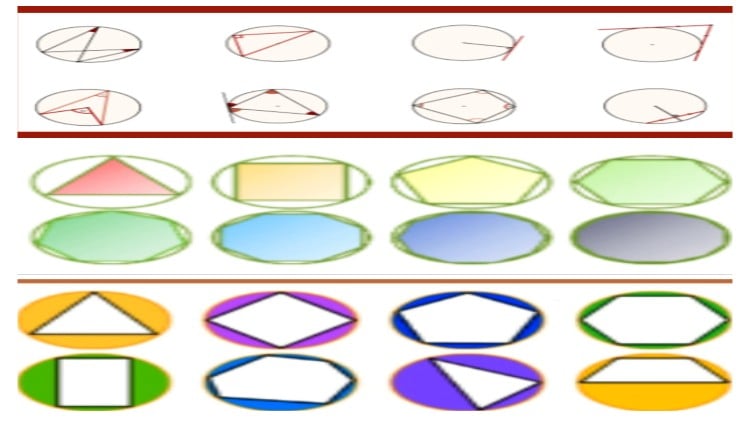
Unlocking The Secrets Of Circles: Theorems, Formulas, Problem Solving And Everyday Use.
⏱️ Length: 4.5 total hours
👥 56 students
🔄 July 2025 update
Add-On Information:
Note➛ Make sure your 𝐔𝐝𝐞𝐦𝐲 cart has only this course you're going to enroll it now, Remove all other courses from the 𝐔𝐝𝐞𝐦𝐲 cart before Enrolling!
- Course Overview
- The Historical Context of Roundness: This journey begins by tracing the evolution of geometric thought from ancient Euclidean principles to modern computational geometry, providing a narrative framework for every mathematical formula learned throughout the modules.
- Visual Intuition Building: Rather than relying on abstract numbers, the course emphasizes a “see-it-to-believe-it” approach, using dynamic illustrations to show how changing one variable affects the entire circular system in real-time.
- A Structured Path to Mastery: Each module is meticulously designed to bridge the gap between simple definitions and complex multi-step proofs, ensuring that learners experience a smooth transition from basic concepts to intricate spatial puzzles.
- Interactive Concept Mapping: Learners will engage with thematic maps that connect disparate geometric properties, revealing the hidden symmetry and mathematical harmony that governs the behavior of curved lines and intersections.
- Universal Geometric Language: Students will learn to speak the language of circles, which acts as a universal dialect across various scientific disciplines, ensuring cross-functional literacy in both academic and professional environments.
- The Philosophy of Symmetry: Beyond the math, we explore why the circle is considered the most “perfect” shape in nature, helping students appreciate the aesthetic and philosophical implications of the geometry they study.
- Requirements / Prerequisites
- Fundamental Algebraic Fluency: A working knowledge of isolating variables and solving basic linear equations is essential for successfully manipulating the algebraic expressions derived from various geometric theorems.
- Basic Coordinate Geometry: Familiarity with the Cartesian plane will assist students in understanding how circles are represented as equations (x and y coordinates) beyond just physical drawings on a page.
- Drafting Instruments: While not mandatory, access to physical tools such as a compass, a reliable straightedge, and a protractor is highly recommended for students who prefer tactile learning and manual construction.
- Mental Flexibility: A willingness to approach problems from multiple angles and the patience to work through trial-and-error scenarios are the primary non-academic requirements for success in this course.
- Digital Literacy: Comfort with navigating online learning platforms and a basic understanding of how to use web-based graphing calculators will enhance the interactive portions of the curriculum.
- Skills Covered / Tools Used
- Dynamic Geometry Software (DGS): Utilization of tools like GeoGebra or Desmos to simulate circle transformations, allowing for immediate observation of theorem consistency under varying parameters.
- Rigorous Proof-Writing Mechanics: Developing a professional vocabulary for “Given,” “To Prove,” and “Reason” statements, transforming vague observations into mathematically sound and defensible arguments.
- Advanced Pattern Identification: Training the eye to spot “hidden” triangles, perpendicularity, and parallel relationships within complex circular diagrams, a skill that is critical for excelling in advanced calculus.
- Spatial Projection: Learning to translate two-dimensional circular concepts into three-dimensional spherical applications, aiding in the transition to solid geometry and topographic mapping.
- Precision Calculation: Mastering the use of scientific calculators to handle irrational numbers like Pi and square roots, ensuring high-level accuracy in simulations that mimic real-world physics.
- Heuristic Problem Solving: Mastering the “working backwards” technique for complex geometry problems where the final answer is known but the logical path to reach it is initially obscured.
- Benefits / Outcomes
- Heightened Cognitive Rigor: The demanding nature of geometric logic enhances the brain’s ability to process non-linear information, a trait that is highly valued in fields such as data science, law, and strategic planning.
- Standardized Test Proficiency: Students will find themselves significantly better prepared for the geometry sections of international exams like the SAT, ACT, or GRE, where circle-based problems are a frequent staple.
- Bridge to Theoretical Physics: Understanding circular motion, centripetal force, and optics becomes significantly easier when the underlying geometry of arcs and curvature is second nature.
- Artistic and Design Application: Graphic designers and fine artists will gain a mathematical perspective on composition, symmetry, and the “Golden Ratio” as it pertains to circular forms and layout balance.
- Professional Credibility: Gaining a certificate in this niche area signals to potential employers or university admissions boards a dedication to the “first principles” of mathematics and structural logic.
- Algorithmic Thinking: Developing the step-by-step logic required for computer-aided design (CAD) software, where circle geometry forms the mathematical backbone of modern digital modeling and 3D printing.
- PROS
- Comprehensive 2025 Updates: This version includes the latest pedagogical techniques and digital integration strategies to keep the learning experience fresh, modern, and highly relevant.
- Efficient Time Investment: At just 4.5 hours of total content, the course distills years of traditional high school curriculum into a high-impact, concentrated learning path for busy students.
- Peer-Validated Quality: With a consistently growing student base, the course offers a community-vetted curriculum that has proven effective for diverse learning styles and educational backgrounds.
- CONS
- Narrow Subject Focus: This program is hyper-specialized on the geometry of circles; students seeking a broad overview of all Euclidean shapes like polygons or 3D polyhedra might find the scope too restrictive for a general geometry review.
Learning Tracks: English,Teaching & Academics,Math
Found It Free? Share It Fast!