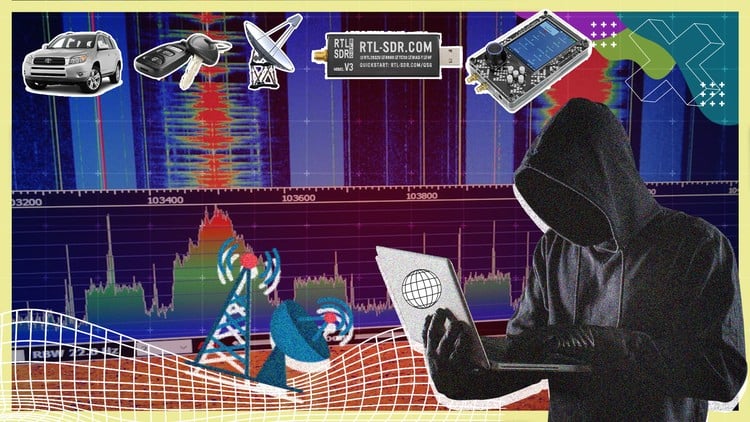
Learn Software Defined Radio (SDR) basics, GNU Radio, AM receivers, filters, and real SDR hardware, HackRF, RTL-SDR-2025
⏱️ Length: 9.0 total hours
⭐ 4.29/5 rating
👥 16,152 students
🔄 November 2025 update
Add-On Information:
Note➛ Make sure your 𝐔𝐝𝐞𝐦𝐲 cart has only this course you're going to enroll it now, Remove all other courses from the 𝐔𝐝𝐞𝐦𝐲 cart before Enrolling!
-
Course Overview
- This comprehensive course, “Mastering Software Defined Radio (SDR): GNU Radio and SDR++,” serves as your essential gateway into the dynamic and rapidly evolving field of Software Defined Radio. It’s meticulously designed to demystify complex radio frequency concepts and transform them into tangible, software-driven applications, making cutting-edge wireless technology accessible to a broad audience.
- Embark on a practical journey where you’ll not only grasp the theoretical underpinnings of radio communication but also gain hands-on proficiency with industry-standard SDR software and hardware. The curriculum emphasizes a robust learning path, guiding you from foundational signal theory through to advanced real-world implementation challenges.
- Discover the incredible flexibility and power of SDR, enabling you to explore the radio spectrum in unprecedented ways, from analyzing elusive signals to designing your own custom communication systems. The course provides a unique blend of theoretical clarity and practical application, ensuring you build a solid understanding and actionable skills in this transformative domain.
- Updated for November 2025, this course incorporates the latest best practices and tools in the SDR ecosystem, ensuring that the knowledge and techniques you acquire are current and highly relevant. With its focus on both GNU Radio for powerful signal processing and SDR++ for intuitive real-time spectrum analysis, you’ll be equipped with a versatile skillset.
- Perfect for hobbyists, aspiring RF engineers, cybersecurity enthusiasts, and anyone curious about the unseen world of radio waves, this course offers a structured and engaging learning experience. It bridges the gap between abstract radio concepts and practical, software-driven solutions, fostering a deep appreciation for modern wireless technology.
-
Requirements / Prerequisites
- A working computer (Windows, Linux, or macOS) with administrative privileges is necessary for installing essential software like GNU Radio and SDR++. While examples might lean towards Linux for optimal GNU Radio performance, guidance for other operating systems will be provided where applicable, ensuring broad accessibility.
- Familiarity with basic computer operations, including navigating file systems, installing applications, and using command-line interfaces (basic understanding optional but beneficial), will significantly smooth your learning experience. The course assumes a baseline comfort level with general computing tasks.
- No prior experience in radio frequency (RF) engineering, signal processing, or advanced programming is explicitly required. The course is structured to introduce all fundamental concepts from the ground up, making it suitable for motivated learners eager to delve into the world of SDR without a specialized background.
- While not strictly mandatory for initial software-only exercises, possessing an RTL-SDR dongle and/or a HackRF One is highly recommended to fully engage with the practical, hardware-accelerated modules and real-world signal capture opportunities. These devices unlock the course’s full experiential potential.
- An eagerness to experiment and troubleshoot is a valuable asset. The field of SDR often involves hands-on problem-solving and iterative refinement, and a curious mindset will empower you to explore beyond the course material and develop deeper expertise.
-
Skills Covered / Tools Used
- You will master the art of designing intricate signal processing flowgraphs using the visual programming paradigm of GNU Radio Companion. This includes optimizing block placement, understanding data types, and debugging complex signal paths, transforming theoretical concepts into functional software applications.
- Gain expertise in real-time spectrum analysis and waterfall display interpretation through SDR++. Learn to identify different types of radio signals, measure their characteristics, and understand common interference patterns, enhancing your practical signal reconnaissance capabilities.
- Develop advanced proficiency in configuring and fine-tuning various SDR hardware devices, including the popular RTL-SDR and the versatile HackRF One, for diverse reception and transmission (where applicable with HackRF) scenarios. Understand their capabilities and limitations in practical settings.
- Explore the intricacies of frequency translation and digital downconversion, understanding how signals are shifted in the frequency domain for efficient processing. This core skill is fundamental to building adaptable and high-performance SDR systems for various applications.
- Acquire practical insights into antenna selection, placement, and basic RF principles vital for optimal signal reception and transmission. Understand how environmental factors impact signal quality and learn strategies to mitigate common challenges, improving your system’s overall performance.
- Learn to implement custom filtering techniques directly within GNU Radio, allowing you to isolate desired signals from noise and interference. This includes understanding filter types, cutoff frequencies, and tap design for precise signal conditioning.
- Understand the architectural synergy between software components and hardware modules in an SDR system. You’ll gain an appreciation for how software algorithms directly manipulate hardware functionality to achieve specific radio tasks, providing a holistic view of the SDR ecosystem.
- Practice advanced demodulation techniques beyond simple AM, laying the groundwork for understanding more complex modulation schemes like FM and various digital modulations. This will expand your capacity to decode a wider array of radio transmissions.
-
Benefits / Outcomes
- Upon completion, you will possess the foundational expertise to confidently design, build, and deploy your own basic Software Defined Radio applications. This empowers you to move beyond passive listening into active experimentation and innovation in the RF domain.
- You will gain invaluable practical experience that is highly sought after in emerging fields such as wireless communication, cybersecurity, IoT development, and RF engineering. This course provides a tangible skill set that can enhance your professional profile and open new career pathways.
- Develop a profound understanding of the radio spectrum and signal characteristics, allowing you to interpret complex RF environments with clarity. This analytical capability is crucial for anyone working with wireless technologies, from troubleshooting to advanced research.
- You will be equipped to troubleshoot common issues encountered in SDR setups, from software configuration conflicts to hardware connectivity problems. This problem-solving prowess ensures you can maintain and optimize your SDR systems effectively.
- This course fosters an innovative mindset, enabling you to independently explore and experiment with various radio signals and protocols. You’ll be well-prepared to delve into advanced topics, contribute to open-source SDR projects, or even develop novel radio applications.
- Build a strong portfolio of practical SDR projects, showcasing your ability to apply theoretical knowledge to real-world challenges. This tangible demonstration of skill can be a significant asset for academic pursuits or professional advancement in tech-driven industries.
- Gain the confidence to independently research and integrate new SDR hardware and software tools into your setup. The principles and methodologies taught are universal, preparing you to adapt to future advancements in the fast-evolving world of Software Defined Radio.
-
PROS
- Highly Practical and Hands-On: The course strongly emphasizes practical application with real SDR hardware, ensuring learners gain actionable skills rather than just theoretical knowledge, which is crucial for mastering SDR.
- Up-to-Date Content: With a November 2025 update, the curriculum remains current with the latest advancements in SDR software and hardware, providing relevant and cutting-edge information to students.
- Beginner-Friendly with Advanced Scope: It effectively guides novices from basic concepts to advanced applications, making complex SDR topics accessible without overwhelming new learners while still challenging experienced individuals.
- Strong Student Endorsement: A high rating of 4.29/5 from over 16,000 students signifies a well-regarded and effective learning experience, indicating quality and student satisfaction.
- Efficient Learning Curve: At just 9.0 total hours, the course is concisely structured to deliver maximum impact in a manageable timeframe, ideal for busy individuals seeking rapid skill acquisition.
-
CONS
- Full engagement with the practical hardware components of the course may require separate purchase of SDR devices (like RTL-SDR or HackRF), which represents an additional investment beyond the course fee.
Learning Tracks: English,IT & Software,Network & Security
Found It Free? Share It Fast!