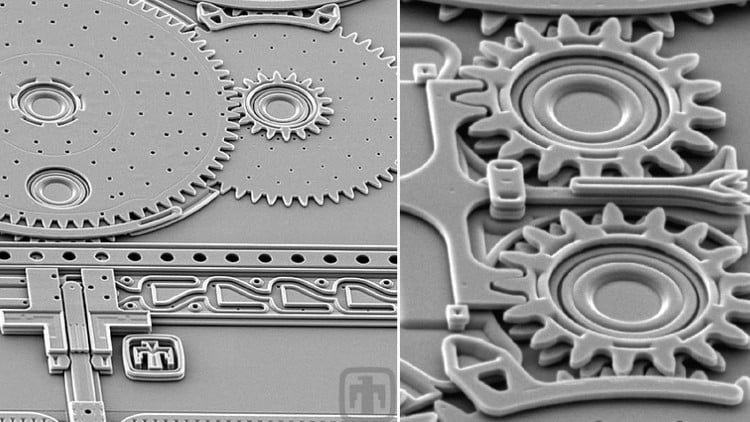
MEMS Devices; Modeling, and Design Principles
⏱️ Length: 4.2 total hours
👥 309 students
🔄 January 2026 update
Add-On Information:
Note➛ Make sure your 𝐔𝐝𝐞𝐦𝐲 cart has only this course you're going to enroll it now, Remove all other courses from the 𝐔𝐝𝐞𝐦𝐲 cart before Enrolling!
- Course Overview
- This course, “Microelectromechanical Systems II: Design Principles,” is a crucial second installment in the MEMS curriculum, focusing on the systematic and strategic approach to designing functional micro-scale devices.
- Building upon foundational MEMS concepts, this course delves into the intricate process of translating theoretical understanding into practical, deployable micro-architectures.
- Students will explore the iterative nature of MEMS design, emphasizing the interplay between physics, materials science, and electrical engineering to achieve desired performance metrics.
- The curriculum is structured to provide a comprehensive understanding of the design lifecycle, from initial concept generation and feasibility studies to detailed modeling and optimization.
- Emphasis is placed on understanding the underlying physical phenomena that govern MEMS behavior and how these can be leveraged or mitigated through intelligent design choices.
- The course addresses the challenges inherent in micro-scale fabrication and how design considerations can significantly impact manufacturability and yield.
- Key themes include the selection of appropriate materials, the geometry optimization of micro-structures, and the integration of sensing and actuation mechanisms.
- Students will gain insights into common design methodologies and best practices employed in the MEMS industry.
- The objective is to equip learners with the knowledge and skills to design novel MEMS devices and to analyze and improve existing designs.
- This course serves as a bridge to more advanced MEMS topics and research, preparing students for real-world application and innovation in the field.
- Requirements / Prerequisites
- A solid grasp of fundamental physics principles, particularly mechanics (statics, dynamics, continuum mechanics) and electromagnetism.
- Prior exposure to or equivalent knowledge of introductory Microelectromechanical Systems (MEMS I) is highly recommended, covering basic device structures, fabrication processes, and transduction principles.
- Familiarity with basic semiconductor physics and device operation.
- Proficiency in a programming or scripting language (e.g., Python, MATLAB) for simulation and data analysis is beneficial.
- Basic understanding of material science concepts related to micro-fabrication (e.g., thin films, stress, etching).
- Exposure to differential equations and their application in modeling physical systems.
- Skills Covered / Tools Used
- Systematic Design Methodology: Developing a structured approach to designing MEMS devices, moving from requirements to detailed specifications.
- Physics-Based Modeling: Applying fundamental physical principles to create accurate models of MEMS behavior, including mechanical, thermal, electrical, and fluidic domains.
- Finite Element Analysis (FEA): Utilizing FEA tools to simulate and predict the performance of complex micro-structures under various operating conditions.
- Multi-Physics Coupling: Understanding and modeling the interaction between different physical domains within a MEMS device (e.g., electro-mechanical, thermo-mechanical).
- Optimization Techniques: Employing algorithms and strategies to optimize device geometry, material selection, and operating parameters for desired performance.
- Trade-off Analysis: Evaluating and balancing competing design considerations such as performance, power consumption, fabrication cost, and reliability.
- Design for Manufacturability (DFM): Incorporating fabrication constraints and considerations into the design process to ensure successful and cost-effective manufacturing.
- Sensor and Actuator Design Principles: In-depth study of design strategies for various MEMS sensing and actuation mechanisms (e.g., capacitive, piezoelectric, thermal).
- Simulation Software: Practical experience with industry-standard MEMS simulation tools (e.g., COMSOL Multiphysics, ANSYS, Lumerical, or similar platforms for modeling and simulation).
- Mathematical Modeling: Developing and solving mathematical equations that describe the behavior of MEMS components.
- Parameter Extraction: Techniques for extracting critical performance parameters from simulations and experimental data.
- Benefits / Outcomes
- Graduates will be capable of independently designing novel MEMS devices tailored for specific applications across various industries (e.g., healthcare, automotive, consumer electronics, aerospace).
- Acquire the ability to critically analyze existing MEMS designs, identify areas for improvement, and propose optimized solutions.
- Develop a strong intuition for the behavior of micro-scale systems, enabling effective troubleshooting and innovation.
- Become proficient in using advanced simulation tools to predict device performance, reducing the need for costly and time-consuming prototyping.
- Gain expertise in understanding and mitigating common MEMS design challenges such as stiction, residual stress, and parasitic effects.
- Enhance problem-solving skills by tackling complex multi-disciplinary design problems.
- Prepare for roles in MEMS research and development, product design, and advanced engineering positions.
- Foster a mindset geared towards innovation and pushing the boundaries of micro-scale technology.
- Understand the economic implications of design choices in MEMS, contributing to cost-effective product development.
- Build a solid foundation for pursuing advanced studies or research in specialized areas of MEMS.
- PROS
- Focuses on practical design application, moving beyond theory to actionable implementation.
- Covers essential simulation and modeling techniques widely used in the industry.
- Develops critical thinking and problem-solving skills applicable to real-world engineering challenges.
- Provides a comprehensive understanding of the entire MEMS design lifecycle.
- Enhances job prospects in a rapidly growing and technologically advanced field.
- CONS
- May require significant computational resources for advanced simulations.
Learning Tracks: English,Teaching & Academics,Engineering
Found It Free? Share It Fast!