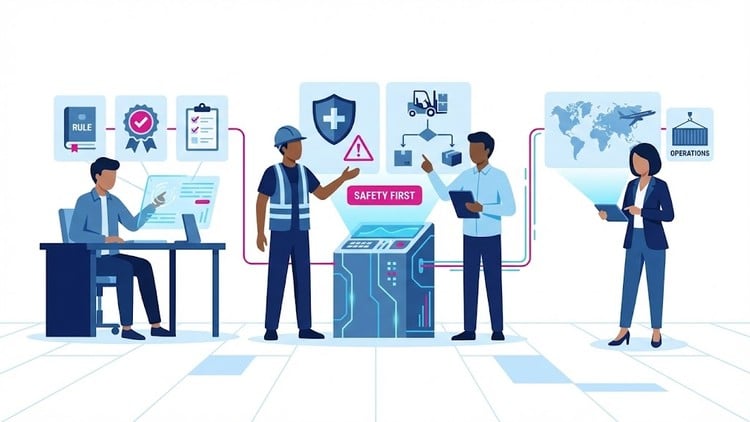
Develop practical, standards-aligned skills to handle passengers, baggage, ramp operations, and cargo safely
⭐ 5.00/5 rating
👥 435 students
🔄 August 2025 update
Add-On Information:
Note➛ Make sure your 𝐔𝐝𝐞𝐦𝐲 cart has only this course you're going to enroll it now, Remove all other courses from the 𝐔𝐝𝐞𝐦𝐲 cart before Enrolling!
- Course Overview
- This comprehensive certification program equips individuals with the essential knowledge and practical skills to excel as a Certified Handling Agent within the aviation industry.
- It delves into the critical aspects of airport operations, focusing on the meticulous and secure management of passengers, baggage, and cargo, ensuring compliance with international standards.
- Emphasis is placed on fostering a safety-first culture, enabling participants to proactively identify and mitigate potential hazards in diverse operational environments.
- The course provides a robust understanding of regulatory frameworks and industry best practices that govern ground handling operations globally.
- Participants will gain insight into the complex logistical challenges of airport environments and develop effective strategies for efficient and timely service delivery.
- This certification is designed to elevate proficiency in critical ground support functions, contributing to the overall safety and efficiency of air travel.
- The curriculum is structured to provide a foundational understanding for newcomers and a refresher for experienced professionals seeking to validate their expertise.
- It covers the lifecycle of an aircraft turn-around from a handling agent’s perspective, from passenger disembarkation to baggage loading and aircraft departure preparation.
- Understanding the interconnectedness of various ground handling departments and their role in the broader aviation ecosystem is a key component.
- The program aims to cultivate a sense of responsibility and professionalism essential for roles that directly impact passenger experience and aircraft safety.
- Requirements / Prerequisites
- A foundational understanding of basic mathematical concepts is beneficial for tasks involving weight and balance calculations.
- Familiarity with general workplace safety principles is advantageous.
- Basic literacy and numeracy skills are required for understanding documentation and communicating effectively.
- A willingness to learn and adhere to strict safety protocols and operational procedures.
- Physical ability to perform tasks associated with ground handling, as the role can be physically demanding.
- Reliability and punctuality are crucial attributes for success in this field.
- The ability to work effectively both independently and as part of a team.
- A positive attitude towards customer service and passenger interaction.
- While not strictly mandatory, prior exposure to customer-facing roles or logistics can be helpful.
- Successful completion of any preliminary background checks as required by aviation authorities or employers.
- Skills Covered / Tools Used
- Passenger Handling: Efficient check-in procedures, gate management, special assistance protocols, and conflict resolution.
- Baggage Management: Baggage screening, sorting, loading/unloading techniques, and handling of oversized or fragile items.
- Ramp Operations: Aircraft marshalling, baggage cart operation, aircraft pushback procedures, and equipment safety checks.
- Cargo Handling: Documentation review, cargo screening procedures, pallet building, and safe loading/unloading of freight.
- Safety Procedures: Hazard identification, risk assessment, emergency response protocols, personal protective equipment (PPE) usage, and FOD (Foreign Object Debris) prevention.
- Communication: Effective radio communication, inter-departmental coordination, and clear reporting.
- Regulatory Compliance: Understanding of IATA, ICAO, and local aviation authority regulations.
- Equipment Operation: Familiarization with ground support equipment (GSE) such as baggage tractors, belt loaders, and aircraft pushback tugs (under supervision/training).
- Weight and Balance Principles: Basic understanding of aircraft load distribution for safe operations.
- Documentation and Record Keeping: Accurate completion of manifests, loading instructions, and safety reports.
- Benefits / Outcomes
- Enhanced Career Prospects: Opens doors to numerous job opportunities within airlines, ground handling companies, and airport authorities.
- Globally Recognized Certification: Provides a credential valued across the international aviation industry.
- Increased Employability: Differentiates candidates with verified skills and knowledge in a competitive job market.
- Improved Safety Performance: Contributes to a safer working environment and reduces the risk of accidents and incidents.
- Operational Efficiency: Enables smoother and faster aircraft turnarounds, leading to improved punctuality.
- Customer Satisfaction: Fosters positive passenger experiences through efficient and courteous service.
- Professional Development: Enhances individual skills and knowledge base, promoting career growth.
- Adaptability: Prepares individuals to work in dynamic and demanding airport environments.
- Foundation for Specialization: Serves as a stepping stone for further specialization in areas like cargo, ramp supervision, or safety management.
- Reduced Operational Costs: Efficient handling practices can lead to fewer damages and operational errors.
- PROS
- High Demand Industry: Aviation is a continuously growing sector with consistent demand for skilled handling agents.
- Tangible Skill Development: Focuses on practical, hands-on skills directly applicable to the job.
- Safety-Centric Curriculum: Prioritizes crucial safety knowledge, a non-negotiable aspect of aviation.
- Comprehensive Coverage: Addresses key facets of ground handling, from passengers to cargo.
- Clear Career Path: Offers a well-defined entry point into the aviation industry.
- CONS
- Physically Demanding Nature: Some roles may require significant physical exertion and working in various weather conditions.
Learning Tracks: English,Business,Operations
Found It Free? Share It Fast!