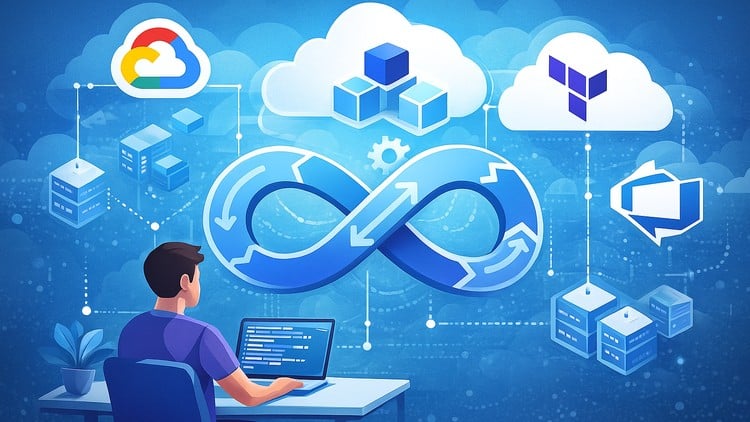
Master GCP DevOps with Terraform IaC and Azure DevOps CI/CD for end-to-end cloud automation.
⏱️ Length: 2.7 total hours
👥 49 students
Add-On Information:
Note➛ Make sure your 𝐔𝐝𝐞𝐦𝐲 cart has only this course you're going to enroll it now, Remove all other courses from the 𝐔𝐝𝐞𝐦𝐲 cart before Enrolling!
Course Overview
- This masterclass offers a unique deep dive into establishing robust cloud infrastructure and continuous delivery pipelines across two leading platforms: Google Cloud Platform (GCP) and Azure DevOps. It’s meticulously designed for professionals aiming to orchestrate complex cloud environments with precision and efficiency. You will explore the synergy between Infrastructure as Code (IaC) principles using Terraform and the powerful CI/CD capabilities of Azure DevOps, specifically tailored for GCP deployments. The curriculum is structured to guide you from foundational concepts of automated infrastructure provisioning to implementing sophisticated, production-grade deployment strategies. It emphasizes not just the “how” but also the “why” behind leveraging these technologies for scalable, repeatable, and secure cloud operations, positioning you to lead transformative projects in your organization.
- Gain a comprehensive understanding of the modern DevOps landscape, focusing on integrating cloud-native services with automated workflows. This course moves beyond theoretical knowledge to provide practical, hands-on experience in configuring and managing cloud resources programmatically. You will learn to articulate the business value of IaC and CI/CD, enabling you to design and implement resilient cloud architectures that support rapid software delivery cycles. The journey includes mastering declarative configuration management and understanding how to maintain consistency across various deployment stages, ultimately driving operational excellence.
Requirements / Prerequisites
- Foundational Cloud Knowledge: A basic familiarity with general cloud computing concepts (e.g., virtual machines, networks, databases, storage, serverless functions) is recommended. No deep expertise in GCP or Azure is strictly required, but a conceptual understanding of cloud services will be beneficial.
- Command-Line Interface (CLI) Familiarity: Experience with navigating and executing commands in a terminal or command prompt environment is advantageous, as much of the interaction with cloud tools involves CLI operations.
- Basic Understanding of Software Development Lifecycle: A general awareness of software development phases, from coding to deployment and maintenance, will help contextualize the CI/CD pipeline discussions.
- Access to Cloud Accounts: While detailed setup instructions will be provided, having access to a GCP account (a free tier or trial account is sufficient) and an Azure DevOps organization will be necessary for hands-on exercises. Some features may incur minimal costs.
- Text Editor / IDE: Proficiency in using a code editor like VS Code or similar for writing and managing configuration files (e.g., HCL for Terraform, YAML for Azure Pipelines).
- Internet Connectivity: A stable internet connection is essential for accessing cloud services, course materials, and tools.
Skills Covered / Tools Used
- GCP Ecosystem: Explore provisioning and managing various Google Cloud services beyond basic infrastructure, including networking components (VPC, subnets, firewall rules), compute instances (Compute Engine), managed Kubernetes (GKE clusters), storage solutions (Cloud Storage buckets), and serverless functions (Cloud Functions) through automated scripts.
- Terraform for Infrastructure Provisioning: Deepen your proficiency in HashiCorp Configuration Language (HCL), learn to utilize official GCP Terraform providers, manage local and remote state backends (e.g., Cloud Storage), implement reusable infrastructure modules for efficiency, and securely handle sensitive data through variable management and secrets integration. Understand resource dependencies, data sources, and output values for complex deployments.
- Azure DevOps for CI/CD Orchestration: Master the creation and management of multi-stage YAML pipelines to automate the build, test, and deployment of Terraform configurations to GCP. This includes configuring service connections to GCP, setting up agent pools, defining deployment environments, leveraging pipeline variables and parameters, and implementing approval gates for controlled releases.
- Infrastructure as Code (IaC) Principles: Apply core IaC tenets such as idempotency, immutability, version control for infrastructure, and declarative configuration management to build robust, predictable, and scalable cloud environments.
- DevOps Best Practices: Incorporate principles like shift-left testing for infrastructure, secure coding practices for IaC, environment parity, automated testing of infrastructure changes, and continuous monitoring setup (though not explicitly detailed in the ‘What you will learn’, it’s an inherent part of ‘production-ready automation’).
- Version Control Systems: Utilize Git effectively within an Azure DevOps context for managing Terraform codebases, collaborating with teams, and implementing branching strategies for infrastructure development.
- Cloud Security Integration: Understand how to apply security best practices within Terraform configurations for GCP, including IAM roles, service accounts, network security groups, and encryption at rest and in transit.
- Error Handling and Troubleshooting: Develop skills in diagnosing and resolving common issues encountered during Terraform plan/apply operations and within Azure DevOps pipeline execution for cloud deployments.
Benefits / Outcomes
- Enhanced Employability: Become a highly sought-after professional with specialized skills in two prominent cloud and DevOps platforms, opening doors to roles like Cloud Engineer, DevOps Engineer, Site Reliability Engineer, or Cloud Architect.
- Accelerated Cloud Adoption: Drive your organization’s transition to a fully automated cloud infrastructure, significantly reducing manual effort, deployment times, and operational costs associated with managing GCP resources.
- Reliable & Consistent Environments: Gain the ability to provision identical development, staging, and production environments with absolute consistency, minimizing configuration drift and environment-specific bugs.
- Reduced Human Error & Downtime: Implement automated, repeatable processes that virtually eliminate human error from infrastructure provisioning and updates, leading to more stable systems and improved uptime.
- Scalable Infrastructure Management: Develop the expertise to manage infrastructure at scale, effortlessly spinning up new environments or expanding existing ones in response to business demands.
- Cost Optimization: Learn to implement cost-effective infrastructure solutions by defining precise resource requirements and automating their lifecycle management through IaC.
- Career Advancement: Position yourself as a leader in cloud automation, capable of designing and implementing sophisticated CI/CD strategies that integrate seamlessly with Google Cloud Platform, contributing significantly to project success.
PROS
- Highly Relevant Skillset: Combines two industry-leading technologies (GCP, Terraform, Azure DevOps) to provide a comprehensive and in-demand skill set for modern cloud roles.
- Practical & Hands-On Focus: Emphasizes real-world application, enabling learners to immediately apply their knowledge to practical scenarios.
- End-to-End Automation: Covers the entire lifecycle from infrastructure definition to automated deployment, offering a complete solution perspective.
- Multi-Cloud Expertise Potential: While focused on GCP, the principles of Terraform and Azure DevOps are largely transferable to other cloud providers, broadening a learner’s potential scope.
- Structured Learning Path: The course is well-organized to build knowledge progressively, starting from core concepts and advancing to best practices.
CONS
- Extremely Short Duration: At only 2.7 total hours, the “Masterclass” title might set unrealistic expectations for the depth and breadth of topics that can be covered, potentially serving more as an introduction or quick overview rather than a comprehensive mastery course.
Learning Tracks: English,IT & Software,Other IT & Software
Found It Free? Share It Fast!