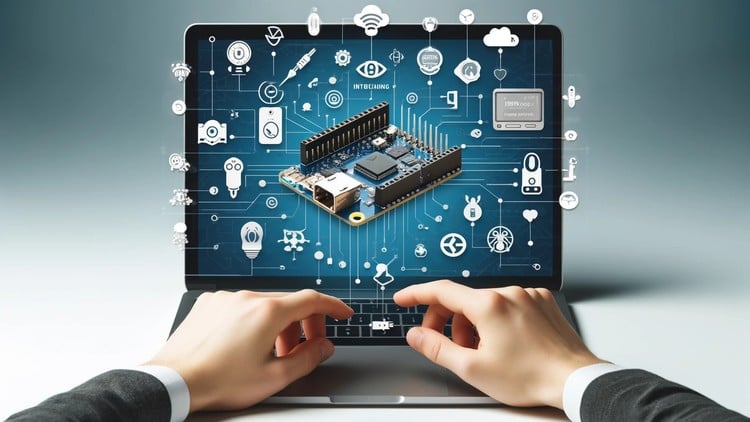
A Different IoT Power and Performance, Use ESP32 microcontroller to MAKE IoT projects to unleash your creativity
⏱️ Length: 2.6 total hours
⭐ 3.96/5 rating
👥 2,175 students
🔄 June 2025 update
Add-On Information:
Note➛ Make sure your 𝐔𝐝𝐞𝐦𝐲 cart has only this course you're going to enroll it now, Remove all other courses from the 𝐔𝐝𝐞𝐦𝐲 cart before Enrolling!
- Course Overview:
- Embark on an enlightening journey into advanced IoT project development by mastering the powerful synergy between Arduino and ESP32. This course is your definitive guide to unleashing creativity by combining the user-friendliness of Arduino with the robust networking capabilities of ESP32.
- Discover how to overcome individual microcontroller limitations by creating a hybrid system that leverages Arduino’s extensive sensor compatibility and real-time control alongside ESP32’s built-in Wi-Fi and Bluetooth for seamless internet connectivity.
- This step-by-step curriculum is crafted for practical application, guiding you through concrete examples of interfacing techniques. Learn to build web-enabled projects that intelligently blend local device control with remote monitoring and interaction.
- Explore effective architectural strategies for distributing tasks between the two microcontrollers. Delegate critical sensor reading and basic actuation to Arduino, while offloading complex network communication and web hosting to the powerful ESP32.
- Perfect for makers, hobbyists, and developers, this course demystifies the integration process, providing the knowledge and confidence to transform standalone electronic projects into sophisticated, internet-connected systems.
- Requirements / Prerequisites:
- A basic understanding of fundamental electronics components (resistors, LEDs) and familiarity with breadboard usage for assembling simple circuits.
- Working knowledge of the Arduino IDE and fundamental C/C++ programming concepts, including variables, loops, and conditional statements.
- Access to at least one Arduino development board (e.g., Uno, Nano) and one ESP32 development board (e.g., ESP32 DevKitC) for hands-on practical exercises.
- Essential hardware components such as jumper wires, a breadboard, USB cables for programming, and a computer with internet access for software and library downloads.
- Skills Covered / Tools Used:
- Microcontroller Interfacing Techniques: Master various communication protocols like UART (Serial) and I2C for reliable data exchange between Arduino and ESP32.
- ESP32 Wi-Fi Programming: Configure the ESP32 to connect to Wi-Fi networks, enabling it to function as an IoT gateway for your Arduino projects.
- Custom Web Server Development: Create lightweight web servers on the ESP32 to provide a user-friendly interface for remotely monitoring and controlling Arduino-connected devices.
- Hybrid System Architecture: Learn to design intelligent systems where tasks are optimally distributed between the two microcontrollers, enhancing performance and functionality.
- Data Flow Management: Acquire skills in securely and efficiently transmitting sensor data from Arduino to ESP32, and then onward to web interfaces or cloud services.
- Debugging Multi-Microcontroller Setups: Develop robust troubleshooting methodologies to diagnose and resolve issues in integrated hardware and software environments.
- Tools & Libraries: Utilize the Arduino IDE (configured for both platforms), various communication libraries, and common electronic components including sensors and actuators.
- Benefits / Outcomes:
- Gain expertise in building advanced IoT solutions that effectively combine the strengths of both Arduino and ESP32, capable of local control and global connectivity.
- Develop the ability to design and implement remote monitoring and control systems for various applications, from smart home automation to environmental data logging.
- Significantly broaden your understanding of embedded systems integration, opening up new possibilities for creating complex and interactive electronic projects.
- Acquire practical skills in network programming and web interfacing, making your projects accessible and controllable from anywhere with an internet connection.
- Empower yourself to innovate by leveraging powerful microcontroller combinations, transforming abstract IoT concepts into tangible, functional devices that stand out.
- PROS:
- Optimal Resource Utilization: Maximizes the potential of each microcontroller by assigning tasks suited to its strengths, leading to more efficient and capable projects.
- Cost-Effective Connectivity: A smart economic choice for adding advanced Wi-Fi/Bluetooth capabilities to existing Arduino setups without needing to re-engineer an entire project.
- Enhanced Project Scalability: Provides a flexible framework for expanding project functionality, allowing you to easily add more sensors, actuators, or network features.
- Accelerated IoT Prototyping: Speeds up the development of sophisticated IoT applications by combining the vast libraries and ease of use of Arduino with ESP32’s integrated networking.
- CONS:
- Increased Initial Setup Complexity: The process of configuring and synchronizing two distinct microcontrollers might present a steeper learning curve compared to single-board solutions for absolute beginners.
Learning Tracks: English,IT & Software,Hardware
Found It Free? Share It Fast!