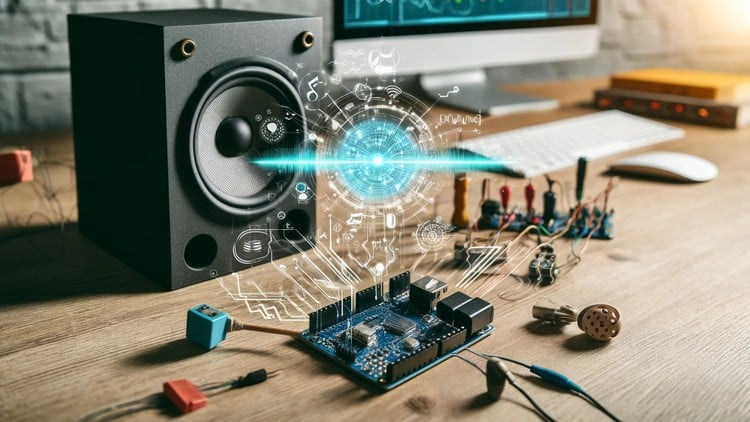
Elevate your Arduino projects with voice! Dive deep into creating an Arduino-based Text-to-Speech converter
⏱️ Length: 2.3 total hours
⭐ 3.60/5 rating
👥 4,028 students
🔄 June 2025 update
Add-On Information:
Note➛ Make sure your 𝐔𝐝𝐞𝐦𝐲 cart has only this course you're going to enroll it now, Remove all other courses from the 𝐔𝐝𝐞𝐦𝐲 cart before Enrolling!
-
Course Overview
- Embark on a journey to inject personality and interactivity into your Arduino creations with Voice of Arduino: Transform Text to Speech!
- This comprehensive 2.3-hour course, updated in June 2025, empowers you to bridge the gap between silent circuits and audible communication.
- Designed for makers of all levels, this course will guide you from understanding fundamental concepts to deploying a fully functional Text-to-Speech (TTS) system.
- Discover the magic of making your Arduino projects speak, transforming them from mere blinking lights into engaging conversational agents.
- The course boasts a solid 3.60/5 rating from over 4,028 enthusiastic students, signifying its practical value and effective teaching methodology.
- Unleash the potential of your hardware by giving it a voice, making your creations more accessible, intuitive, and captivating for users.
- This program is an ideal gateway for those new to the Arduino ecosystem, providing a tangible and exciting first project to build confidence.
- Explore how to leverage your Arduino to create responsive systems that can articulate information and react to user input through speech.
- Elevate your Arduino control capabilities beyond basic output, introducing a sophisticated and human-like communication channel.
-
Requirements / Prerequisites
- A basic understanding of electronics fundamentals is recommended, though not strictly required as core concepts will be reinforced.
- Familiarity with the Arduino IDE and its basic programming syntax is beneficial for a smoother learning experience.
- Access to an Arduino board (e.g., Arduino Uno, Nano, Mega) is essential for hands-on practical application.
- A computer capable of running the Arduino IDE and performing code uploads.
- A selection of basic electronic components such as jumper wires, a breadboard, and a speaker or audio output module.
- A USB cable to connect your Arduino board to your computer.
- Optional but highly recommended: A powered USB hub if you plan to connect multiple peripherals to your Arduino.
- An eagerness to learn and experiment with embedded systems and audio output.
-
Skills Covered / Tools Used
- Text-to-Speech (TTS) Synthesis: Gain insights into how digital text is converted into audible speech.
- Arduino Microcontroller Programming: Develop proficiency in coding Arduino for audio output and control.
- Hardware Integration: Learn to connect and interface audio modules and speakers with your Arduino.
- Command-Based Voice Control: Understand how to trigger specific voice responses using custom commands.
- Project Prototyping: Develop practical skills in building functional hardware prototypes.
- Human-Computer Interaction (HCI) Design: Explore how to create more engaging and user-friendly interactive systems.
- Troubleshooting and Debugging: Acquire skills to identify and resolve common issues in embedded audio projects.
- Software Tools: Primarily the Arduino IDE for coding and uploading firmware.
- Hardware Components: Arduino boards, speakers, audio amplifier modules, and necessary wiring.
- Conceptual Understanding: Grasp the underlying principles of digital audio generation and voice synthesis.
-
Benefits / Outcomes
- Create interactive devices that communicate audibly, enhancing user engagement and accessibility.
- Build unique voice-enabled Arduino projects for personal use, education, or even commercial applications.
- Develop a tangible project that demonstrates advanced Arduino capabilities beyond simple blinking LEDs.
- Expand your skillset in embedded systems with a practical and exciting audio component.
- Gain a deeper understanding of how to integrate sophisticated output mechanisms into microcontroller projects.
- Transform static Arduino projects into dynamic and responsive systems that can provide verbal feedback.
- Become proficient in translating textual data into spoken words using readily available hardware.
- Acquire the confidence to tackle more complex Arduino projects that involve multimedia output.
- Open doors to creating voice-controlled robots, interactive displays, accessible tools, and much more.
-
PROS
- Highly practical and project-oriented learning, leading to tangible results.
- Excellent introductory project for newcomers to Arduino, demystifying complex topics.
- Enhances the interactivity and user-friendliness of any Arduino project.
- Leverages affordable and widely available hardware components.
- Empowers creative exploration in voice-enabled applications.
-
CONS
- The quality of synthesized speech may depend heavily on the specific TTS module used, with some being more robotic than others.
Learning Tracks: English,IT & Software,Hardware
Found It Free? Share It Fast!