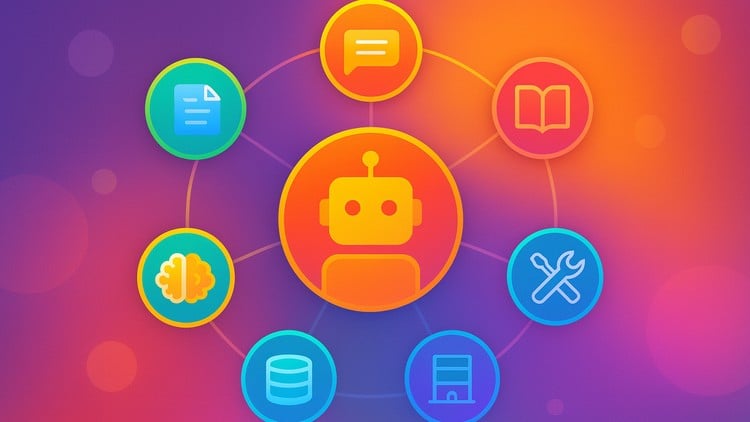
Learn how to design smarter, effective AI agents using the 6 essential context types: Instructions, Memory, Tools & more
⏱️ Length: 2.5 total hours
⭐ 4.16/5 rating
👥 17,386 students
🔄 August 2025 update
Add-On Information:
Note➛ Make sure your 𝐔𝐝𝐞𝐦𝐲 cart has only this course you're going to enroll it now, Remove all other courses from the 𝐔𝐝𝐞𝐦𝐲 cart before Enrolling!
Course Overview
- This course transcends conventional prompting techniques, offering a deep dive into the strategic architecture of AI agent intelligence. It redefines how developers and AI enthusiasts approach agent design by emphasizing the profound impact of well-structured context on an agent’s ability to reason, interact, and perform complex tasks autonomously. You’ll move beyond superficial interactions to build AI agents that genuinely understand their operating environment and objectives.
- Delve into the art and science of “context engineering,” a critical discipline for unlocking advanced AI capabilities. This program illustrates how the deliberate crafting and injection of specific information types directly influence an agent’s decision-making process, its capacity for multi-step reasoning, and its overall reliability in diverse scenarios. It’s about building a robust cognitive framework for your AI.
- Learn to orchestrate AI agent behavior with precision, transforming reactive models into proactive problem-solvers. The curriculum highlights how a comprehensive contextual foundation empowers agents to navigate ambiguity, adapt to new information, and operate with a higher degree of autonomy and effectiveness. This is foundational for developing AI systems ready for real-world deployment and dynamic user interactions.
- Explore methodologies for embedding operational intelligence directly into your AI agents, enabling them to interpret complex instructions, leverage past experiences, access external utilities, and understand the implications of their actions. This course is designed to empower you with the strategic foresight needed to design AI agents that are not just smart, but truly intelligent and adaptable in their operational scope.
- Gain a mastery over the nuanced interplay between various forms of contextual input, understanding how they collectively contribute to an AI agent’s holistic comprehension and performance. This holistic approach ensures that your agents are not merely executing commands but are engaging in sophisticated cognitive processes, leading to superior outcomes and groundbreaking applications across industries.
Requirements / Prerequisites
- A foundational understanding of artificial intelligence, machine learning concepts, and the basics of large language models (LLMs) or generative AI is highly recommended to maximize learning outcomes.
- Familiarity with general programming concepts, particularly in a language like Python, will be beneficial for comprehending examples related to API integration and tool usage, though direct coding exercises may not be a primary focus of this conceptual design course.
- An eagerness to explore advanced AI agent development paradigms and a willingness to challenge conventional prompting methodologies to unlock next-level AI capabilities.
- No advanced mathematical background or deep machine learning expertise is required, as the focus is on practical context design principles rather than model architecture.
- Access to an internet connection and a modern web browser to access course materials and potentially interact with AI models (though specific platform accounts are not strictly required for the design principles themselves).
Skills Covered / Tools Used
- Strategic Contextualization: Developing the acumen to identify, categorize, and prioritize the exact information an AI agent needs to perform specific tasks optimally, moving beyond generic prompts.
- Agent Behavioral Engineering: Skills in sculpting an AI agent’s persona, operational guidelines, and ethical guardrails purely through the intelligent design of its initial context and ongoing inputs.
- Cognitive Scaffolding: Techniques for building multi-layered contextual structures that allow AI agents to engage in complex, multi-turn dialogues and chained reasoning processes without losing coherence.
- Dynamic Knowledge Integration: Expertise in systematically feeding AI agents with up-to-date, relevant, and domain-specific information, ensuring their responses are accurate, authoritative, and contextually appropriate.
- External System Interfacing: Developing robust strategies for enabling AI agents to interact seamlessly with a myriad of external APIs, databases, and software tools by defining their capabilities and expected outputs through context.
- Stateful Intelligence Architecture: Designing sophisticated memory mechanisms that allow AI agents to retain and recall information over extended interactions, fostering true conversational continuity and personalized experiences.
- Adaptive Prompt Optimization: Mastering the iterative process of refining and testing contextual inputs to enhance agent performance, reduce errors, and improve task completion rates across various applications.
- No specific proprietary “tools” beyond modern AI development environments and large language model platforms (e.g., OpenAI API, Anthropic Claude, Hugging Face models) are taught in this course, as it focuses on universal design principles applicable across various AI ecosystems.
Benefits / Outcomes
- You will be equipped to architect highly reliable, precise, and domain-specific AI agents that significantly outperform those developed with conventional prompting methods, minimizing common AI pitfalls like hallucination.
- Gain a profound understanding of how to influence AI agent behavior at a fundamental level, empowering you to create agents that consistently adhere to desired operational guidelines, ethical considerations, and brand voices.
- Accelerate your AI application development cycles by understanding how to systematically imbue agents with the necessary intelligence, reducing the need for extensive post-processing or error correction.
- Unlock the potential for building advanced AI agents capable of complex decision-making, long-term interaction, and autonomous task execution in real-world business and technical environments.
- Position yourself as a leading expert in advanced AI agent design, a skill set increasingly critical as AI systems become more integrated into critical workflows and user experiences.
- Transform raw AI models into highly functional, user-centric agents that provide more relevant, helpful, and contextualized responses, significantly enhancing user satisfaction and engagement.
PROS
- Highly Practical Skill Set: Teaches techniques immediately applicable to real-world AI agent development challenges, delivering tangible improvements in agent performance.
- Strategic Depth: Goes beyond surface-level prompting, fostering a deeper understanding of how AI agents truly reason and execute tasks.
- Concise & Efficient: Delivers critical knowledge in a compact 2.5-hour format, making it accessible for busy professionals.
- Future-Proofing: Focuses on foundational principles of AI agent intelligence that will remain relevant across evolving AI models and platforms.
- Strong Endorsement: Excellent student rating and high enrollment figures affirm the course’s value and effectiveness in a competitive learning landscape.
CONS
- May require some prior foundational exposure to AI/ML concepts or programming for the more advanced design patterns to be fully internalized and applied.
Learning Tracks: English,Development,Data Science
Found It Free? Share It Fast!